NSW Government’s Blanket Protest Ban: A Massive Gifting Away of Our Basic Rights for Xmas
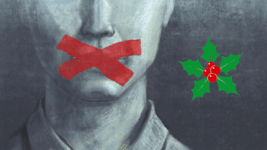
The Minns government has passed laws that provide for the imposition of blanket bans on public protest, in circumstances when NSW police has designated an incident terrorism-related under state law.
These dissent silencing laws were rushed through NSW parliament this week, and they were predicated upon the false claim of the premier that pro-Palestine/antigenocide protests had fuelled the sentiment behind the Bondi Beach massacre.
A psychotic father and son perpetrated a mass shooting targeting a Jewish religious festival and callously murdered 15 people on Gadigal land at Bondi Beach on 14 December 2025.
New South Wales Greens members of parliament questioned the legitimacy of NSW Labor choosing to place the highly publicly sought tighter gun control laws in the wake of the mass shooting in the same omnibus bill with the extremely divisive protest ban measures, which appeared to guarantee the passage of both sets of laws prior to the Christmas-New Years break.
The Terrorism and Other Legislation Amendment Bill 2025 was passed by the second chamber of NSW parliament, the upper house, on 24 December after 3 am, and it returned to the lower house on Christmas Eve morn to obtain its final rubberstamping.
NSW premier Chris Minns and his cabinet should be congratulated on progressing the illegitimate conflation of the Bondi Beach massacre with the 26-month-old anti-Gaza genocide movement to such a height in the public sphere, that in turn, it had the capacity to see enacted such rights-eroding suppressions on legitimate free speech and political communication in public.
Several key Gadigal-based social justice groups have announced they will be challenging the legitimacy of Minns’ overbearing regime to silence protest. However, such a legal challenge will not be able to be launched in the NSW court system until it reopens in 2026, and this leaves serious questions around whether there will be an attempt to ban Invasion Day protests next month.
A skewwhiff view from Macquarie Street
“When you see people marching and showing violent bloody images, images of death and destruction, it’s unleashing something in our community that the organisers of the protest can’t contain,” said Minns last week, as he announced he would be moving broad measures to place blanket bans on public protest for up to three months at a time.
“The truth of the matter is we can’t risk another mass demonstration on that scale in NSW,” the top minister added, as he conflated the mass murder of Australian Jewish people with a long-term nonviolent protest movement calling on the Israeli state to stop its mass slaughter of Palestinian people. “The implications can be seen, in my view, on Sunday.”
The measures that this sort of sensationalist posturing facilitated the passing of are contained in schedules 4, 5 and 6 of the Terror and Other Bill, which have resulted in amendments to three pieces of NSW legislation to establish the draconian blanket ban on protest laws, which are otherwise known as “public assembly restriction declarations” or by the unfortunate acronym PARDs.
A public assembly restriction declaration can be applied to blanket ban demonstrations, protests, processions and assemblies in a designated area for the period of 14 days, after the NSW police has declared an incident to be terror-related under the provisions of the Terrorism (Police Powers) Act 2002 (NSW). This can be extended every 14 days, for up to a total 90 days, if circumstances persist.
The circumstances that must be established to remove the right to demonstrate in public, along with exercising the right to free speech and the implied right to political communication, are set out in the legislation and comprise of the NSW police commissioner or a deputy assessing that a reasonable person would fear harassment, intimidation, violence or for their safety if a protest took place.
The premier made clear repeatedly prior to the Bondi Beach massacre and after it, that he considers free speech has not been prioritised in this state and ultimately, won’t be, because the NSW community is multicultural and this means it can’t have the broad freedom of speech laws enjoyed in the United States, even though American society is increasing considered multicultural too.
Challenging legislative hasbara
A press conference, with a distinctly large turnout of speakers, was held at NSW parliament on the morning of 23 December, as the Terrorism and Other Bill was making its way through the chambers. The groups included representatives from the NSW Greens, Palestine Action Group, Jews Against the Occupation ‘48, the Blak Caucus, the NSW Council for Civil Liberties and Sheikh Wesam Charkawi.
“This is the latest set of Chris Minns’ knee-jerk antiprotest laws that are being passed again, based on a series of lies and misinformation and outrageous conflating of this horrible antisemitic attack at Bondi with the protest movement more broadly, and the protest movement for Palestine in particular,” said Palestine Action Group organiser Josh Lees.
“Of course, these laws, if passed, aren’t just taking away the rights of the Palestine movement, they’re taking away the right of everyone in NSW to gather together as a community to express their views, to express their opposition to whatever government policy they oppose, to demand change: all the things that we know have been so crucial for our democracy,” the justice advocate added.
Palestine Action Group, Jews Against the Occupation ‘48 and the Blak Caucus are set to file a legal challenge against the legitimacy of the powers to shut down protests.
Lees led a successful legal challenge against a Minns-inspired police move on power that applied to protests near places of worship earlier this year. After the NSW Supreme Court struck down the original law as unconstitutional, the state went on to reenact the power without its original overreach.
Before the press on Wednesday, the coalition of civil society groups opposing the protest blanket ban powers broadly agreed that there was absolutely no evidence that the pro-Palestinian protests of the last 26 months contributed in any way to influence the mass murder by a father and son that it is known were rather influenced by ISIS.
Minns has too repeatedly insisted that he’ll be banning the use of the phrase “globalise the intifada”, even though, as Lees confirmed and others had been thinking, no one at the Sydney protests has been chanting.
Indeed, it appears that the post-shooting New York Times headline Bondi Beach Is What ‘Globalize the Intifada’ Looks Like has inspired this ridiculous debate about a potential law.
Questionable authority to ban protests
The PARD protest ban laws took effect immediately after the NSW Legislative Assembly signed off on the Legislative Council-amended version of the bill on Christmas Eve. By midafternoon on 24 December, no PARD declaration had been made under new section 23B of the Terrorism (Police Powers) Act.
But under that section, the NSW police commissioner or a deputy has up to 14 days to declare a PARD is in place, following the initial declaration that an incident is being investigated as terror-related, under the Terrorism (Police Powers) Act. This in turn opens up broad investigative powers, which see the AFP and ASIO joining the inquiry as part of the Joint Counter Terrorism Team.
The Bondi Beach massacre was declared terror-related by NSW police commissioner Mal Lanyon on 14 December, which means a PARD can still likely be declared up until this Sunday.
If the blanket ban is set in place, this would then mean that repeated reapplications of the prohibition could see it impinge upon the 26 January 2026 Invasion Day protest, which is an event that has been broadly rising in numbers and impact since the 40th anniversary of the Aboriginal Tent Embassy in 2012.
“It’s absolutely appalling,” Blak Caucus organiser Elizabeth Jarrett made clear, during the 23 December press conference at NSW parliament.
The esteemed Gumbaynggirr, Bundjalung, and Dunghutti activist stressed that “it would really be a kick in the face to this conversation that the government keeps having with us about reconciliation, Closing the Gap and putting the realities of First Nations people on the table”.
Paul Gregoire
Receive all of our articles weekly
Related Articles
 Minns’ Mammoth Rights-Eroding Christmas Bill Bonanza Explained
 Proposed Temporary Ban on NSW Protests Is a Slippery Slope to Permanency
 Premier Minns, All NSW Wants for Christmas Is Drug Decriminalisation
 NSW Government Proposes to Extend Anti-Protest Regime to “Places of Worship”
 NSW Government to Reintroduce Antiprotest Move-On Power, After Police Approve Nazi Rally
 NSW Government Considers Banning Protests Due to Cost, While Opposition Flags User Pays System