Death in Custody Protesters Vow to Take to the Streets on Invasion Day
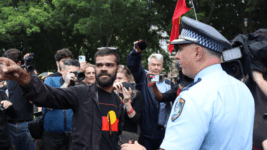
A First Nations deaths in custody protest took place on Gadigal land in Sydney’s Hyde Park on 18 January 2026. The rally marked 10 years since the funeral of Dunghutti man David Dungay Junior. Yet, whilst calling for a new corruption inquiry into coronial processes, the gathering had a further focus, as the new laws enabling a ban on street protest marches also threatened the stationary assembly.
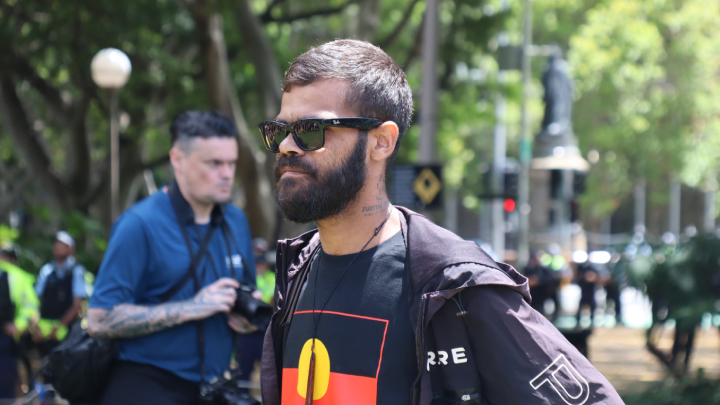
As organiser Paul Silva recalled, his uncle David Dungay was killed in Long Bay prison on 29 December 2015, when five specialist prison guards attacked the diabetic man over eating a packet of biscuits and held him in the prone position until he stopped breathing. Silva, a Dunghutti man in his mid-20s, has been campaigning for justice in terms of Aboriginal deaths in custody ever since.
The protest ban regime was enacted on Christmas Eve 2025, in response to the 14th December Bondi Beach mass murder. The laws permit the New South Wales police commissioner to designate a public assembly restriction declaration (PARD) for 90 days, following a designated terrorism-related incident. So, NSW police will not approve street marches, and participants in one can be arrested.
As became clearer when NSW police commissioner Mal Lanyon extended the original 24 December 2025 PARD on 6 January 2026 for another two weeks, the block on NSW police approving Form 1 protest notifications is in place for 90 days, and the 14 day reviews on whether a ban should remain as protests may cause constituents to be fearful, are actually opportunities to revoke it not reapply it.
And for the hundreds at the Black deaths in custody rally in the park on Sunday afternoon, they understood that not only were they gathered at a point when the overrepresentation of First Nations people in prisons and the numbers of Aboriginal deaths in custody are in fact in steep increase, but the heightening of these crises is being accompanied by escalating civil society repressions.
No justice, no peace
“We now sit at over 615 Aboriginal deaths in custody since the 1991 Royal Commission, with no justice and accountability for the families. I have been on the frontline for the past decade, since my uncle was brutally taken by this system,” Paul Silva said. “I stood alongside many families…. I have sat there and despite the evidence, I have seen the families have no justice or accountability.”
“It is important that not only me, but other First Nations people and non-Indigenous people realise that deaths in custody are one of the main forms of killing our people in 2026,” the Dunghutti man continued. “Even when you have racist white people running our people down in the Northern Territory and getting no real justice or accountability, the system continuously allows it.”
Silva then addressed that the protest for David Dungay was the only pre-planned protest across the large section of Greater Sydney where processions are currently banned that was affected by its imposition, which meant that only a stationary assembly could take place. And Silva had appeared in the press several times last week, declaring that the rally would march despite the ban.
Thirty three First Nations people died in the custody of Australian law enforcement or corrections over 2024-25, which marked the highest level since records began in 1979-80.
The NSW Bureau of Crime Statistics and Research (BOCSAR) noted that previously disproportionate numbers of First Nations prisoners were on the rise in this state in March last year, and by last September, Indigenous people accounted for 33 percent of the overall prisoner population, whist only making up 3.4 percent of the state’s populace.
“This Australian government got orders 238 years ago to wipe First Nations people off the face of the Earth,” Silva underscored. “They do that in the forms of deaths in custody, the forced removal of our children, destruction of sacred sites, medical/healthcare negligence causing death, systematic racism causing people to take their own lives, and the tremendous pressure of oppression in 2026.”

First Nations intifada
In addressing the rally, Padraic Gibson, an associate professor at the UTS Jumbunna Institute, firstly raised Bidjigal warrior Pemulwuy, who launched an “intifada, an uprising” against the British about 18 months after their January 1788 arrival, as he declared that “the foreign imperialist regime” was illegitimate and he and other locals fought the invading British.
Gibson drew a correlation with the British moving to outlaw the Dharug language that Pemulwuy spoke in the 18th century, with the NSW Labor government’s proposal to ban the Arabic word “intifada”, which means uprising, as when it has been chanted at Palestine protests it has supposedly “unleashed forces”, according to the NSW premier Chris Minns, that led to the Bondi massacre.
“That resistance that has come from First Nations people is more necessary than ever,” Gibson made clear. “This government, Chris Mnns, who leads the racist government of NSW, which tried to outlaw, supress and kill off Aboriginal languages, just as it tried to kill off the people, is now trying to outlaw language of resistance as we speak.”
“This government is presiding over the highest number of Aboriginal people behind bars in the history of this state,” continued Gibson. “The prisons are bursting, and they are bursting because he has made laws that are specifically about bail and keeping people locked up, and he said that’s going to lead to higher numbers and they’re going to continue to climb because they’re not backing down.”
In terms of the protest ban, Gibson pointed out that it was the move on powers that Minns enacted on Christmas Eve that were directly threatening the Sunday protest proceeding in the park, as the new laws enable police officers to issue move on directions to public assemblies if participants are assessed as blocking people or cars or that they could intimidate others or cause fear.
Paddy ended by sending a collective message from the rally, as he said, “Police commissioner, Chris Minns, if you dare extend this protest ban, we will defy it en masse. We will break the ban. So, keep your ban as far away from the 26th of January as you possibly can, or you will see it in tatters on the floor, where it belongs, like all the other racist laws that you have on the books.”
Locking up kids
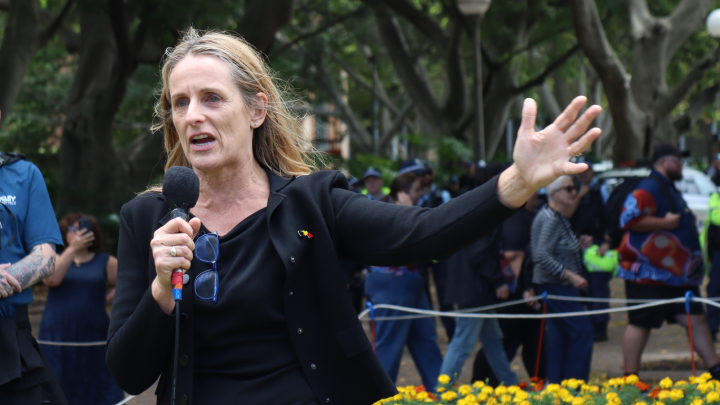
NSW Greens MLC Sue Higginson set out that over the last two years, Minns has rolled out “some of the worst, most draconian racist laws this state has ever seen”, and she added, the premier “is literally priding himself on the number of First Nations people getting thrown in bars across this whole state, every day. He thinks that is a measure of success.”
This is in relation to a legislative crack down on bail that specifically targeted 14 to 17 year olds in rural NSW in March 2024. This had translated, 12 months later, to 80 percent more youths having bail refused, with 88 percent of youths captured under the new laws having been First Nations kids, as well as their having accounted for 90 percent of those incarcerated as a result of the new law.
Higginson further noted that in terms of the increase in First Nations young people having been incarcerated over the last 18 months, such a steep rate had never been seen before in the history of the nation, and she added that 60 percent of all Aboriginal kids in NSW prisons right now are on remand, meaning they have not been convicted or are continuing to await sentencing.
“I’m calling on Chris Minns and police commissioner Mal Lanyon – don’t you dare think about it,” Higginson said in terms of the threat a continuation of the protest ban would pose the 2026 Invasion Day rally marching across Gadigal land and through the CBD streets, “you keep your hands off our main day of serious resistance, Invasion Day.”
Protest loggerheads
As the death in custody protest marking 10 years since the death of David Dungay Junior came to an end, Silva then called on the demonstrators to follow him in a street procession making its way to Djarrbarrgalli-The Domain.
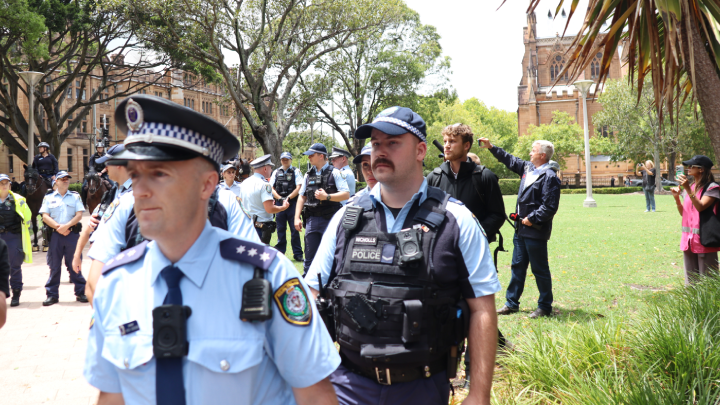
However, the NSW police presence along the path was so large there was no passage. Indeed, so many officers were present on Sunday, that each protester could have had their own personal law enforcement escort. As demonstrators did face off with the NSW police, senior officers then issued a move on order to all protesters before them, and those assembled dispersed.
And while the NSW police commissioner is yet to determine whether the ban on authorised protests will continue across three broad policing districts in Greater Sydney, protesters have vowed to challenge the protest orders and march on the streets on Invasion Day, 26 January 2026.
Paul Gregoire

Receive all of our articles weekly
Related Articles
 NSW Government’s Blanket Protest Ban: A Massive Gifting Away of Our Basic Rights for Xmas
 Sydney Rallies Against Trump’s Imperial Assault on Venezuela, Despite Protest Ban
 The Ban on “Authorised” Protest and Suppression of Political Dissent Continues in NSW
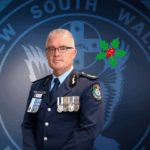 NSW Police Commissioner Bans Protests, Suppressing Fundamental Democratic Rights
 Proposed Temporary Ban on NSW Protests Is a Slippery Slope to Permanency
 NSW Government Considers Banning Protests Due to Cost, While Opposition Flags User Pays System