Ignoring Local Muslim Concerns: Mukhlis Mah on the Heckling of the PM at Lakemba Mosque
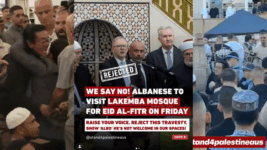
Despite it being announced the night prior that they would be in attendance, when prime minister Anthony Albanese and home affairs minister Tony Burke turned up at Lakemba Mosque during the end of Ramadan Eid celebration last Friday, 20 March 2026, a significant number of worshippers decried their attendance at the event, claiming their political actions didn’t warrant their presence.
The reason for the heckling was obvious to all present on Dharug land inside the country’s largest mosque, and for those watching news reports afterwards, it was the same, the federal Labor government has provided unbridled support for Israel during its mass extermination of Palestinians in Gaza, whilst just a few weeks ago, it embroiled our nation in a war of aggression against Iran.
Footage of Albanese sitting at the front of the mosque, shows the top minister looking somewhat perplexed about the reaction he was receiving, as more than a dozen hecklers rose to their feet to insist that he was not welcome, specifically because of his support for the mass murder of tens of thousands of Palestinians, and now for his further backing of the US-Israeli illegal warring upon Iran.
Following the mosque appearance, the PM then hightailed it over to South Australia, and after being questioned during a presser about the heckling he received in Lakemba, Albanese went on to explain that the “couple of people” who shouted at him were upset that his government recently passed laws outlawing “extremist organisations like this Hizb ut-Tahrir”, which was a baldfaced lie.
A growing divide
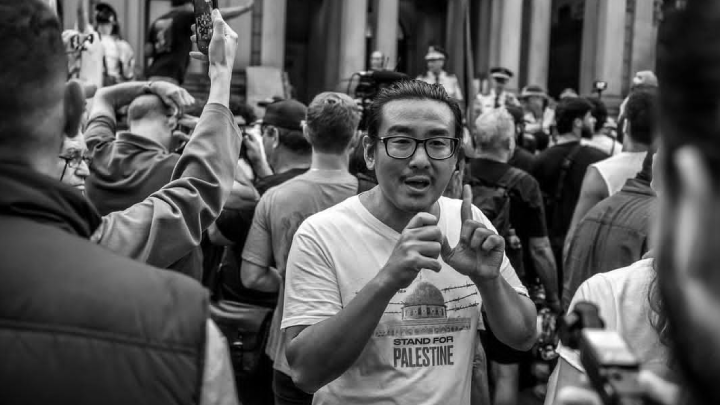
Mukhlis Mah, a member of the Stand for Palestine campaign, was the first heckler to stand and question why the prime minister had fronted up to Lakemba Mosque, which, as the place of worship is located in New South Wales, meant that mounting tensions that have been spurred by recent events in Greater Sydney, also played a factor in the reception that our prime minister received.
The local concerns have involved NSW authorities having set the NSW police upon pro-Palestinians protesting the official visit of the Israeli president using unbridled force, while a group of police officers then assaulted Muslims praying at the event, of which the NSW premier and police minister refused to apologise for, and then the state went on to cancel its official Iftar event.
Sydney Criminal Lawyers spoke to Arabic language teacher Mukhlis Mah about the underlying issues that have led to the mounting tensions between the Labor Party and Muslim Australians, which include concerns around the denial of the Gaza genocide, the support for the rogue state of Israel as it perpetrates mass atrocities, and the government’s recent sanctioning of attacks on Iran.
Firstly, on the morning of Friday, 20 March 2026, around 30,000 Muslims were gathered at Lakemba Mosque in western Sydney to mark the end of Ramadan.
Prime minister Anthony Albanese and home affairs minister Tony Burke made an appearance at the significant religious event, which was something that had been planned at the last minute.
This led to the two Labor leaders being heckled by worshippers for their appearance at the occasion.
Mukhlis, you were a part of the dozen or so people who did call out the Australian prime minister’s presence. Can you give us a rundown about what occurred at Lakemba Mosque last Friday morning?
Eid at Lakemba Mosque is a very significant event for Muslims as people have been attending it for decades. So, people from all around Sydney congregate there, and that location holds great significance for Muslims in Sydney.
We gathered there from pre-dawn. We prayed. We prayed our Eid prayer first. Imam Yahya Safi stood up and gave his sermon, and when he stood up to give his sermon, that is when the prime minister and Tony Burke were ushered in.
Albanese and Burke were then placed in front of the congregation. Albanese was sitting where the imam normally sits, and there were camera people everywhere.
Once the imam had finished his sermon, I stood up and said, “This is our sacred place. What are you doing here? You shouldn’t be here.”
It was clear that these ministers were not there to engage with us, but it was just a photo shoot opportunity. It was a PR stunt to show that everything is fine with the Muslim community.
So, I stood up and there were others who stood up. Then some other congregants pounced on me and got me out of the mosque, which was disappointing because it was like the community was self-policing.
I then got a move on order from the police.
So, you were the first person to stand up?
I was the first one. That is probably why people pounced on me. But there were quite a few others afterwards.
I believe the people who ejected you from the mosque then apologised afterwards.
Yes. The individuals who did eject me, then got in contact and apologised for that. They also said their intention had not been to do that to me. It all took place in a dramatic manner.
The look of police pulling me down the mosque stairs was not a good look at all.
And this doesn’t excuse the short-sightedness in allowing Albanese to have that honoured and almost sacred position given the political climate that we are currently in.
Did the prime minister’s appearance in the mosque seem out of the blue for those present?
For most people, it was a surprise. There was word out the night before that he was going to appear at the mosque. But when he appeared there was confusion. People wondered why he was there.
Those calling out the PM’s presence were not shy about doing so. It came across like it was obvious his presence would not be appreciated by many worshippers at the event.
Can you explain why the prime minister’s presence at Lakemba Mosque was such an affront?
For the Muslim community, we have been severely hurt over the last two or so years, particularly in relation to the genocide that has been happening in Gaza, in Palestine.
We have seen the government consistently take a position that has given a lot of cover and support to Israel. And even though we’ve been calling this out for all these years now, we still see the government brushing it off time and time again.
We have seen the government inviting the Israeli president to the country and honouring him. They have defended the strikes against and the war on Iran. They’ve been justifying the bombing of a girls school.
Why does the prime minister think that we are going to be happy with him coming to take photos, when really that deep-seated anger exists amongst the Muslim community because of the government’s position and support?
Later that same day, Albanese was asked about being called out in the mosque at a press conference, and he put it down to there being a couple of hecklers, who didn’t like the fact that his party has “outlawed extremist organisations like this Hizb ut-Tahrir”.
This assessment by the PM appeared not only dishonest but provocative. Can you talk about how Albanese’s assessment of what occurred at the mosque was taken by those involved?
That was very provocative. It just proved that the prime minister is not listening. He intentionally interpreted the events in a different way, trying to present everything through a rosy lens.
Personally, I was very offended by that. It was almost suggesting that for me, in voicing those concerns, he was labelling me as an extremist, or even like I was from a ‘prescribed hate group’ from the new law his government has just recently come up with.
It’s clear to me that they’ve taken this strong stance in defending Israel, and they have not listened to the concerns about that.
You’re part of the group running the Stand for Palestine social media campaign, which has been consistently posting over the course of the Gaza genocide in order to push back against the misconceptions progressed about the ongoing atrocity.
Can you talk about why campaigns like yours are necessary? And would you say that what you have been doing with this campaign feeds into the confrontation with the PM at Lakemba Mosque last week?
The Stand for Palestine campaign has been well received and has become an important campaign amongst the Muslim community and people more generally, because it has tapped into deep-seated anger about the situation in Gaza.
The widespread support for the campaign amongst the Muslim community has led to various events, which has had a large collaboration with Muslim organisations and speakers.
The campaign really has demonstrated the sentiment amongst the Muslim community. That sentiment has then been translated into events, including what happened in Lakemba last Friday.
The centring of the concerns around the genocide in Gaza was reflected in the harsh words and the unfriendly reception that the prime minister received.
And finally, Mukhlis, the fact that two Labor ministers turned up at Lakemba Mosque only to be unwelcomed by some of those gathered is part of a broader division that appears to be occurring in NSW in respect of the government and the Muslim community.
Further aspects relating to this involve the NSW authorities setting the NSW police on protesters at an anti-Israeli president Isaac Herzog demonstration gathered on Gadigal land at Sydney Town Hall on 9 February 2026. And in particular, NSW police officers attacked some Muslims praying at the event, and the premier and police minister have refused to apologise for this.
So, in your opinion, how is the situation in this state in respect of these relations at present? And how do you see this progressing in the near future?
There have been rising tensions in the last two years, and I don’t see that changing, given that the government is not even acknowledging these concerns. When these serious issues do come up, they are deflecting.
The prime minister did not even acknowledge the reason he was booed and not welcome, which is a prime example of that. It is the fact that the government thinks it can remove grants from Muslim organisations for mourning the passing of a religious leader.
It is the fact that the government thinks it can ban slogans. This shows they are not acknowledging this sentiment and a growing disconnect.
The reality is that they are hiding behind a guise of fighting antisemitism to actually suppress this dissent.
For us, that is only widening the gap, and unless the government has a strong reflection on these events and it changes its approach, then I can’t really see too much changing.
Paul Gregoire