Minns’ Mammoth Rights-Eroding Christmas Bill Bonanza Explained
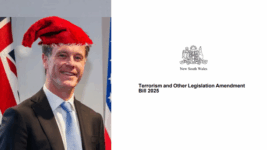
During the first of two additional sitting days of NSW parliament, NSW police minister Yasmin Cateley introduced a piece of omnibus legislation, covering gun control laws, restrictions on public protest and other measures to stamp out prejudice in public. These laws have been drafted in the wake of the 14 December 2025 Bondi Beach mass shooting, in order to prevent another such massacre.
Introduced on 22 December, the Terrorism and Other Legislation Amendment Bill 2025 covers sweeping reforms that infringe upon multiple rights and liberties, and it was drafted in the whirlwind week following the mass murder of 15 people in Bondi on a Sunday evening, and the Minns government wants the bulk of these laws passed on Tuesday, so they’ll apply over the holidays.
“We cannot undo the events of that terrible day, but this bill progresses reforms that respond directly to lessons from the atrocities on that day,” Catley told the chamber on Monday, in respect of Bondi. “The government is taking steps to protect the community and enhance social cohesion in the wake of these terrorist acts by placing sensible limits on the authorisation of public assemblies.”
Developments last week came thick and fast, as NSW premier Chris Minns spruiked passing the strictest gun control laws in the country, but, after a pause, he then commenced his ongoing campaign against protests, especially those countering the Gaza genocide, and this time, the Labor leader is itching to place a blanket ban on all such forms of political expression for up to 3 months.
So, over the weekend, rights advocates, like NSW Council for Civil Liberties president Timothy Roberts, have been campaigning until blue in the face, warning that in the chaos following the Bondi massacre, the state government is convening parliament for a brief two days right before Christmas, and if NSW Labor gets its way, some nasty little laws will be enacted whilst no one is watching.
Gun control reform
Schedule 2 of the Terrorism and Other Bill amends the Firearms Act 1996 (NSW), which contains the framework governing firearm ownership in this state.
Proposed new section 8A of the Firearms Act contains a limitation on how many weapons a licensed gunowner can obtain via the NSW permit system. Different limits apply to the different categories of licence.
Gunowners who possess their weapons for genuine occupational use, such as primary production, vertebrate pest animal control, business or employment, occupational requirements relating to rural purposes or animal welfare, will have an ownership limit of up to 10 firearms.
However, if people own a gun for the “genuine reason of sport/target shooting”, which involves the least restrictive A and B category licences, there will too be a limit of owning up to 10 firearms, or a number that’s been approved by the NSW police commissioner. Firearms dealer licenses and firearms collector licences will have no stipulated limit on how many firearms they can own.
The bill too amends section 8 of the Firearms Act, so that restrictions on certain category A guns are tightened and further moved into category B licensing territory, which then sees licensees having to provide more justification in respect of owning such a weapon. Magazine capacity limits will also be introduced for A and B categories. Firearms that can use belt-fed magazines will now be banned.
Terms of licences, under section 21 of the Firearms Act, are to drop from 5 years to 2 years, so the need to renew and review licensing arrangements occur more often. An amended section 11 will require that only Australian citizens can be issued a gun ownership licence, with the one exception being for New Zealanders, who do have a genuine employment reason for owning a firearm.
The bill also inserts subsection 19(2)(a) into the Firearms Act, so that all gun licensees must be a registered member of an approved gun club.
Part 8 of the Firearms Act is also being overhauled as it contains the laws relating to seeking a review of a gun licencing decision at the NSW Civil and Administrative Tribunal.
The bill removes the NCAT as an appeal pathway for decisions like license refusal, removal or any other stipulation applied to one, as this process will now be conducted by the NSW Police Force, as it cannot share certain intelligence with the NCAT that has resulted in a restrictive decision for a gunowner if the intel has been obtained from authorities in another jurisdiction.
Antiprotest laws
Schedule 4 of the Terrorism and Other Bill inserts subsection 200(5) into section 200 of the Law Enforcement (Powers and Responsibilities) Act 2002 (NSW) (the LEPRA), so that police are permitted to issue move on orders to demonstrations, protests, processions and assemblies if they’re being held in an area that is the subject of a public assembly restriction declaration, or a PARD.
Schedule 6 of the Terrorism and Other Bill inserts section 23B into the Terrorism (Police Powers) Act 2002 (NSW), and it applies when special powers to investigate terror-related acts have been unlocked under this Act. When these powers have been triggered, the commissioner or a deputy, can call a PARD in a designated area, which means all public assemblies and protests are prohibited.
A PARD holds for up to 14 days, if it is found that the staging of public assemblies at a specific time would cause a reasonable person to fear harassment, intimidation, violence or to fear for their safety. The PARD can be reapplied if the same conditions are met for another 14 days. The laws allow for this process to be repeated, so that a protest ban in a designated area can last for up to 90 days.
Schedule 5 of the bill amends part 4 of the Summary Offences Act 1988 (NSW), which contains laws governing protest authorisations. The Terrorism and Other Bill inserts section 27A into this Act, which would prevent police from authorising a protest if it is planned for a designated area during an active PARD. New section 27B would work to end pre-approved protests after a new PARD has been issued.
Additional measures
Schedule 4 of the Terrorism and Other Bill further inserts a new subsection into section 19A of the LEPRA, which contains powers requiring a person wearing a face covering in public to remove it to identify themselves to police.
New subsection 19A(1)(c) will result in officers being able to require protesters to remove face coverings in relation to suspected criminal activity, and if they refuse to meet this requirement, a person will face up to 12 months in prison and/or a $5,500 fine.
Schedule 1 of the bill contains the final broad measure, which is the creation of a new offence under proposed new section 93ZB of the Crimes Act 1900 (NSW), which is the crime of knowingly displaying, without a reasonable excuse, a prohibited terrorist organisation symbol by public act.
An individual found to be displaying terror symbols could then be imprisoned for up to 2 years and/or fined $2,200 under this new law, while a corporation would face a fine of up to $110,000.
A lack of movement at the station
At the end of the first additional sitting day called by premier Minns, 22 December 2025, the Terrorism and Other Bill had made its way through the lower house of NSW parliament, with a late night vote in its favour of 59 votes to 15.
The passage of this legislation is hardly guaranteed, however, as the NSW Nationals had raised its opposition to the new gun control measures, with party leader Gurmesh Singh outlining that the new gun control laws would have done little to prevent the Bondi Beach tragedy if in place prior to its commission.
With members in the upper houser for today’s likely vote, the Shooters, Fishers and Farmers Party are neither supportive of the gun control measures in the new bill, which is hardly surprising after its members originally had the premier’s support in respect of a recent piece of legislation that would have liberalised hunting and shooting laws, as well as having enshrined the right to hunt in state law.
The NSW Greens is supportive of new gun control measures, but it broadly opposes the draconian blanket ban laws on protests. So, the minor party is disappointed that NSW Labor has jammed the two disparate sets of laws into the one piece of legislation and is expecting to get the gun reforms in place for the Christmas/New Years period, necessitated on the passing of the draconian protest bans.
So, on Tuesday, despite the fact that NSW Labor doesn’t hold a majority in the upper house, there is talk of the potential for NSW parliament to pass the laws or to sit right through to Christmas Eve in order to facilitate their passing, or else, these reforms may have to wait until the new year.
Paul Gregoire
Receive all of our articles weekly
Related Articles
 Proposed Temporary Ban on NSW Protests Is a Slippery Slope to Permanency
 Premier Minns, All NSW Wants for Christmas Is Drug Decriminalisation
 Spare a Thought for Julian Assange Spending His Fifth Christmas Behind Bars
 Have a Very Perrottet Christmas, Let’s Make Sure It’s Our Last
 Attorney General’s Christmas Gift to Dan Duggan: You Will Be Extradited to the US
 Spare a Thought for the Whistleblowers Labor Continues to Persecute This Christmas