The Ban on “Authorised” Protest and Suppression of Political Dissent Continues in NSW
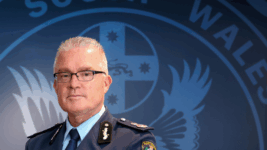
New South Wales police commissioner Mal Lanyon announced on Tuesday, 6 January 2026, that he’d come to the decision to reimpose the official prohibition on all authorised protests for another 14 day period across three policing areas in Greater Sydney. This blanket ban on approved demonstrations continues to be in place because of the 14 December 2025 Bondi Beach massacre.
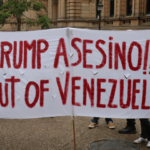
The powers that permit the ban were enacted on Christmas Eve 2025, as a result of the Bondi mass shooting. A public protest opposing the US attack on Venezuela that took place on Gadigal land in the Sydney CBD on Sunday provided clarity on how the new laws are working: no Form 1s are being approved to hold street marches, while stationary assemblies can proceed but may be moved on.
“This is not about stopping free speech. It’s about making sure that the community has time to feel safe,” said Lanyon on Tuesday. “This declaration today is about providing support to the community. It is about saying that time is not now for any retribution. Time is not now about affecting public safety. And it’s about saying we want the community to feel confident to move around safely.”
Despite the initial 14 day ban, which can be extended for a total of 90 days, being in place over the holiday season, the US attack on Venezuela provoked a public gathering to oppose it.
In terms of the extension, it will come to an end on 20 January, and as to whether a further ban might impinge upon 26 January Invasion Day protests, this won’t be decided until a week out from those events.
Lanyon added that the ongoing ban is due to “heightened tensions in the community” and that people are fearful following the Bondi mass murder. But rights and protest groups consider there are no justifiable reasons to continue the silencing of political voice in public three weeks after the tragedy and in fact, this extremely antidemocratic move is creating its own community tensions.
“A disgraceful misuse of power”
“The police commissioner should never have been given these powers and has demonstrated he does not have the restraint to keep them,” said NSW Council for Civil Liberties president Timothy Roberts.
“Not only has he prohibited the authorisation of protests across vast areas of Greater Sydney… he has extended this prohibition while significant portions of the community have demonstrated a desire to assemble in the wake of the USA attack on Venezuela and in the lead up to Invasion Day.”
“The prohibition declaration has a chilling effect on the community, who should not have to fear police intervention when they wish to assemble,” the respected lawyer added. “The Minns government undermines the police commissioner’s operational role by having him make political decisions about what protests can and cannot proceed without police intervention.”
The protest ban, or public assembly restriction declaration (PARD), as it is officially termed in the legislation, has been reimposed across three NSW policing areas, which include on Gadigal land in the NSW Police Central Metropolitan Region, as well as across Dharug land in the North West Region and on Dharawal, Dharug and Gundungurra land in the South West Region.
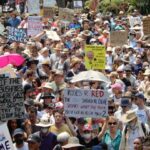
The 4 January 2025 protest against the US operation that saw Venezuelan president Nicolás Maduro kidnapped took place beside Sydney Town Hall. An atmosphere of uncertainty hung over the event. There was a huge police presence, and protesters were told the rally could take place but any obstruction of pedestrians on the footpath could result in move on orders, or even arrest.
“It is not the place of the unelected NSW police commissioner to make this call,” Roberts underscored, “it is a matter for the community to decide. In using and extending the power, the NSW police commissioner suppresses the community’s freedom to assemble and politically communicate. This is an infringement on the people of NSW’s ability to engage in democracy.”
Lanyon’s PARD stinks
“The legislation applies for up to 90 days but asks that I review the order every 14 days,” Lanyon explained at the Tuesday presser in response to a question. “The factors that exist at the time are considered at the time, and I need to consider the community’s safety at that time, which is what we will do.” The top cop added that tensions are still high post-Bondi, so the ban remains.
Reforms were made to three pieces of NSW legislation to facilitate the new authorised protest ban regime. This was done over 22 to 24 December 2025. The laws were passed on the assertion from NSW premier Chris Minns that there was some link between the pro-Palestinian/anti-Gaza genocide protests of the last two years, as organisers have been “unleashing forces that they can’t control”.
Lanyon has reimposed his PARD, or public assembly restriction declaration, under section 23B of the Terrorism (Police Powers) Act 2002 (NSW). The commissioner or a deputy can make such a call.
The law states that a PARD can only be passed when a top cop is “satisfied the holding of public assemblies in the area to which the declaration applies would be likely to cause a reasonable person to fear harassment, intimidation or violence, or for the person’s safety”, or that it risks community safety.
A PARD also means that, under section 27A of the Summary Offences Act 1988 (NSW), the regular Form 1 process, which sees civilians organising a protest submitting notification to the NSW police commissioner outlining the details of their planned event, and if police raise no objection to it, it is considered authorised and regular public obstruction summary offences do not apply to protesters.
New subsection 200(5) of the Law Enforcement (Powers and Responsibilities) Act 2002 (NSW), or the LEPRA, provides police officers with the power to move on demonstrators in an area where an active PARD is in place, which can apply to both motor traffic and pedestrians on a footpath.
In response to a question about why people are afraid of street protests, Lanyon said, “What I’m particularly concerned about, and it’s for mine to make that declaration, is the potential for community safety, the potential for a counterprotest. We know that the heightened tension means that a number of people will be absolutely upset if people hold a public assembly at this time.”
Outrageous overreach
“Police commissioner Mal Lanyon’s threadbare justification for extending the ban reveals how baseless these laws are,” Palestine Action Group said, in the wake of the reimposition of the block for another two weeks. “Lanyon is reported to have said, ‘It’s about saying the time is not now for any retribution’. ‘It’s about saying we want the community to feel confident, to move around safely.’”
“Protests… in previous years have not been about ‘retribution’, nor have they posed any risk to public safety,” the group added. “They have been about hundreds of thousands of people peacefully expressing their opposition to the genocide in Gaza, and the complicity in that genocide by our own governments, who continue to export weapons components to Israel.”
The 6 January 2025 statement by Palestine Action Group is significant as it is the group that has organised the ongoing anti-Gaza genocide protests over the past 26 months. These PAG protests have been significant for their mass civil society participation calling for an end to the killing off of innocent civilians by Israel to grab land. But Minns has suggested PAG has “unleashed forces”.
PAG organisers have reiterated what great numbers of the community think: that the NSW premier’s reaction to the Bondi massacre, which saw 15 innocent people killed, in comprising a suppression on protests is “irrational and appalling”.
Three plaintiffs, PAG, Jews Against the Occupation ’48 and the Blak Caucus will be lodging a legal challenge to the PARD laws with the NSW Supreme Court this week.
PAG organiser Josh Lees already led a successful and significant challenge to a last year enacted policing power to move on protesters demonstrating near places of worship, as the way it operated was unconstitutional.
The protest group made clear that “banning workers from protesting against cuts to workers compensation, banning protests for climate action as we enter another fossil fuel-driven heatwave, banning protests against Aboriginal deaths in custody or banning Jewish and non-Jewish people from marching together against the genocide in Gaza” is illegitimate overreach.
“None of this has anything to do with public safety or stopping ISIS-inspired terrorist attacks,” PAG rightfully concluded.
“All it does is allow bad governments to silence the people’s voices.”
Paul Gregoire
Receive all of our articles weekly
Related Articles
 NSW Police Commissioner Bans Protests, Suppressing Fundamental Democratic Rights
 NSW Government’s Blanket Protest Ban: A Massive Gifting Away of Our Basic Rights for Xmas
 Sydney Rallies Against Trump’s Imperial Assault on Venezuela, Despite Protest Ban
 Proposed Temporary Ban on NSW Protests Is a Slippery Slope to Permanency
 NSW Government Considers Banning Protests Due to Cost, While Opposition Flags User Pays System
 NSW Government Effectively Bans Climate Protests, Under Threat of Imprisonment