The New Federal Hate Group Laws: Further Empowering the Government to Silence Dissent
The Albanese government managed to catapult its two combatting antisemitism bills through both chambers of federal parliament on 20 January 2026, and with the removal of the dubious incitement of racial hatred offence, the listed hate group regime has risen to the fore as the most dangerous laws within the package of kneejerk measures passed post-Bondi Beach massacre.
Federal Labor and the Liberals are understood to have struck a deal on Tuesday morning guaranteeing the passage of both bills. The listing of hate groups has been sold to the Australian constituency as a means to prohibit neo-Nazi group the National Socialist Network and Islamic group Hizb ut-Tahrir. But the fear is they might be used to silence the Palestine solidarity movement.
“There’s a dirty stitch-up happening this morning between Labor and the Coalition that shows the government’s so-called hate speech laws are in fact designed to silence support for ending genocide and a free Palestine, and to shut down protest more broadly when they choose” warned Australian Greens Senator David Shoebridge on Tuesday.
Indeed, when ABC journalist David Speers quizzed Australian attorney general Michelle Rowland about the capacity for the laws to be used if a group “accuses Israel of genocide or apartheid and, as a result, Jewish Australians do feel intimidated” on three occasions during the interview, the AG skirted around answering directly, which left viewers still wondering how the laws might apply.
What constitutes a hate crime
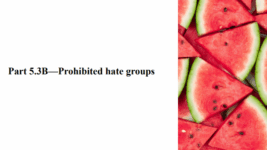
After making its way through the lower house, the Combatting Antisemitism, Hate and Extremism (Criminal and Migration Laws) Bill 2026 passed the Senate late on 20 January. Schedule 1 of the legislation contained the laws providing a framework for the listing of prohibited hate groups, which sits under new part 5.3B of the Criminal Code Act 1995 (Cth).
New section 114A.1 sets out the purpose of the laws which is to “protect the Australian community or part of the Australian community against social, economic, psychological and physical harm… and from the promotion of violence, by prohibiting organisations that engage in, prepare or plan to engage in, or assist the engagement in, or advocate engaging in, conduct constituting a hate crime”.
The definition of hate crime is then set out in section 114A.3 of the Code, which includes the crimes contained in subsection C division 80 part 5.1 of the Code that were either strengthened or created in February 2025, in response to concerns over rising antisemitism, along with the section 80.2H and 80.2HA offences of prohibiting symbols.
Hate crime also captures publicly inciting hatred against a person or a group due “race or national or ethnic origin”. This includes conduct captured by Commonwealth, state or territory laws, or that which “would, in all the circumstances, cause a reasonable person who is the target, or a member of the target group, to be intimidated, to fear harassment or violence, or to fear for their safety”.
Further behaviour captured under the term hate crime, includes causing serious harm to a targeted person, serious damage to targeted property, causing the death of a targeted person, endangering a targeted person or creating a serious risk to the health or safety of a section of the public. If an accused has been found to have mistakenly targeted a person or group, this doesn’t lessen the crime.
Listing a hate group
The Australian governor general can make a regulation to list a group as a prohibited hate group. This can be done if they engaged in hate crime or advocate for the commission of hate crime. This law also acts retrospectively. The GG can only do this if the AFP minister is satisfied that the group has engaged in hate crime or advocated for it, either prior to the laws being passed or afterwards.
The AFP minister can be satisfied that a group has engaged in hate crime and therefore, should be listed as prohibited, even if none of the members of the group have been convicted of a hate crime.
The minister doesn’t have to provide procedural fairness to the group or its members, when consideration of a listing is underway. This means that targets of these laws are denied what is also known as natural justice, which requires that the subject of a case be notified of it, be told what the case involves and then have the right of appeal following an unfavourable determination.
But it is ultimately up to the director general of security or the ASIO director general to assess whether a group should be listed as a hate group, and if so, they should provide written advice to the AFP minister, outlining the circumstances warranting a listing. And the ASIO boss must be satisfied the group has been engaged in or advocated for politically motivated violence or communal violence.
Then the AFP minister must be satisfied that the advice from the ASIO boss warrants the listing and further, they must have obtained a written agreement from the Australian attorney general prior to recommending the governor general list the group as a prohibited hate group.
Hate group offences
Just like the legislative framework pertaining to listed proscribed terrorist organisations, which results in those involved with a listed terror group then potentially being liable to a number of related terrorism group offences, once a group has been listed as a prohibited hate group, a number of newly created hate group offences may apply to them.
Six new hate group offences sit under new sections 114B.1 through to 114B.6. These include directing a hate group knowingly, which carries 15 years prison, or recklessly, which carries 10 years. Being a member of a hate group carries up to 7 years prison time, while knowingly recruiting for a hate group carries 15 years, or 10 years if done recklessly.
Providing training for a hate group makes a person liable to 15 years imprisonment, while funding a hate group carries 15 years gaol time, unless it is done unintentionally and then it carries up to 10 years.
The final offence covers knowingly providing support to a prohibited hate group, which carries up to 15 years in prison, while recklessly providing support to a group holds a maximum penalty of 10 years.
This mess we’re in
“But even though the powers will, most likely, be exercised responsibly now and those targeted organisations may indeed be heinous, I still don’t think it is wise to include such laws on the statute books,” warned University of Sydney Professor Emerita Anne Twomey on Constitutional Clarion prior to the laws being passed. “There is a real risk that they could be abused in the future.”
The renowned constitutional lawyer then related a hypothetical scenario where an authoritarian party takes majority in both houses of federal parliament during a “security crisis” and sets about designating the opposition party a prohibited hate group that needs to be disbanded. Such a scenario might not eventuate, the lawyer added, due to a likely High Court challenge blocking it.
The idea that an authoritarian government might take control in Australia seemed a far cry a decade ago, but with the Trump administration in the White House and a three month ban on protests in place in Greater Sydney, it’s likely the nation has never been closer to voting in its own “true blue” führer.
“This is the sort of stuff you get in authoritarian countries,” Australian Lawyers Alliance former president Greg Barns SC told the Australian Financial Review. “It is a fundamental breach of the rule of law. We know that the banning of organisations is always problematic. The Communist Party case in the 1950s told us that, when the Menzies government tried to ban the Community Party.”
“It’s particularly not a good idea when you don’t accord procedural fairness. You can have a huge impact on somebody’s life, who might have been said to be a member of that organisation,” the esteemed lawyer added in ending.
“No minister should have that power. No member of the executive government should have that power. The executive always has to be subject to checks and balances, including the courts. Not to do so, breaches the rule of law and is fundamentally undemocratic.”

Paul Gregoire

Receive all of our articles weekly
Related Articles
 New Federal Hate Crime Offences and Penalties in Australia
 New Federal Hate Speech Offences and Mandatory Minimum Prison Sentences Enacted
 Stamping Out Hate with Draconian Laws Is a Rush to the Bottom in Terms of Rights
 Federal Government’s Antisemitism Hate Bill Threatens to Further Erode Civil Liberties
 Antisemitism-Specific Offence and Other Hate Crime Laws Are Coming to NSW
 NSW’s Illegitimate Hate and Protest Laws Are Creating Social Division, Says NSWCCL President Timothy Roberts