Victoria Police Can Now Randomly Search Anyone in the Melbourne CBD
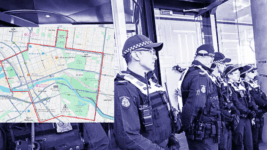
Victoria police recently announced that the Naarm-Melbourne CBD has been declared a designated area from 30 November 2025 until 29 May 2026, which means police officers and protective services officers can search civilians without reasonable grounds for suspicion over that six month period. But civil society groups are mounting a legal challenge against this distinctly draconian arrangement.
The designation means that VicPol can approach civilians in the area, which is the city’s central business district and its surrounds, and then require them to undergo a search, even without a reason to suspect a crime. Along with pat downs, officers can search vehicles and bags, ask for masks to be removed and scan people with an electronic wand. Cops can also move on people in the area.
“”Anyone in the Melbourne CBD over the next six months can be stopped and searched for no reason or be ordered to leave the areas if they refuse to remove a face covering,” said the Human Rights Law Centre on Monday, 8 November 2025, as it announced that activists are mounting a legal challenge against the designation providing VicPol with “extraordinary powers” for half a year.
Gunditjmara, Yorta Yorta, Bindal and Meriam protest organiser Tarneen Onus Browne and 80-year-old environmental activist Benny Zable lodged the challenge on 8 November, aiming to see the Federal Court strike down the six-month designation prior to Invasion Day, 26 January 2026.
Victorian authorities state the measures are needed to deter knife crime. The plaintiffs argue that the invasive measures covering such a large area for so long are unjustified, and will lead to a surge in racial profiling, criminalisation and traumatisation of civilians, while this shift towards searches without need for reasonable grounds of suspicion is becoming increasingly normalised nationwide.
Searching all and sundry
As MALS (Melbourne Activist Legal Service) explained in 2023, the Victorian government rolled out 2009 designated area laws, which sit in the Control of Weapons Act 1990 (Cth) (the Act). This was in response to a panic around knife crime. Initially, VicPol took extra measures to prevent racial profiling. Zones were declared in outer suburbs and transport hubs and could only last for 12 hours.
Section 10G of the Act permits police to stop and search a person, anything in their possession or under their control, to locate weapons in a designated area, while section 10H of the Act provides for vehicles to be stopped and searched. Schedule 1 of the Act explains that police can conduct an electronic metal detection scan or pat down search, and this can lead to a strip search if need be.
Amendments to the Act passed in March this year provided that designated areas are no longer restricted to 12-hour periods, but rather they can run for up to 6 months at a time, 24 hours a day.
Interactions with police officers nationwide have traditionally required officers to hold reasonable grounds of suspicion to approach a person, meaning they have a reason to suspect them of a crime. This can’t be based on a person’s looks or their clothes. In the current circumstances, the major issue is racial profiling or the pulling up of people for a search based on their ethnic background.
Victoria police officially banned racial profiling in 2015, after a high-profile Federal Court case found VicPol had engaged in the racial profiling of some African Australian men. But a recent report involving the data over the 12 years since, has found that First Nations, Middle Eastern, African and Pasifika people continue to be profiled in terms of stop and search compared to European people.
And while regular Victoria police officers will be able to randomly search anyone in the Melbourne CBD, so too will VicPol’s protective services officers be let off the leash. These officers are sworn into Victoria police, but they have limited powers and are restricted to certain areas, like transport hubs. PSOs issue fines and are said to keep the community safe and build rapport with it.
Ended prior to Invasion Day
“I’m bringing this case because I’m worried about the impact of these extra police powers not just on Blackfullas, but on anyone who comes into the CBD,” said Tarneen Onus Browne in an 8 December statement. “This is about all of our basic human rights and safety in our city.”
“I’ve been organising the Invasion Day rallies for the last 10 years, and see this as our national day of protest, marking the stealing of our land and our ongoing resistance and survival. What does it say that Victoria has just signed a Treaty but are now expanding the powers for police to harm us and stop us from speaking up about our history and resistance?”
The Human Rights Legal Centre is arguing that a six month designation over such a large area of Boon Wurrung and Wurundjeri land is not “necessary” in order to address the risk of weapons. The legal challenge also asserts that the Charter of Human Rights and Responsibilities Act 2006 (VIC) is being breached in a number of ways, including undermining freedom from arbitrary arrest and detention.
HRLC is to further put to the Federal Court that the requirement to remove masks or face coverings is unconstitutional, at least at protests, as it interferes with the implied right to political expression in the Australian Constitution. “People wear facemasks and coverings to protest as a form of political expression, and also to protect their privacy, health, safety and security,” the press release states.
“This is about pushing back against ever-expanding police powers in Victoria which make all of us less safe in our own city,” added HRLC legal director Sarah Schwartz. “The powers provided to Victoria police within designated areas are extraordinary and ripe for abuses of power.”
A designated continent
Victoria was ahead of the pack in enacting its draconian designated area laws in 2009. But as it moved to extend their use from 12 hour periods to 6 months earlier this year, the state was this time rather following other jurisdictions around the continent, as they moved towards installing temporary systems that provided for random police searches without need of reasonable suspicion.
Queensland trialled wanding laws in 2021 and rolled them out in 2023. These are similar to the Victorian designated area laws, as they allowed officers to randomly scan anyone in a specific zone for a particular time frame. The Northern Territory commenced wanding in 2023, while NSW and Western Australia did so last year, and South Australia and Tasmania followed suit over 2025.
Queensland expanded its wanding laws midyear this year, however, so that police officers can now exercise them at will anywhere in the state at “relevant places”, which includes licensed premises, public transport stations and vehicles, retail premises, safe night precincts, shopping centres and sporting or entertainment venues.
The Australian Capital Territory has also determined to consider such draconian measures.
In NSW, as elsewhere, the warrantless use of drug detection dogs in public places was introduced in the early 2000s. The canines have increasingly been accompanied by strip searches over the last 10 years. And despite sniffer dogs being shown to turn up nothing two-thirds to three-quarters of the time, state authorities are completely resistant to any suggestion to pull back on such operations.
The imposition of new wanding laws streamline the random policing of the public a step further by removing the need to receive a drug dog indication prior to searching someone.
In fact, developments in Queensland have effectively turned the entire state into a designated area, and as the various states and territories are all shifting in the same general direction in terms of randomly searching the public, its likely not too far a stretch of the imagination to consider the entire continent will soon be determined a 24/7 designated area.

Paul Gregoire

Receive all of our articles weekly
Related Articles
 Queensland Empowers Police to Conduct Random Searches on Members of the Public
 NSW Government Uses Knife Crime to Justify Wholesale Random Searches and Surveillance
 Queensland Police to Get Random Stop and Search Powers
 NSW Police Use of Drug Dogs and Strip Searches Slammed as Ineffective and Unlawful
 NSW Police Are Strip Searching Around 100 Civilians at Public Train Stations Annually
 Border Force Randomly Seizes and Searches Citizen’s Devices at Sydney Airport