“Opposing the Current State of Policing”: Watch the Cops to Rally Before the Downing Centre

Appearing on social media about a month back, the poster for the Rally Against Police Violence and Overreach, which is being staged by new social justice grouping Watch the Cops on Gadigal land in front of Sydney’s Downing Centre courthouse next week, has garnered much attention and interest as organisers have hit upon an issue that is front and centre for many at the moment.
The instigator for the mobilisation against not just New South Wales police, but Australian law enforcement in general, was the display of police brutality that demonstrators were subjected to at the Indo Pacific Weapons Festival held at the International Convention Centre last month, which included the unbridled targeting of all and sundry with pepper spray: a weapon that is banned in warzones.
But the fact that NSW police turned up the volume on its use of force, seemingly to ensure that it can be just as brutal and rights-eroding as Victoria police have been over recent years, is not the only issue.
The police assault on Hannah Thomas, as she was acting as a legal observer at a protest in June, was so brutal that it almost blinded her, and then law enforcement management sought to cover it up.
The call to end law enforcement targeting of First Nations people, and particular, their kids, has been growing at an expedited rate amongst the broader NSW community as well.
The recent appearance of online education resource anticop, alongside Watch the Cops, reveals that awareness campaigning around the issues being propagated by local law enforcement has matured into a mobilising force for change.
Sydney Criminal Lawyers spoke with a Watch the Cops spokesperson about the issues around the prosecution of the Indo Pacific Twelve, who are going before the courts on the day of the rally, along with the antipolice activists speaking at the event, and the fact that there appears to be something rotten in the state of our criminal justice system.
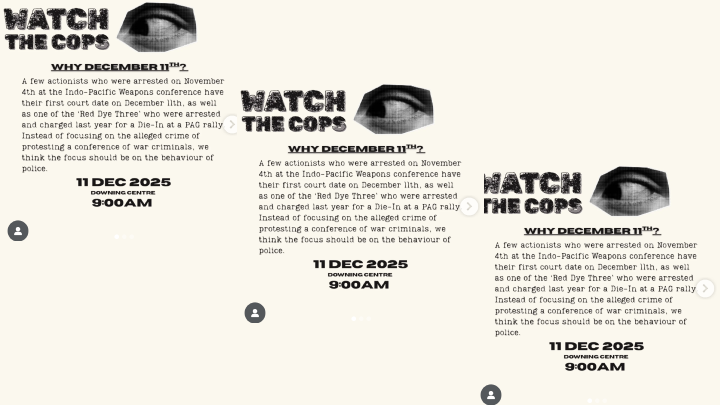
Watch the Cops is a newly aligned coalition of community members opposing police violence and seeking to extend solidarity to those who are affected by it. The group will be rallying on Gadigal land out the front of Sydney’s Downing Centre next week.
So, firstly, while it’s not uncommon to see people rallying against the war machine, Israel’s genocidal practices or the ever-accelerating climate crisis, it isn’t so often that you come across a protest opposing the police.
So, why is there a need for a social justice grouping like Watch the Cops at present? What’s been going on that would motivate individuals to organise against law enforcement?
Most of the activists who were arrested on 4 November at that Indo Pacific weapons expo are facing court on 11 December.
We called this rally because we wanted to support that, but we also thought it was ridiculous that after a day of police brutality it was activists in court and not the officers who caused mass injury and distress.
In addition to this, there were 12 Black deaths in custody in NSW this year alone. And in over 200 years of police killings, the first guilty verdict was handed down to a killer cop on 28 November this year, with Benedict Bryant being found guilty for the 2022 killing of 16-year-old Jai Wright.
The force nationwide contains violent killer cops who continue in their roles without opposition.
In our different movements on the left, there can be a hesitancy to reject tools of police control, such as Form 1s, as well as the prioritisation of being minimally confrontational as possible.
The events of the Indo Pacific blockade proved that no amount of building goodwill with the police will protect protesters from brutality.
It doesn’t matter if you show up ready for a ceasefire wearing goggles and deidentify, or if you show up in normal attire fully identified, because police consistently hand down violence to nonviolent protesters.
All of this in combination with growing police search powers put marginalised communities in danger.
So, we need to organise against police violence and overreach, because they are the common denominator that threaten our movements, our livelihoods and safety.
Were you at the Indo Pacific weapons expo protest?
I was. I was there as a medic.
The footage taken of the event both by official news outlets and independent journalists appeared to show the police use of force and officer use of pepper spray was heightened.
It was heightened and police started it. So, people tried to move towards the conference, but nobody went up against the cops. It was the cops who circled us.
The story was that protesters had been pushing the metal barriers, but it was actually police pushing them to create a perception of rowdy protesters.
There is footage of trigger-happy officers applying the pepper spray and protesters then writhing on the ground in agony.
Personally, I witnessed a woman being tackled to the ground by three officers, and while she was on the ground, she was pepper sprayed about three or four centimetres from her face.
Watch the Cops is prioritising three demands in respect of police forces across the continent. Can you explain what they are and why you’re prioritising these issues?
Our first demand is that there should be consequences for killer cops. This refers to the staggering lack of accountability for police when they kill. This is in particular if their victims are First Nations or they have been called upon for mental health reasons.
Six months on from his death, the family of Kumanjayi White are still yet to see the CCTV footage, and his killer is now prosecuting White’s father in court. This is emblematic of the issue.
There is no sense of urgency or alarm when cops kill Black people. It is business as usual in this nation.
Police cannot be trusted to investigate themselves and with six hundred plus Black deaths in custody since the Royal Commission, and with few recommendations implemented, it is clear that more people must be fighting for justice than just the grieving families.
Why does Kumanjayi Walker’s killer Zachary Rolfe walk free, when countless First Nations people are swallowed up by the system.
Our second demand is drop the charges for the Indo Pacific Twelve. It is a call to scrap the various charges handed down to activists on 4 November. Protesting weapons battled-tested on Palestinians should not be the crime, showcasing them should be.
The 4 November was a day of police violence and brutality, in the name of protecting war profiteers. It is unconscionable that antigenocide activists ended in the lockup that day.
Albanese himself has dodged ICC summons on the basis of genocide complicity since early 2024.
Why are those standing up for genocide having their day in court, while the prime minister is exempt?
Our third demand is to repeal the antiprotest laws. That speaks to the repressive nature of NSW antiprotest legislation, which was implemented to subdue climate protests.
When people who oppose the genocide of the Palestinians can’t gather nonviolently at the Opera House, but literal Nazis can display antisemitic signage outside parliament with police approval, it is clearly only one type of protester these laws apply to.
These laws have been deemed unconstitutional in the court and in the eyes of the UN, but the Minns Labor government seeks to expand them.
Another issue that Sydney Criminal Lawyers has been focusing on is increasing law enforcement encroachments into public space.
In NSW, this has taken the form of drug dogs that have increasingly been accompanied by strip searches and now there are wanding laws in place that allow officers to approach anyone in a designated area to be scanned with a metal detector.
How does Watch the Cops consider the increasing ability of law enforcement officers to approach civilians in public for a search without reasonable grounds for suspicion?
Police encroachment into daily life is increasing in in sinister ways. The use of drug dogs, wanding, the expansion of police search powers are unreliable ways to stop crime.
Investing in welfare, education and accessible housing are much more reliable measures for crime reduction. However, the Labor government wants to expand search powers and give the police the ability to cut someone’s welfare off if someone is merely suspected of a crime.
Evidence does not support the idea that expanded powers for police reduce crime. In fact, very little crimes are actually prevented by the police even when they do have prior evidence.
We see this with the killing of Hannah Clarke, who was in contact with police and had expressed that she felt her ex-partner was going to kill her. They knew all this, and they still coached him and essentially, let him continue on to kill Hannah and her children.
A world in which police need no justification to intrude upon and influence someone’s life is a world with more traumatised children and more racially oppressed people all cast into an unnavigable system. It is a world where accountability exists for everyone except for the police.
Have you seen that in Naarm-Melbourne the central business district has been turned into a designated area for six months?
Yes, and they have selectively targeted shopping centres, which I find the most egregious, because if you think realistically about it, a shopping centre is where someone who is less fortunate or may have had their welfare cut, will steal things for their basic livelihood.
So, that is clear entrapment of people who need help from the government and not to be criminalised.
So, they are focusing on shopping centres?
They’ve added four shopping centres to the expanded search areas. They are part of the CBD.
So, they can randomly search anyone without reasonable grounds in the CBD, which includes inside those shopping centres.
Yes.
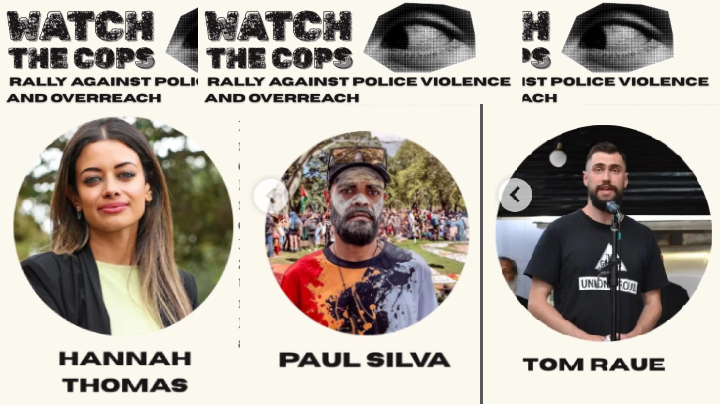
Three social justice advocates are speaking at the Watch the Cops event. Can you tell us a little bit about them?
In their own ways, all of our speakers are really significant voices in the antipolice space.
First of all, Dunghutti activist Paul Silva is the nephew of David Dungay Junior, who was killed in custody in 2015.
For the past decade, Paul has been fighting for justice for his uncle and other communities who have had the lives or freedom of someone they love taken.
Paul also sets a really important precedent for activists, in that he refuses to submit a Form 1 for protests, citing that he should not have to apply to protest on stolen land.
Non-Form 1 rallies can be pretty dynamic events, and the police can act pretty poorly as we saw on 1 November 2025, when NSW police drove a car into a procession of protesters, including children.
Despite this, Paul and his Blak Caucus collaborators worked to keep protesters safe and informed. And the feeling of defiance at these protests is rarely replicated at Form 1 rallies.
Tom Raue, another speaker, previously ran the Sniff Off campaign against drug dogs with David Shoebridge, which was an important community effort that kept many people safe from overpolicing and unnecessary charges, as well as keeping them from the trauma of strip searches.
Now, Tom is the founder of educational resource anticop, in which Tom writes about police weapons, tactics and history.
Recently, Tom has launched a de-recruitment campaign, leafleting police recruitment events and arming potential future officers with the knowledge that much of the job is actually about strip searching children and criminalising gender diverse people, while it also leads to an exceedingly high rate of PTSD in officers.
Hannah Thomas is an activist, lawyer and member of the Greens. She ran for the seat of Grayndler against Albanese, and she represented a huge swing to the left and against the prime minister in that area.
Hannah is a passionate advocate for Palestine and against weapons, and for this, she was brutally attacked by NSW police at a picket of SEC Plating earlier this year.
SEC provides electroplating services to make parts of the F-35 jets that are used to kill men, women and children in Gaza.
After NSW police punched Hannah so hard in the face that it popped her eye, they then charged her under trumped up riot charges.
Hannah fought this, whilst having multiple surgeries to her eye, and won. The cop has now been charged with recklessly causing grievous bodily harm, and she is pursuing legal action against NSW police, as a whole.
Hannah’s case is an important step towards police accountability.
The first Watch the Cops rally is taking place at 9 am on Thursday 11 December 2025 at Sydney’s Downing Centre. What can participants expect on the day?
We will have speeches. We will have chants. We will have solidarity. We are gathering at 9 am to give the arrestees time to be part of it prior to the court opening at 9.30 am.
Most of these cases are actually being seen at the John Maddison Tower next door, due to mould issues at Downing Centre – so, perhaps, there is something rotten about our judicial system, I don’t know.
Despite this, the rally will remain out the front of the Downing Centre for accessibility reasons.
The courthouse is where activists are up for opposing genocide, but it is also where many people whose lives are affected by police intrusion end up. It is where police lie in the court. It is where you find out you will be going to prison.
The courthouse is where the dehumanisation that the police begin continues. And it is where we are showing up to support the Indo Pacific Twelve and to oppose the current state of policing.
The Watch the Cops Rally Against Police Violence and Overreach is taking place on Gadigal land at Sydney’s Downing Centre at 9 am on Thursday 11 December 2025
Paul Gregoire

Receive all of our articles weekly
Related Articles
 Police Brutality Escalates Under the Cover of COVID
 Police Brutality at Disrupt Land Forces Protests Goes Unchecked in Victoria
 Thin-Skinned, Heavy-Handed Policing: A Worldwide Trend
 Report Condemns Heavy-Handed Response to COVID and Calls for Fines to Be Dropped
 Victim of Police Brutality Commences Legal Proceedings
 NSW Police Under Fire for Illegally Conducting Warrantless Searches