Federal Government’s Antisemitism Hate Bill Threatens to Further Erode Civil Liberties
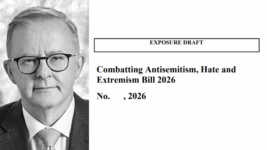
Federal parliament is convening for special sitting days on 19 and 20 January 2026, with the aim of passing new hate crime laws and gun measures contained in an omnibus bill, which taken together with a swag of other post-Bondi Beach massacre policies, reveals that the creep towards authoritarianism in this country is reaching fever pitch.
The exposure draft of the Combatting Antisemitism, Hate and Extremism Bill 2026 was released on 13 January 2026. And just like the emergency passing of protest ban and firearms laws in New South Wales prior to Christmas 2025, spruiked firearm reforms are contained in the same piece of legislation as other more controversial measures.
“Let me be clear – once these laws are passed, they will be the toughest hate laws Australia has ever seen,” said attorney general Michelle Rowland, as she stood beside PM Anthony Albanese on Monday. “They will specifically target those who seek to spread hatred and disrupt social cohesion in our community. And it will send a clear message that this conduct will not be tolerated.”
The onslaught of measures contained in the omnibus bill include offences criminalising hate preachers and radicalising kids, increased penalties for hate crimes, making extremism an aggravating factor in sentencing, an inciting hate offence, expansion of bans on symbols, cancellation of visas on hate grounds, the listing of prohibited hate groups and a national gun buyback.
At the Monday presser, the PM too made clear that he’s progressing these laws after many other post-Bondi measures. These have included implementing the plan to combat antisemitism, launching a Royal Commission and coordinating new national gun laws, which all appears like this country is creeping towards the same draconian civil society repressions noted in European nations since Gaza.
Enhancing hate crimes
The 144 page bill is chockfull of rolling repressions. Schedule 1 contains the federal criminal law amendments, which run for 50 pages.
Initial criminal law changes involve raising the penalties for a number of hate crimes contained in the Criminal Code Act 1995 (Cth) and further, create aggravated versions of these crimes that apply to hate preachers and therefore, carry steeper penalties. These hate crime offences were rolled out in early 2025, which was once again in response to suggested rising antisemitism.
These hate crimes relate to targeted groups, which can be “distinguished by race, religion, sex, sexual orientation, gender identity, intersex status, disability, nationality, national or ethnic origin or political opinion”.
These hate crimes include the section 80.2A offence of advocating force or violence against a group, section 80.2B’s advocating force or violence against members of groups or close associates, the 80.2BA offence of threatening force or violence against groups and the section 80.2BB offence of threatening force or violence against members of groups or close associates.
Further beefed-up criminal offences are the 80.2BC offence of advocating damage to or destruction of real property or a motor vehicle, threatening damage to or destruction of real property or a motor vehicle under section 80.2BD, along with the 80.2BE offence of advocating force or violence through causing damage to property.
New section 80.2DB of the Code would provide an aggravated offence when the force or violence involved in these hate crimes is targeted towards a child, and this carries steeper penalties.
The penalty applying to the offence of using a postal or similar service to menace, harass or cause offence, contrary to section 471.12 of the Criminal Code is being upped to 5 years from its current 2 years prison time.
Proposed new section 474.45BA contains an aggravated form of the offence of using a carriage service for violent extremist material, when it is distributed to a person under 18 years of age. Such material can involve that describing or depicting or providing instruction on or supporting or facilitating serious violence. If passed, this grooming crime will carry up to 7 years inside.
The omnibus legislation inserts being motivated by hatred or being motivated by hatred due to a person’s beliefs or race, national or ethnic origin, so they act as aggravating factors on sentencing, under section 16A(2)(ma) of the Crimes Act 1914 (Cth). So, if an accused has been motivated by these factors, then judicial officers impose harsher penalties.
The bill too amends the offence of publicly displaying prohibited Nazi symbols or gesturing a Nazi salute under section 80.2H of the Code, along section 80.2HA’s publicly displaying a terrorist organisation symbol, so that in arguing the defence of having a legitimate purpose to engage in such conduct, the burden will now be upon the defendant to show that, rather than the prosecution.
Listing hate groups
If it makes it through the two chambers next week, the legislation further creates “a new framework for organisations which engage in or advocate hate crimes on the basis of race, or national or ethnic origin to be listed as prohibited hate groups”. These laws will sit under new section part 5.3B of the Criminal Code.
New section 114A.1 sets out the objectives of these new laws, which involves protecting “the Australian community against social, economic, psychological and physical harm by prohibiting organisations that engage in, prepare or plan to engage in, or assist the engagement in, or advocate engaging in, conduct constituting a hate crime”.
A broad definition of a hate crime is then set out in new section 114A.3 of the Code, which involves the behaviour captured in the amended hate crimes listed above, as well as crimes involving offensive symbols, and these provisions would further serve to criminalise such behaviour retrospectively.
Hate crimes also involve conduct causing serious harm to targeted persons or targeted property, as well as causing the death of, endangering or creating a risk towards targeted persons. This involves the targeting of persons or their property due to their beliefs, or their race or national or ethnic origin.
Under new section 114A.4 of the Criminal Code, the governor general can make a regulation prohibiting a hate group only after the AFP minister is satisfied the group has engaged in or advocated for hate crime, or if it’s considered listing the group will prevent harm. This law acts retrospectively. No conviction is required for such a listing, and neither is any procedural fairness.
New section 114A.5 of the Criminal Code would require that the director-general of security provide written advice to the governor-general prior to a particular group being listed as a prohibited hate group and section 114A.6 would require that the attorney general do the same for such listing to proceed.
Hate group offences
The bill then sets out six offences related to listed hate groups. New section 114B.1 of the Code contains the offence of directing the activities of a hate group, which doing so intentionally carries 15 years, while recklessly doing so triggers 10 years. The section 114B.2 offence involves being a member of a hate group, which is a crime that carries 7 years.
The crime of recruiting for a prohibited hate group can see an individual facing 15 years for intentionally doing so, or 10 for doing so recklessly, under section 114B.3 of the Code, while section 114B.4 contains the offence of providing training to a hate group, which carries up to 15 years prison time.
Funding a hate group, under section 114B.5 of the Code, carries 10 years prison time, whilst providing support for a hate group, contrary to new section 114B.6, makes an offender liable to up to 15 years and 10 years, respectively.
Incitement of hatred offence
The bill’s explanatory memorandum sets out that the new offence of publicly promoting or inciting racial hatred is warranted in the present climate as “the recent terrorist attack at Bondi Beach… demonstrated how ideologies rooted in antisemitism and hatred can manifest in catastrophic violence”. The incitement of hatred offence sits in section 80.2BF of the Criminal Code.
An individual commits this crime if they “promote or incite hatred of another person” or a targeted group based on “race, colour or national or ethnic origin” or raises supremacist ideas based on race, colour or national or ethnic origin, when a reasonable person targeted would feel “intimidated, to fear harassment or violence, or to fear for their safety”. This carries up to 5 years prison time.
If it is shown in court that a person has raised such ideas because they are quoting out of a religious text or referencing such ideas in the text for the purpose of teaching or discussion, then the offence has not been committed.
In inciting hatred against another in a public place, the communication can consist of “speaking, writing, displaying notices, graffiti, playing of recorded material, broadcasting and communicating through social media and other electronic methods”, while offending conduct can involve “actions and gestures and the wearing or display of clothing, signs, flags, emblems and insignia”.
A smorgasbord of other extreme measures
Schedule 2 of the omnibus bill makes amendments to the character test in section 501 of the Migration Act 1958 (Cth), which would allow the minister to refuse to grant or cancel a visa based on the grounds of hate-motivated conduct and conduct or offences relating to the spread of hatred and extremism. Another change will ensure that once such a rejection has been made it is final.
Schedule 3 amends customs prohibited exports and import regulations, so they prohibit “goods that are violent extremist material, prohibited hate symbols and goods that contain such things” either entering or exiting the country.
Schedule 4 of the gigantic bill amends a variety of federal legislation to first create a national gun buyback scheme, which will see a legislative instrument created, covering a compensation schedule, a timeframe, data collection requirements, the role of the Australian federal police in destruction of the firearms collected, and the “form in which reimbursement requests are to be made”.
This section also lays out the legislative groundwork to create a new federal system of background checking in relation to firearm licence holders. This will enable ASIO and the Australian Crime Intelligence Commission (ACIC) to be consulted when state and territory licences are under consideration and in certain circumstances spent or quashed convictions may be disclosed.
The bill further seeks to tighten laws around importing firearms so that they include “removing open ended permissions to import firearms”, requiring federal permission to import certain firearms, like handguns and repeating straight-pull rifles and shotguns, as well as capturing gel-ball blasters as firearms for import control and restricting importation of firearms solely to Australian citizens.
Buckleys chance
Home affairs minister Tony Burke wrote to the Parliamentary Joint Committee on Intelligence and Security on Monday and told them they have a week prior to the second special sitting day next Tuesday, 20 January, to scrutinise the bill and report back to government, which is a complete joke, especially as the bill is not just lengthy but a rollercoaster ride of different matters.
As for the input of civil society organisations and the public in general, submissions closed at 4 pm on Thursday 15 January 2026.
The prime minister explained on Monday that he’d be briefing the Coalition on the omnibus bill that afternoon, and he’d already been giving them running updates during the drafting process. The Greens and other crossbenchers were to be able to access the bill on the following day. And he mentioned that the PJCIS was to be referred the bill “for report”.
“The legislation will… be debated on Tuesday in the House of Representatives,” Albanese told the press. “We intend to have that legislation pass the House before Question Time, which will occur at the normal time at 2:00 pm, and then will be considered by the Senate in the afternoon in order to ensure its passage on that day.”
Opposition leader Sussan Ley told the press on Thursday morning that the Liberals and the Nationals would not be supporting the “unsalvageable bill”.
The Greens announced it won’t be passing the bill in its current form later that afternoon, with Senator David Shoebridge citing issues with the sections containing migration laws and the listing of hate groups.
So, it’s quite unlikely these emergency laws will even make it through the lower house next Tuesday.

Paul Gregoire

Receive all of our articles weekly
Related Articles
 The Special Terrorism Policing Powers Triggered by the Bondi Beach Massacre Explained
 Legal Challenge Launched Against Draconian Blanket Ban on Protests
 Governments Likely to Use Bondi Massacre to Justify AI-Powered Mass Surveillance
 Antisemitism-Specific Offence and Other Hate Crime Laws Are Coming to NSW
 NSW Government’s Blanket Protest Ban: A Massive Gifting Away of Our Basic Rights for Xmas
 Stamping Out Hate with Draconian Laws Is a Rush to the Bottom in Terms of Rights