Police Commissioner Reduces Scope of Protest Ban Pending Court Appeal
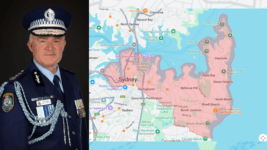
The 24 December 2025-imposed blanket ban on protests covering a large section of Greater Sydney was extended by NSW police commissioner Mal Lanyon on 20 January 2026, but at a much-reduced scope across Gadigal land to cover the CBD and the Eastern Suburbs. However, it continues to be a deplorable violation of constituents’ rights that ought to be struck down on pending court challenge.
The original public assembly restriction declaration, or PARD, covered central, north west and south west Sydney policing districts, prohibiting approved street march protests and providing police with a power to move on stationary public rallies. Yet, once Hyde Park is carved out, the only places that people regularly protest now covered are Sydney Town Hall and NSW parliament.
Enacted on Christmas Eve 2025, the PARD laws provide for the imposition of a 90 day ban on protests, following NSW police declaring an incident to be terrorism-related if it is considered that such events would cause fear amongst the constiuency. The law then requires the NSW police commissioner assess fear in the community and whether the ban should remain every 14 days.
The 20 January decision to extend the protest ban for another 14 days was controversial as if the original PARD was repeated, then the massive 26 January Invasion Day protest in the CBD would be banned. And during a deaths in custody assembly in Sydney’s Hyde Park last weekend organisers warned the NSW premier and the police commissioner that the march would progress either way.
But while the reduced scope of the blanket ban on the right to protest is welcomed, as is the warning having been heeded regarding Invasion Day, the fact that the original PARD remains in place partially and the laws facilitating the regime are still on the books, these continue to be unwanted blemishes on local democracy, and the hope is the NSW Supreme Court agrees with those challenging the laws.
Fraudulent excuse continues
Lanyon explained at a press conference on 20 January that the borders of the much-reduced PARD “go from Darling Harbour, through the north of the CBD, do not include Hyde Park, and then go out through Oxford Street and take in all of the Eastern Suburbs”.
“We are still less than six weeks from the most serious and devastating terrorist act ever in New South Wales,” the top cop continued before the press on Tuesday.
“I want to make sure that as a police force we ensure that community safety is the priority. Today’s decision to extend that declaration is about ensuring community safety.”
Since enactment on 24 December 2025, section 23B of the Terrorism (Police Powers) Act 2002 (NSW) permits the commissioner or a deputy to call a PARD across an area of NSW. The PARD holds for 90 days, and every 14 days a top cop reviews whether to revoke it.
A PARD is issued if a major crime is declared a terror incident, and it is assessed that street protests would cause a reasonable person to fear “harassment, intimidation or violence, or for the person’s safety” or that it would comprise a “risk to community safety, including the safety of participants in public assemblies in the area”. This assessment is repeated every 14 days.
The current PARD is in place until 24 March 2026, unless it is revoked by Lanyon.
The PARD regime was passed in the immediate wake of the Bondi Beach mass murder that saw 15 people killed by an ISIS-inspired father and son.
There is no clear link between that devastating event and the 26-month-long NSW Palestine solidarity movement, however NSW premier Chris Minns has drawn one. He claimed that protest organisers have been “unleashing forces they can’t control”, hence Bondi. Yet, ISIS is opposed to the Palestine movement in the Middle East.
Politicising the police
“In extending the public assembly restriction declaration this way, the NSW police commissioner has made it unequivocal that he is acting in a political capacity and not with respect to community safety,” said NSW Council for Civil Liberties president Timothy Roberts.
“While we welcome the NSW police saying that it will not mass arrest people for marching in the Invasion Day rally in Sydney, what a very low bar that is for our democratic freedoms in NSW,” the esteemed lawyer added.
Roberts asserted that having the police commissioner determine whose voice will be heard at the end of every two week period is not bringing social cohesion to the community, as he points out that the top cop deciding that the Invasion Day rally can proceed but then blocking all other demonstrations in that same determination is a divisive step.
The lawyer further makes clear that the community should not be in fear of police if parts of it meet to communicate politically in public. But this is what has been occurring in Greater Sydney since Christmas, as even when gathering at stationary rallies, the NSW police can move on demonstrators if they obstruct others, or officers consider they are causing fear, intimidation or harassing others.
“The Minns government undermines the police commissioner’s operational role by having him make political decisions about what protests can and cannot proceed without police intervention,” Roberts further set out. “The people of NSW deserve a government that is genuinely interested in combating racism, not merely repressing the expression of opinions they do not agree with.”
Challenging constitutional validity
On the day following the first 14 day extension of the current protest ban, 6 January, three social justice groups lodged a legal challenge to the constitutional validity of the PARD regime with the NSW Supreme Court, as the law appears to clearly breach the implied right of political communication, which is contained within the Australian Constitution.
Palestine Action Group, Jews Against the Occupation ’48 and The Blak Cacus are the plaintiffs challenging the validity of the draconian laws. And at an 8 January directions hearing, Justice Julia Lonergan determined that the case should be adjourned until 29 January, in order to allow NSW Chief Justice Andrew Bell to determine whether the case should be heard by more than one judge.
As constitutional lawyer Anne Twomey explained in early January, there have been two recent sets of hurriedly-passed draconian protest laws – one in April 2022 and another in February 2025 – and court challenges to these regimes saw them partially revoked. The last of these challenges was led by Palestine Action Group organiser Josh Lees and it saw a place of worship move on power repealed.
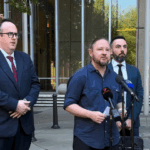
During a post-directions hearing press conference before the courts at Queens Square, Lees outlined that there was no basis for the “preposterous claim” that those who have been marching against the Israeli perpetrated genocide in the Gaza Strip have somehow influenced a psychotic father and son to go out and kill Jewish people at Bondi Beach.
The linking of these two disparate events makes no sense, except if taken as a politically convenient means to set about silencing support for Palestine in the face of creeping Israeli settler colonialism.
“This movement has been the most staunch opponent of all forms of racism, including antisemitism, and on top of that, of course, ISIS violently opposes the Palestinian cause and from what we know about these alleged gunmen so far, it seems like they were radicalised several years before October 2023 and the mass movement that has erupted on our streets,” Lees explained in ending.
Paul Gregoire
Receive all of our articles weekly
Related Articles
 Legal Challenge Launched Against Draconian Blanket Ban on Protests
 NSW Government’s Blanket Protest Ban: A Massive Gifting Away of Our Basic Rights for Xmas
 The Ban on “Authorised” Protest and Suppression of Political Dissent Continues in NSW
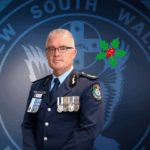 NSW Police Commissioner Bans Protests, Suppressing Fundamental Democratic Rights
 Proposed Temporary Ban on NSW Protests Is a Slippery Slope to Permanency
 Sydney Rallies Against Trump’s Imperial Assault on Venezuela, Despite Protest Ban