The State Set the Scene for Police Brutality: NSWCCL President Timothy Roberts on the Herzog Rally
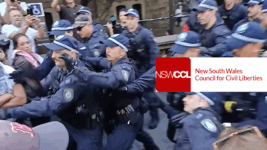
The 9 February 2026 NSW police assault upon the 20,000 pro-Palestinian Sydneysiders gathered to peacefully protest the official visit of Israeli president Isaac Herzog continues to leave much of the constituency stunned. The shock of witnessing NSW police liberally applying brute force to civilians appears unprecedented in living memory, and it’s not since been condemned by NSW authorities.
Those present in the crowd who did participate in the first 1978 Mardi Gras, which saw NSW police resort to kettling and brutalising the LGBTIQA+ protesters, who were not authorised to march, said they’d considered last Monday night triggered recollection of that police operation close to half a century ago. Yet, that incident had not involved as many as 20,000 civilians and 3,000 plus police.
New South Wales premier Chris Minns and police commissioner Mal Lanyon have refused to condemn the overreach. However, NSW police minister Yasmin Catley did condemn a member of her party instead, MLC Anthony D’Adam, for taking part in the protest, as she suggested last Thursday that he’d broken the law and sought to facilitate others in doing so, when this was far from the truth.
In response to numerous complaints made to it, the NSW police watchdog, the Law Enforcement Conduct Commission (the LECC), announced last Friday “that it is in the public interest to investigate the police operation at Sydney Town Hall and surrounds on the evening of Monday, 9 February 2026, including incidents of alleged misconduct on the part of NSW police officers against persons”.
Protecting all our liberties
Sydney lawyer Timothy Roberts has been a key voice opposing rising repressions over the last two summers, as the current president of the NSW Council for Civil Liberties. This has involved a plethora of draconian laws that suppress political expression to ostensibly “combat antisemitism”. But the laws have the dual impact of cracking down on criticism of the Gaza genocide.
The NSWCCL has been a key force in the ongoing campaign against the bipartisan attempt by the NSW major parties to dramatically restrict the ability to protest in this state, which commenced in a big way in 2022. The CCL formed in 1963, after the NSW police raided a party at a premises in Kings Cross without a warrant or any good reason.
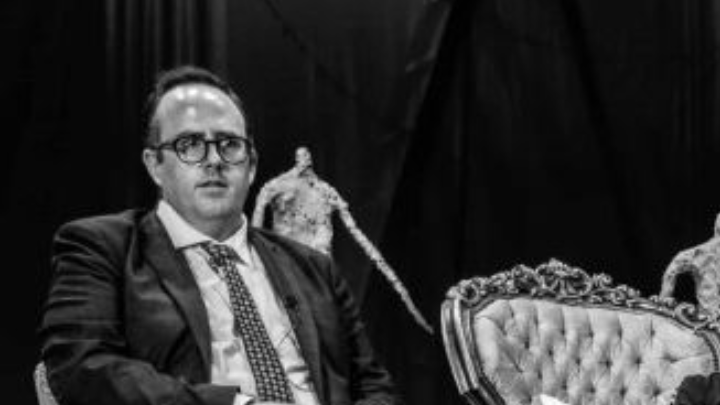
Sydney Criminal Lawyers spoke to NSWCCL president Timothy Roberts about how the council considers what transpired on Gadigal land in Sydney at the Herzog protest, what the NSW premier and authorities should have done when 20,000 constituents mobilised with the intention of marching, and why a transparent investigation is primary to stop a repeat of the police overreach.
On Monday, 9 February 2026, the NSW police set upon around 20,000 pro-Palestinian Sydneysiders in a manner that meant they were brutalising the public gathered on Gadigal land before Sydney Town Hall to demonstrate the official visit of Israeli president Isaac Herzog.
The NSW state had bolstered law enforcement powers on the evening and government ministers have since refused to condemn the police violence.
So, Timothy, what is the position of the NSW Council for Civil Liberties on this?
What we saw was the end result of exactly where the Minns government has driven us to as a community.
These were highly repressive and restrictive laws, empowerment of police without due discretion about democratic traditions, or even, in fact, a real point that we have in terms of what police do and their involvement in our society was not actively considered.
As a result of this, we saw this highly fractious adversarial environment that resulted in police violence. It was really distressing.
But also, this is exactly where a lot of civil society was pointing that this would go.
What about the planning on the part of NSW authorities? On the evening, when NSW police officers initially charged the crowd, they appeared to be acting with impunity in terms of applying excessive force, and they appeared to understand that was the case.
Exactly. We have got a police force that is unfortunately under a lot of organisational pressure, and importantly, a lot of political pressure, to act in a particular way.
Now that is a failure in leadership, in Minns, to drive us there. Absolutely, they were resourced, they were trained and maybe planned to do much of what they did.
But let’s be real here, the reason that they did this was that the Minns government gave backing and support to do that.
Now, Minns should have been the reasonable premier here and led a peaceful resolution to an assembly, which would have included a march, because that is what was wanted.
But he didn’t. He created an unsafe environment.
So, you seem to be inferring there, that when 20,000 people have assembled together and seek to march in opposition to a political matter, that it may be incumbent on the authorities to facilitate this? Is it within the right to protest to insist under these circumstances that authorities do facilitate such a crowd in an endeavour to march peacefully?
There are two answers to this. At the start of this aim of logic is the fact that this is a democracy. Assembly and protest march are a part of what we do. This is how our community express our views and share our differing opinions. That is the starting point.
The end here is that we have police officers that clearly wanted to make some operational decisions on the ground. The example of the Muslim men praying being moved on is one of them. These men were prevented from praying.
We have police here that have not been able to use its operational experience during the incident. We have to ask ourselves why and the answer is obvious:
Both the organisation from the top down and the political pressure has created a situation where the police have been asked to act in a number of ways, and this is when mistakes were made and police were stopped from doing their job.
The 20,000-odd pro-Palestinian civilians gathered at Town Hall on 9 February ended up with a double shock, as not only did they experience a law enforcement body supposedly there to protect them going on to attack them, but on the following day, senior ministers and top police all refused to condemn the brutality involved in the operation.
How does the liberties council consider these developments?
The CCL has called on both the premier and the police minister to resign if they don’t address what has happened on Monday in a more appropriate manner.
Quite frankly, the rhetoric from the police minister in condemning Anthony D’Adam was an extraordinary outburst in parliament, and it shows that she doesn’t have the capacity to turn this position around.
If we want to move forward, we need a police commissioner and police minister who understand their roles.
In so far as this connects to the police minister, it is that she is our elected representative to head up the police department. She is not the head of the Police Association. She is our elected member.
Catley is our minister. But she is not reflecting this well.
There also appears to be a concern here that in the NSW premier and police minister not condemning NSW police officers for, in some instances, beating up civilians, they’re actually further conveying some strange ideas about how pro-Palestinian constituents can be treated.
Is this a concern for the council?
We have a government here that is not first and foremost putting the dignity and respect of the human in their decision-making. We have rhetoric that has eroded the understanding that these people are not lesser persons.
These advocates and activists are our brothers and sisters and siblings in the community. They are doing what they are allowed to do under our democracy.
The rhetoric here is very close to being dehumanising. There is no real mystery here as to why the police thought they could act in the manner in which they did in some instances, and that sort of environment is the toxic one that Minns needs to stop, and the Labor caucus needs to bring him into account about, or they need to kick him out.
Minns needs to resign if he cannot control and set a more positive tone.
And lastly, Timothy, what else is the NSWCCL recommending happens from here. And should NSW constituents be concerned that next time they consider protesting or in particular, demonstrating against the ongoing Gaza genocide, that NSW police might set upon them with open brutality once more?
We have to have an independent investigation into what happened. If we are going to prevent it from happening again. This inquiry needs to be highly transparent, so that we can all see what is going on, and how this process is going, so we can restore confidence.
Absolutely, we need to look at how human rights are put front and centre in our decision-making in public, because it isn’t in NSW, but it has to be.
We cannot rely on community and civil society to keep doing all the muscle work here in keeping this government to account.
We need to have an independent body, like the LECC, which has decided to investigate the matter and inquire into it.
The LECC needs to have full independence and proper oversight when it is investigating, so that we know that we have had a proper investigation through this process.
Paul Gregoire

Receive all of our articles weekly
Related Articles
 How do Changing Social Values Affect Criminal Law?
 Man Sues NSW Police Force for Reputational Damage
 Marketing or Informing? Daniel Andrews Spends Big on Social Media
 The Legalise Cannabis Victoria Election Result Bodes Well for Genuine Law Reform
 Campaign for Free Speech About the Rights of Occupied Peoples Calls for Delisting of Hamas
 NSW Police Trapped and Brutalised Anti-Herzog Protesters, Report Confirms