The Antisemitism Royal Commission Will Further Suppress Criticism of Israeli Atrocities
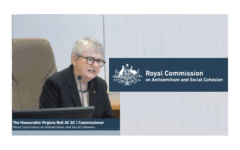
Following the 8 January 2026 establishment of the Royal Commission into Antisemitism and Social Cohesion, those concerned that it might be a platform for the Israel lobby’s agenda had considered such fears might be allayed with former High Court Justice Virginia Bell heading up the inquiry, but now she’s announced the IHRA antisemitism definition will be key, that hope’s been dashed.
The commission, with its far-reaching investigative powers, has been called in direct response to the ISIS-inspired 14 December 2025 Bondi Beach terrorism incident, although as Bell further explained on 24 February 2026, as one of the shooters is yet to be tried, the focus cannot be on the mass murder. So, therefore, the drivers of antisemitism in institutions and society will be the key charge of the inquiry.
The reasons why it is disconcerting that Bell, during the opening hearing of the inquiry on 24 February, insisted that the IHRA working definition on antisemitism will be central, is that the definition is understood to conflate criticism of Israel with prejudice against Jewish people, which serves to suppress free political expression about Israeli policy for fear of being charged antisemitic.
The concern is that the inquiry into the heinous tragedy might be commandeered by the lobby to silence criticism of Israel, especially in relation to the 29-month-long Gaza genocide, and this is given more credence when it is factored in that the prime minister appointed antisemitism envoy Jillian Segal to her role in July 2024, and she’s now enforcing the IHRA definition at all levels of government.
Indeed, the Antisemitism Royal Commission was preceded by PM Anthony Albanese announcing the adoption of Segal’s all pervasive Plan to Combat Antisemitism on 18 December, and it was followed by the passing of two federal combatting antisemitism bills on 20 January, while the moral panic around rising antisemitism has unsurprisingly been proceeding in tandem with the Gaza genocide.
Set up to conflate and conceal
“The starting point in addressing this first term of reference requires an understanding of what constitutes antisemitism. This is not a subject that is free of controversy,” said commissioner Bell on Tuesday. “The International Holocaust Remembrance Alliance, which from now on I shall refer to as IHRA, has developed a non-legally binding working definition of antisemitism.”
“This is a definition that has been adopted by many liberal democracies. It was adopted by the Australian government in October 2021 under prime minister Morrison, and following the May 2022 federal election, prime minister Albanese affirmed that adoption,” the former High Court justice continued. “The IHRA definition has been adopted or is supported by the governments of the states.”
Bell explains that a purpose of the inquiry is to advise government on how to tackle antisemitism, so she adds, using the same definition it does, makes sense. She further explained that the brief “uncontroversial” definition is accompanied by 11 examples of antisemitism, two of which, she adds, has led critics to claim that it “wrongly labels as antisemitic the expression of political views”.
The head of the Royal Commission further added to this point that she’s happy be to accept submissions on IHRA use, due to some misgivings on the issue. But mind you, Bell considers that many concerns are the result of homing in on the definition itself, rather than looking more broadly at the context in which it is being raised to provide determination in respect of potential prejudice.
“I should note that it is uncontroversial that criticism of the policies that may be pursued by the government of Israel from time to time is not, of itself, antisemitic,” said the former judge, in ending her consideration of the IHRA definition.
The politics of a definition
Bell states that “the definition itself is uncontroversial”, and when she does, she’s referring to the two lines that state that antisemitism is a hateful perception of Jewish people expressed towards them, their religion or their institutions. The May 2016 IHRA Plenary unanimously voted to officially adopt the two lines but then failed to agree on adopting the accompanying eleven examples.
The IHRA definition includes eleven accompanying examples, seven of which involve criticism of Israel presented as antisemitic. Oxford University PhD candidate Jamie Stern-Weiner’s 2021 report on the IHRA definition outlines that the representatives from a small number of European nations were wary of adopting the examples because they involve Israel and may deter political criticism.
Despite this, the IHRA definition has been presented as the superior antisemitism definition and Israel lobbyists have been presenting it to foreign governments to incorporate into their institutions on the suggestion that it serves to prevent any repeat of the World War II Nazi Holocaust against the Jews of Europe, yet this mechanism can too be wielded to suppress the plight of the Palestinians.
US attorney Kenneth Stern is these days warning people that the IHRA definition that he and others at the European Monitoring Centre on Racism and Xenophobia initially developed in 2005, has since been wielded by Zionists to stamp out criticism of the Israeli settler colonial project in historic Palestine. Zionists believe in Zionism: the political doctrine advocating for a Jewish state in Palestine.
Following the out-of-the-blue appointment of Jillian Segal to antisemitism envoy, she joined the Special Envoys and Coordinators Combating Antisemitism conference, which involved preexisting envoys from across the western world. The first US envoy was appointed in 2004. And it would seem like our local envoy, they all share a concern about propagating the adoption of the IHRA definition.
Overshadowing all other prejudices
Following the commencement of the Gaza genocide in October 2023, there were reported spikes in both antisemitism and Islamophobia in Australia. However, only the former garnered broad political and media consideration.
Over recent weeks, Islamophobia has skyrocketed due to Senator Pauline Hanson making purposefully divisive anti-Muslim statements in order to capitalise on her massive surge in popularity in this year’s political polls. Yet, antisemitism will continue to be the chief concern of the inquiry and the public mind, regardless of the increase in anti-Muslim sentiment.
And throughout this process, the ever pervasive and systemic racism against First Nations people in this country is being broadly overlooked, to the point that such prejudice has been tacked onto the antisemitism inquiry as an afterthought and filed under the term ‘social cohesion’.
In beginning her opening speech on the Royal Commission on Tuesday, Bell strangely opened up with consideration of the third term of reference, as it is the one that considers the Bondi Beach mass shooting, which necessitated the inquiry, yet due to a criminal trial of an alleged killer, the terror incident won’t be considered too closely at all, and therefore, more focus with be on antisemitism.
“I am mindful that while antisemitism may be the oldest religious and ethnic prejudice, other religions and ethnicities are also subject to prejudice in Australia,” said the former High Court justice in respect of further concerns of the inquiry. “I expect that social cohesion will be advanced by measures that address discrimination against religious faiths, ethnicities and cultures generally.”
“Nonetheless, against the background of the massacre of innocent people who appear to have been targeted simply because they were Jewish, I trust everyone will appreciate why the focus of this commission will be on tackling antisemitism as a starting point in strengthening our bonds of social cohesion,” she added in a further reminder as how this all looks likely to play out.
Senator Lidia Thorpe said in the wake of Bell’s speech on Tuesday, that it basically sets out that all eyes will be on antisemitism during the inquiry and no other form of prejudice, despite earlier assertions from Albanese and Indigenous affairs minister Malarndirri McCarthy that the social cohesion aspect of the inquiry would provide a chance to examine prejudices against First Peoples.
“It is irresponsible to tell our communities, and already stretched Aboriginal organisations, to spend their limited time and resources preparing submissions to a process that is not going to deal with racism against First Peoples,” clarified Thorpe.
“The terrorist attack in Boorloo on January 26 shows that we need serious, targeted action to address growing racism, hate and white supremacy against us,” the Gunnai, Gunditjmara and Djab Wurrung senator said in conclusion.
“Pointing to this commission and saying, ‘See, our government is doing something, in response to our calls for action,’ is disrespectful.”

Paul Gregoire

Receive all of our articles weekly
Related Articles
 Envoy Pressures Australia to Adopt a Fraudulent Antisemitism Definition
 The Envoy’s Proposal to Adopt the IHRA Antisemitism Definition Is a Threat to Free Speech
 Universities Australia Antisemitism Definition Regarding Israel: Ambiguous, Illogical and Flawed
 Federal Government’s Antisemitism Hate Bill Threatens to Further Erode Civil Liberties
 Federal Antisemitism Plan Marks the Death Knell of the Public Sphere
 Shoebridge Calls out the Antisemitism Envoy for Disregarding Nazis and Demonising Palestinians