Potentially Groundbreaking Federal Inquiry into Prejudice Against First Peoples Launched
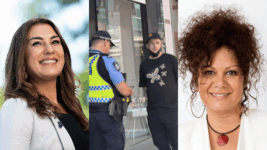
Minister for Indigenous Australians Malarndirri McCarthy announced on 4 March 2026, that a Joint Standing Committee on Aboriginal and Torres Strait Islander Affairs Inquiry into Racism, Hate and Violence Directed at Aboriginal and Torres Strait Islander people is underway, and Senator Lidia Thorpe, who’s long been calling for action, has welcomed the inquiry, on which she’ll be a member.
McCarthy explained that she’d written to the committee this week to request the inquiry, in light of rising racism specifically targeting First Peoples, which has been particularly pronounced online. The Yanyuwa Garrwa senator further pointed to the fear many are feeling after the white supremacist attacks on sacred site Camp Sovereignty and an Invasion Day act of terrorism in Boorloo-Perth.
The inquiry terms of reference include that the committee will be delving into the “nature, prevalence and impact of racism, hate and violence towards First Nations people”, along with the effect of online platforms on this prejudice, initiatives already in place to reduce it, as well as the threat of extremism, effective avenues of reporting and other related matters.
The announcement of the First Nations racism inquiry came a week after the opening of the Royal Commission into Antisemitism and Social Cohesion had put to rest government assurances that prejudice against First Peoples would be covered under the official investigation’s category of social cohesion. This inquiry was sparked by the 14 December 2025 Bondi Beach massacre.
Thorpe was a key voice in turning around the approach the authorities initially took in the wake of the Boorloo terror attack in January. And the Gunnai, Gunditjmara and Djab Wurrung senator has further underscored that the value of the committee inquiry won’t just depend on the depth of its research, but it will more so depend on whether its recommendations are acted upon.
A surge in prejudice against First Peoples
“I welcome this inquiry looking at the overt racism and abuse that First Peoples are subjected to, but that should not be the limit of its scope,” said Thorpe in a statement on Thursday morning. “This inquiry must also address systemic racism – the structural barriers embedded in systems and institutions across this country that quietly keep us down.”
“We know there are major issues in healthcare, social services, justice, education, and it goes on. While we often talk about fixing these through improved service delivery, we rarely have an honest discussion about the role racism plays,” the senator continued. “This is a fundamental issue for our people, and this inquiry must examine it with open eyes.”
As of August last year, there has been a surge in white nationalism, which politely states that it opposes mass migration, but on the ground says, “Send them back”, about migrants of non-European descent, and at the same time, it has perpetrated serious acts of violence against First Peoples, revealing that the movement is much more about white supremacy than overuse of infrastructure.
In the wake of the failed Boorloo attack, Thorpe suggested the Royal Commission be broadened to encompass all prejudices and Albanese and McCarthy then gave assurances that the issue of racism and First Peoples would be incorporated under social cohesion. But on opening the inquiry, commissioner Virginia Bell outlined that there would be scant room for anything but antisemitism.
“While this inquiry is underway, the government should be working around the clock to tackle racism now, including by implementing the National Anti-Racism Framework and clearing the backlog of committee reports and recommendations it continues to ignore,” Thorpe added.
Seismic shifts
The Australian Human Rights Commission released a report in mid-2024, outlining that racism is rampant and unchecked across all levels of government and departments and no one understands how to identify or deal with it. So, with the government funding and following the report’s findings, the whole-of-society National Anti-Racism Framework was launched in November 2024.
However, two years later, Thorpe and others are still calling on federal Labor to implement the framework, which has a focus on Aboriginal and Torres Strait Island peoples, as well as culturally and linguistically diverse communities. Instead of implementing it, however, the Albanese government determined to implement the Plan to Combat Antisemitism in December 2025.
Australian antisemitism envoy Jillian Segal devised the plan, after a series of antisemitic graffiti and property damage incidents that were mostly staged by organised criminals to turn to their advantage. Segal’s plan, of which she is directing, is a whole-of-society overhaul ostensibly to identify and deal with antisemitism, whilst too covertly stamping out criticism of Israel.
Albanese launched the plan, prior to passing his combating antisemitism laws and establishing the Royal Commission, in response to the Bondi mass shooting, which involved ISIS-inspired killers shooting at a Jewish religious festival and murdering fifteen. As Bell opened the official inquiry last week, she too noted that it can’t focus on the terrorism act because it is the subject of a trial.
As Albanese was implementing all these policies and laws to prevent antisemitism, white nationalist Liam Alexander Hall threw a homemade bomb into the predominately First Nations crowd at the 26 January 2026 Invasion Day protest in Boorloo, which failed but could have killed many. This incident was met with silence from the authorities and the media at first – as if nothing much had happened.
Thorpe and many others cried out for more serious attention to be given to this attack on First Peoples, which they maintained must be at least a hate crime, if not an act of terrorism. The Western Australian police then announced it was investigating the act as terrorism, and Hall was subsequently charged with an act of terrorism on 5 February.
The charging is significant, as only one white Australian has even been convicted with terrorism prior to this. It is the first time that an act of violence by a white Australian towards First Peoples has been charged as terrorism, and any future attacks on First Peoples that mirror this, like last year’s attack on Camp Sovereignty in Naarm-Melbourne, should at least be considered whether they are terrorism.
The decision to press a terrorism charge against Hall over the Boorloo incident that was driven by white supremacy against First Peoples is seismic, and when the initial suppression of Hall’s name to protect him was lifted, this too comprised of a rethinking and reforming of the long-time regular practice of suppressing a white person’s name for their protection, after an incident like this.
Forging reform
The initial downplaying of the Boorloo incident had been the norm. However, the pressure from Thorpe and others to change this approach in the current political climate has resulted in significant shifts. Not only is there a terrorism investigation in respect of Hall, but there is now a significant racism inquiry underway, which will be reporting back in mid-September 2026.
The broader significance of these developments, however, will be whether the recommendations are implemented. Thorpe has been pointing out in parliament for years now that most of the recommendations from the 1991 Royal Commission into Aboriginal Custody Deaths and the 1997 Bringing Them Home report have been left unactioned.
But the broad opposition to the lack of adequate attention initially given to the Boorloo attack and concerns raised over the inadequacy of the current Royal Commission in being able to tackle this issue, did lead to the unprecedented approach taken to an act that reflects the nation’s foundational violence, and there has long been a reluctance to seriously tackle this specific type of issue.
“The government must not use this inquiry as an excuse to avoid taking action or answering hard questions in the meantime. Setting up an inquiry doesn’t mean you’re off the hook,” Thorpe made certain on 5 March. “Urgent action now is still crucial, not just for First Peoples, but for all Black and Brown people around the country who are seeing rising threats.”
“I will approach this inquiry in good faith. But it must not become another tick-a-box exercise or a delay tactic that ends in another long report added to the too-hard basket,” she said in ending.
“Our people deserve more than words. We deserve action.”
Paul Gregoire

Receive all of our articles weekly
Related Articles
 “Facing Another Genocide”: Government COVID Neglect of First Nations
 Silence Remains on Hidden Settler Colonial Crisis of Disappeared First Nations Women
 State-Sanctioned Violence Against First Nations Women: An Interview with Professors Carlson and McGlade
 Government Ignores Revered Report on Reducing First Nations Incarceration
 First Nations Deaths in Custody Must be Independently Investigated: An Interview With David Shoebridge
 Northern Territory Curfew Laws Target First Nations Youth