“Coercion Dressed Up as Harmony”: Shaykh Wesam Charkawi on the State’s Growing Divide
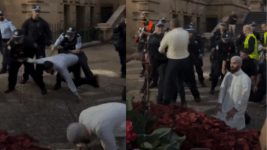
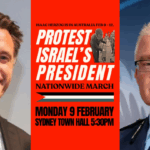
The attack by New South Wales police officers upon pro-Palestinian demonstrators gathered on Gadigal land in Sydney on 9 February 2026 to show their opposition to the official visit of Israeli president Isaac Herzog, as his nation continues to conduct a 29-month-long genocide upon the Palestinians of Gaza, was unprecedented in living memory, in terms of the force used by police and the scope of the operation.
The most disturbing scenes to come out of the apparently sanctioned police attack on civilians involved New South Wales police officers setting upon a group of Muslims being led in prayer by Shaykh Wesam Charkawi in the square beside Sydney Town Hall. Officers actually pulled these worshippers from their kneeling position and then slammed them back into the concrete ground.
This has heightened tensions between the NSW government and the Muslim community, at a time when the relationship has been increasingly strained by approaches related to Gaza. NSW premier Chris Minns and police minister Yasmin Catley have refused to apologise for this specific incident, while NSW police commissioner Mal Lanyon merely said sorry for any offence taken.
Since Israel commenced its genocide against the Palestinians of the Gaza Strip, Shaykh Wesam Charkawi has been a prominent voice at Palestine solidarity rallies, and he’s also been an outspoken voice representing the interests of the NSW Muslim community, which have been disregarded, while the Albanese government rushed to uphold Israel’s right to defend itself.
The shaykh was also a prominent figure in the establishment of The Muslim Vote, which is a lobbying group that strategies on how Muslims in NSW should best vote to see their interests represented in election outcomes. This was also in direct response to how both major parties in this country have simply been repeating Israeli justifications for heinous atrocities committed against civilians.
Sydney Criminal Lawyers spoke to founder of the Abu-Hanifa Institute and expert in countering violent extremism Shaykh Wesam Charkawi about his concerns regarding recent developments affecting the NSW Muslim community, which directly relate to the decisions of local authorities that are driving community divisions deeper.
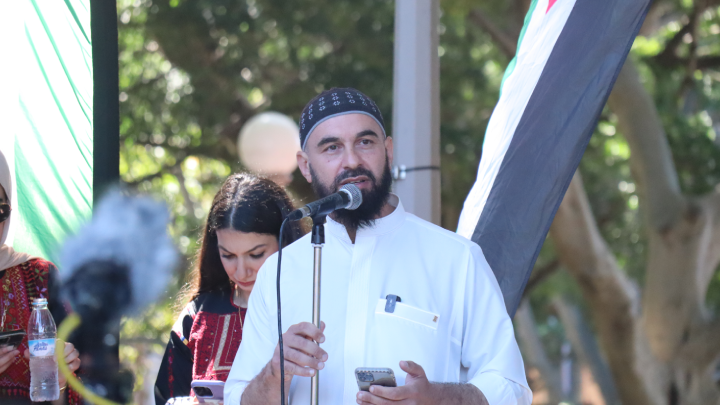
Shaykh Wesam, over the period since the Gaza genocide commenced, there have been concerns that the NSW government has potentially been engaging in decisions and policies that might be framed as anti-Muslim.
However, over recent weeks, the Minns government has taken a number of distinct steps that give more credence to these concerns.
These include the NSW police being set upon pro-Palestinian and Muslim demonstrators, the NSW premier then refusing to apologise for the police assault upon a group of Muslims praying, and further, Minns then cancelled the NSW government official Iftar event.
In your opinion, have these most recent turns marked a hardening in the relationship between the NSW government and the state’s Muslim community?
Hardening is not the appropriate word for Chris Minns. The Muslim community rejects Chris Minns and what he stands for.
His policies, rhetoric and positions on issues have demonised the Muslim community and antigenocide protesters. He has failed to stand for the ideal of social cohesion by dividing NSW.
What happened on 9 February was not read by the community as a misunderstanding. It was read as a message that Chris Minns is prepared to meet peaceful protesters with ruthless force and contempt.
His words about NSW police, “They did everything we asked them,” are indicative of his intentions and the type of leadership he is inflicting on NSW.
The 9 February 2026 police attack on a group of Muslims praying beside Sydney Town Hall, of which you were involved, were the most shocking scenes that came out of that night.
The NSW premier and police minister have refused to apologise for this, while the police commissioner merely said sorry for any offence taken.
What impact has the police attack on Muslims praying had?
The impact has been deeply personal for Muslims. NSW police breached one of the most sacred acts in our faith.
For an entire generation of young Muslim men and women, the image of that night will remain etched in their minds: Muslims in prostration, at their most humble before God, treated as though they were disposable.
That moment did not simply cause outrage. It changed hearts. It changed how police are seen. And for many, that damage will endure for a very long time.
The messaging is dangerous. It tells Muslims that their most sacred practices can be violated, their dignity publicly stripped, and the whole thing can then be sanitised with bureaucratic language if it suits the politics of the day.
What made that night even more morally exposing was that the violence did not stop at Muslim worshipers. Non-Muslim protesters were also beaten, and among them were people who, in that moment, showed more humanity than the state did.
One non-Muslim stood to protect worshippers while praying, placing himself in the path of force out of sheer instinctive decency and respect.
Australian governments insisting “Israel has a right to defend itself” in response to the Netanyahu government’s genocidal actions in Gaza led Muslim political lobbying groups to form in this state. This includes The Muslim Vote, of which you are involved.
But now the US and Israel have launched a full-scale attack upon Iran, and the Australian government has thrown its unbridled support behind it.
How would you say this development is impacting throughout the Australian Muslim community?
The events we have been witnessing unfolding before our eyes have led to the creation of The Muslim Vote.
The pursuit of political independence is not an exercise in recklessness or ideological purity. It is a calculated and necessary shift toward a more empowered and self-determined political future.
The aim is to cause a change in circumstances and ensure that no party, whether Labor or Liberal, can take Muslim voters for granted without consequence.
Political movements throughout history have faced similar dilemmas: whether to remain tied to a system that disregards them or to chart a new course with the understanding that power is never given, it is taken.
The expansion of Israel’s genocide on Palestinians to the current bombing campaign on Iran, carried out by the United States and Israel, is a flagrant act of aggression that once again exposes the violent impulse and militarised machine that feeds on escalation.
For many Muslims, this is not being experienced as some distant geopolitical episode. It is part of the same pattern they have been watching for decades. Palestine, Lebanon, Syria, Iraq, Afghanistan and now Iran.
Muslim lives are treated as cheaply expendable, while governments use the language of security to excuse violence against them.
A priority for premier Minns on taking office in 2023, was to establish the NSW Faith Affairs Council, which is a body made up of leaders from the various religions in this state, aiming to improve the relationship between the government and the faiths, as well as how those faiths interact.
Do you consider the policy of building an interfaith religious community has been progressed over the time in which the council has been operating?
A council means very little if the government’s real posture toward Muslim concerns is dismissive, defensive or securitised. Dialogue without moral courage becomes performance.
And lastly, Sheikh Wesam, since the start of the Gaza genocide, Australian governments have been spruiking social cohesion. However, recent scenes at the Sydney Herzog rally failed to reflect this.
How would you say the recent decisions the NSW government has been making in respect of the Herzog protest and related issues have been progressing the goal of cohesion?
Social cohesion is not produced by suppressing protest, passing laws under a false pretence, assaulting worshippers and then demanding that everyone calm down. That is coercion dressed up as harmony.
Nor is social cohesion achieved by warmly welcoming Isaac Herzog, found to incite genocide.
Real cohesion requires justice, consistency and equal dignity. It requires governments to stop treating some communities as citizens to be heard and others as risks.
Policing does not occur in a vacuum. Major public order operations are shaped by directives, legal interpretations, risk assessments and strategic instructions issued well before officers step onto the street.
The public deserves clarity on what role, if any, was played by premier Chris Minns and police minister Yasmin Catley in the lead-up to the protest.
What briefings were sought? What concerns were expressed? What expectations were communicated regarding enforcement? Were there explicit or implicit signals that a hardline approach was to be taken?
Paul Gregoire
Receive all of our articles weekly
Related Articles
 Banning Political Slogans: The Absurd New Way to Stamp Out Pro-Palestinian Support
 NSW Government’s Proposal to Criminalise the Public Display of Political Slogans Is Concerning
 Australian Lawmakers Continue to Enact Hate Crime Laws that Suppress Free Speech
 NSW Police Authorise Neo-Nazi Protest at State Parliament and Watch On
 The Ban on “Authorised” Protest and Suppression of Political Dissent Continues in NSW
 NSW Protest Ban Extended for Genocidal Israeli President’s Visit