NSW Aboriginal Land Council Lodges Discrimination Complaint Against Minns Government
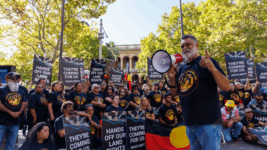
The New South Wales Aboriginal Land Council lodged a racial discrimination complaint with the Australian Human Rights Commission on 14 April 2026, concerning the NSW Minns government having quietly introduced legislation disguised as minor procedural amendments that rather seeks to drastically weaken Aboriginal land rights to ensure prime real estate remains in wealthy white hands.
Introduced in March, the Crown Land Management Amendment (Statutory Review) Bill 2026 has been shelved because the NSWALC caught whiff of the attack on the Aboriginal Land Rights Act 1983 (NSW), via amendments to other Acts, and a united network of 121 local Aboriginal land councils caused the state to renege. But this is just a momentary pause, hence the complaint to the AHRC.
This state’s Aboriginal land rights legislation is the most formidable in the country. It makes “unused and unneeded Crown land” claimable to local Aboriginal land councils. But NSW land and property minister Steve Kamper was caught out leading an attack by stealth to hollow out land rights, so prime real estate doesn’t end up in Aboriginal hands, and this involved no consultation with land councils.
The NSWALC AHRC claim asserts that the bill undermines Aboriginal land rights, and despite a lengthy cabinet process to develop it, councils weren’t consulted, while the Minns government misleadingly claims the reforms are “minor” and “technical” but they’re substantial, and the framing of the bill has caused confusion and disparagement around Aboriginal land rights and land councils.
“We will simply not just sit by while our state government proposes amendments that will hollow out our rights in this state forever,” insists NSWALC chair Dr Raymond Kelly. And his council further notes that NSW Labor has chosen to tear away at Aboriginal land rights amongst a social and political climate of rising “racial inequality and hostility” specifically targeting First Peoples in this country.
Stealing stolen land
“We have been working to support our people through Aboriginal land rights in NSW for more than 40 years, and that work doesn’t stop here,” Kelly continued in a 22 April statement. “The way this bill was introduced was completely unacceptable and without consultation under the guise of a ‘minor amendment’.”
“Aboriginal people living in NSW are not shocked at this level of mistreatment from the government,” he underscored. “We have experienced it for generations. But the direct impact this bill will have on our community is proof that our government will stop at nothing when their own interests are at stake. The reality is that what is at stake for our people is far worse.”
The NSW Wran Labor government enacted the Aboriginal Land Rights Act, which facilitates Aboriginal land councils to apply for Aboriginal Land Agreements if a parcel of Crown land is unused, and from there, if the minister finds that the land is lying dormant and is neither serving any public purpose, then it will be transferred to that Aboriginal land council.
The Australian reported that the Minns government’s attempt to legislatively steal back stolen land involves concerns that choice Sydney real estate has been handed over to Aboriginal land councils, which includes the site of the Paddington Bowls Club, the Talus Street Reserve, the Cronulla Marina and the Matraville Fire Station. But these were transferred over because the land wasn’t being used.
Kamper posits that such sites were never meant to be captured under the Act, which is a baseless claim. The High Cout ruled as much in September last year, when it determined that the then minister was correct in finding that La Perouse Local Aboriginal Land Council had the right to claim the site of Paddington Bowls Club, because despite a lease over that land, it had never been used.
So, the Minns government appears to have attempted to undermine the court’s ruling, which isn’t really that out of character.
“While the bill has been delayed for further consultation, we know the government will stop at nothing to sneak this bill through in May,” Kelly further made certain. “We want to be clear that the network remains united in our complete opposition to the bill in its entirety.”
The racial discrimination complaint
The NSWALC has lodged its complaint with the Australian Human Rights Commission as the peak statutory body representing the network of Aboriginal land councils across NSW. The complaint cites racial discrimination against the Minns government due to it having locked out and attempted to hoodwink the entire population of First Nations peoples in NSW from changes directly affecting it.
The complaint to the AHRC also claims that NSW Labor has taken the opportunity of the current racially divisive climate that’s on the rise right across the nation so as to make this attempt to hollow out the most robust system of Aboriginal land rights in the country amongst this “broader environment of racial inequality and hostility”.
Such an assertion has many examples to support that there is rising hostility towards First Peoples. These include the Boorloo-Perth terror attack on the 26 January 2026 Invasion Day protest, the neo-Nazi attack on sacred site Camp Sovereignty in Naarm-Melbourne in August last year, and of course, the atrocious heckling of Aboriginal speakers at various Anzac Day dawn services last weekend.
The NSWALC is also putting to the rights commission that actions that have been taken by the state government have directly resulted in “Aboriginal people being unable to enjoy property rights on an equal basis with others because their specific rights are uniquely constrained”, and NSW Labor’s public characterisation of what it is up to has attempted to shield the impact its laws would have.
Following the lodging of the NSWALC’s racial discrimination complaint against the NSW state, the AHRC will initially undertake a conciliation process via consolation and mediation with both parties, and if conciliation is possible then the matter will be resolved.
However, if conciliation is not met then either party has 60 days to lodge a complaint with the Federal Court of Australia, so that this higher authority can determine an outcome.
A sneak colonial attack
Minister Kamper has further made the claim that because there are over 43,000 outstanding applications for proposed Aboriginal Land Agreements, the Aboriginal Land Rights Act needs overhauling. However, attempting to make a slow-moving government system more efficient doesn’t seem to equate to watering down Aboriginal land rights.
The minister also told the Murdoch press that “the proposed changes we have put forward are there to address a minute number of edge cases that were never intended to be claimable in the spirit of the Act”. However, Kelly claims that just one of the amendments in the bill would serve to impact around 3,000 parcels of land currently under claim with the NSW government.
“The bill represents a substantial threat to the land claim and land return process, weakening a system designed to provide economic and cultural redress for Aboriginal communities,” Kelly continued. “By excluding the NSWALC and failing to engage in genuine consultation, the NSW government is quietly removing the power of the Aboriginal Land Rights Act”.
“As the body representing the network, we want to make it clear that our rights are under attack. This is an official complaint to the Human Rights Commission, and we demand that action be taken,” the chair of the NSW Aboriginal Land Council said in ending.
Main image: NSW Aboriginal Land Council chair Dr Raymond Kelly speaking at a rally opposing the Minns government’s proposed changes to the Aboriginal Land Rights Act
The Aboriginal Land Rights Protest to Stop the Crown Lands Bill is being held on Gadigal land in Sydney’s Hyde Park North at 11.30 am on Wednesday 6 May
Please sign the petition opposing the Crown Land Management Amendment Bill 2026 to stop the progress of these discriminatory laws

Paul Gregoire

Receive all of our articles weekly
Related Articles
 The UN Human Rights Committee Finds Australia Violated Indigenous Peoples’ Land Rights
 NSW Government Attempts “Stealth Attack” to “Hollow Out” Aboriginal Land Rights
 Court Ruling Proves Land Grants Covering Wiradjuri Are Illegal: Interview With Uncle Paul Towney
 “Stand Up and Take Back Your Homelands”: Gurridyula on His Mission to Stop Adani
 The Aboriginal Tent Embassy Doesn’t Support the Voice Referendum
 Land Rights vs Native Title in NSW: An Interview With Professor Heidi Norman