The Offence of Public Nuisance at a War Memorial or Internment Site in NSW
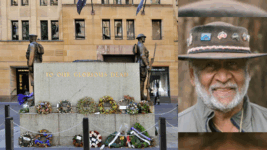
During the Acknowledgement of Country speech that former Australian Army officer and Kabi Kabi, Goreng Goreng and Ambrym Island elder Uncle Ray Minniecon delivered to the 11,000 strong crowd at the Anzac Day dawn service held on Gadigal land in Sydney’s Martin Place on Saturday morning, 24 April 2026, a small group of people in the crowd started booing and heckling the veteran.
The reason for this is that Uncle Ray is a First Nations man. A similar incident occurred at the Naarm-Melbourne dawn service on Anzac Day 2025, and that incident was perpetrated by known neo-Nazis. This year the heckling of Aboriginal speakers at Anzac Day dawn services spread, as it occurred in Sydney, once again south of the border and it too occurred at the service in Boorloo-Perth.
New South Wales Police News reports that law enforcement officers had been onsite and responded to the alleged act of public nuisance at the war memorial in Martin Place. That morning, NSW police high-visibility deployment Operation Anzac Day 2026 was present at the Sydney CBD event, and officers attached to it identified a 24-year-old man involved in the disturbance and arrested him.
The man was then taken to Day Street police station and charged with commit nuisance at a war memorial.
The 24-year-old was then granted conditional bail and will appear at the Downing Centre Local Court on 3 June 2026. And NSW police is set to put to the court that the arrestee booed during the dawn service at the Martin Place Cenotaph, which is an empty tomb erected in honour of those lost at war.
“Apart from a small handful of people, those who attended the dawn service and march were well behaved and respectful,” said operation commander, NSW police acting assistant commissioner Paul Dunstan, following the incident. “Police urge anyone continuing to mark the day to act responsibly, know your limits and look out for each other.”
The crime of public nuisance at a war memorial
The 24-year-old man has been charged with one count of nuisance or any offensive or indecent act in, on or in connection with any war memorial or interment site, contrary to subsection 8(3) of the Summary Offences Act 1988 (NSW). The maximum penalty that applies to this crime is 20 penalty units, which is currently equivalent to $2,200.
In order to see the alleged heckler convicted over this offence, the prosecution will have to prove beyond a reasonable doubt that the young man was intentionally being a nuisance or a significant annoyance or had caused offence, whilst he was in the vicinity of the war memorial.
Section 8 of the Summary Offences Act is titled damaging or desecrating protected places. A protected place means a shrine, monument or statue that is located in a public place, and it can include a war memorial or interment site. Subsection 8(2) of the Act carries a second offence, that of wilfully damaging or defacing a protected place, which carries a fine of up to $4,400.
Subsection 8(3A) provides alternatives for the court when penalising convicted individuals over one the offences contained in this section, which includes imposing a community correction order (CCO), with its standard conditions, which involve not committing any other offences for the duration of the imposition of the CCO, as well as attending court if called upon to do so.
A CCO can also be imposed under this section that further carries a requirement that the individual conduct community service work as an extra condition. The community service can involve up to 500 hours of work in total.
An alternative penalty for a child convicted under a section 8 Summary Offences Act crime is to undertake community service, in accordance with section 5(1) of the Children (Community Service Orders) Act 1987 (NSW).
Definitions pertaining to nuisance at war memorial
In terms of what counts as an interment site, it’s defined under section 44 of the Cemeteries and Crematoria Act 2013 (NSW), as a “place in a cemetery for the interment of human remains”. The section also explains that interment is the placing of human remains in “a mausoleum, vault, columbarium or other structure”, or burial in the earth, either directly or in a container, like a coffin.
Section 8 also defines a war memorial as a public place, and it includes the Anzac Memorial in Hyde Park, or as per subsection 8(4), it can be any “specified shrine, monument, statue or other structure or place, and a specified area (if any) within its vicinity that is a prescribed war memorial under the Summary Offences Regulation 2025 (NSW). The regulation lists no such prescribed sites at present.
In terms of the Anzac Memorial in Sydney’s most famous park, schedule 3 of the Anzac Memorial Act 2025 (NSW) explains that the “memorial area” comprises the land, and any improvements on the land, which includes the ground level extent of the memorial area, the memorial building, the underground storeys of the memorial building and the Anzac Memorial Ceremonial Area.
An additional alternative punishment, under section 8 of the Act, if convicted over the offence of damaging or defacing a war memorial, requires the offender to pay compensation to the “person who has control or management of” it, and this must not be more than of a fine of up to $4,400, and it is “in addition to any fine or other penalty imposed in relation to the offence”.
Defences against nuisance at a war memorial
The 24-year-old who booed Uncle Ray Minniecon could have several defences open to him depending on what was involved. This includes having a reasonable excuse that he puts forward to the court for what he did.
A reasonable excuse is a defence under NSW common law, and it is also set out in various pieces of this state’s legislation. In this case, the defence would involve the accused claiming that he had some form of valid reason for what he was doing.
The defence of duress is also open to argue against this charge given the right set of circumstances. This would entail the 24-year-old arguing that he heckled, in order to avoid a greater harm to himself or a loved one. This could be a threat of violence from another person insisting that he act in this manner. The threat involved in this defence must be significant enough to warrant breaking the law.
The defence of mental impairment or cognitive impairment is also available against a charge of nuisance at a war memorial. Contained in section 28 of the Mental Health and Cognitive Impairment Forensic Provisions Act 2020 (NSW), this defence would involve the man claiming not to be criminally responsible for his heckling, as he was suffering mental or cognitive impairment or both at the time.
The NSW offence of public nuisance
The basic act of public nuisance is captured under the Summary Offences Act section 4 offence of offensive conduct, which involves behaving in an offensive manner in a public place or at a school, or within view or hearing distance of the public or a place of learning.
This crime does not merely involve offensive language, as it must comprise of more than this. Offensive language is a standalone offence under section 4A of the Act.
And subsection 4(3) of the Summary Offences Act contains a legislated form of the defence of reasonable excuse, providing that this is a “sufficient defence” if the defendant provides an excuse to the court and it is found to be a reasonable justification for acting in the manner in which they did.
Paul Gregoire

Receive all of our articles weekly
Related Articles
 Criminal Offences Related to War Memorials and Cemeteries in NSW
 The Offence of Destroying or Damaging Property, Previously Known as ‘Malicious Damage’
 The Law, Penalties and Defences for Offensive or Disorderly Conduct on an Aircraft
 What is the Law on Offensive Language in NSW?
 Offensive Language and Obscene Conduct are NSW Crimes
 Elite Sydney School Students Could Face Criminal Charges Over Offensive Group Chat