NSW Police Drone Surveillance Trial in Moree Is Set to Be Rolled Out Statewide
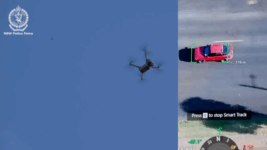
New South Wales police gathered local officials on Gomeroi Country in the northern NSW town of Moree on 8 January 2026 to announce it would be trialling crime-related drone surveillance in the area for the next six months starting then. And half a year later, it now appears that the authorities envision this “eyes in the sky” policing technique being rolled out right across the state.
With other top cops in tow, NSW police assistant commissioner Andrew Holland told the Moree mayor, the local member and the local representative of the Aboriginal Legal Service (ALS), when dropping this “next step in policing” on them without any warning, that it was only a “trial”, although he did expect it would be a success and then “it will be spread out to other locations across NSW”.
Moree was chosen for the trial because of its high youth crime rate. The Minns government had already provided a $13.4 million “targeted response” to address youth crime in Moree in March 2024. And this meant the town, known for its large numbers of First Nations people, about 23 percent of population, was provided with additional legal supports and crime prevention programs.
PolAir officially launched its new capability on 19 February 2026. The two drones now perched on top of Moree police station are remotely controlled from the NSW Police Force Aviation Centre on Bidjigal land in the western Sydney suburb of Bankstown. And NSW police recently reported that the drones have facilitated over 100 arrests, located 70 vehicles and recovered six missing persons.
But as Aboriginal Legal Service acting CEO Sharif Deen told NITV’s Living Black two weeks back, the reduction in crime in the Moree area is not simply down to six months of drone use, as rather the community had been working in accordance with the “targeted response” for these outcomes since early 2024. And the lawyer too warns that the dystopian nature of the program is also impacting.
An aerial cure-all
“What we are hearing from community members and leaders on the ground is that people are now apprehensive or scared to go out,” Deen told Living Black. “The fact that people are already talking about anxiety and being scared, is one thing.”
“The other thing that community members are sharing,” the lawyer continued, “is that, on their observation, the drones appear to be used exclusively, in the areas of Moree where we have a high proportion of Aboriginal people.”
Deen suggested that as NSW police minister Yasmin Catley was raising the expansion of the drone operation within days of the pilot program having been established, he considers that “if there is a community in a regional or remote area where government is already working” with it to reduce crime, then that’s likely to be the next location for the drones to be flown out.
The ALS CEO said he was thinking of “places like Walgett, Bourke and Kempsey – places where there is a high proportion of Aboriginal people” as being “the first likely targets”. And he added that it was clear to all that the NSW government won’t be rolling the drone program out to the eastern suburbs of Sydney.
Deen further warned that NSW police was likely to put the reduction in crime rates in the area down to the six months in which the drones have been operating locally, even though the aerial devices were brought in after a process of that had involved the community actively mobilising to bring down crime rates in response to the March 2024 targeted response.
The March 2024 $13.4 million targeted package had included youth bail accommodation and support services in Moree, the linking of Aboriginal youths to Indigenous support networks, an action plan to improve service delivery to the community, joint council and Aboriginal community-controlled organisation provision of afterhours programs and continued police attention in particular for youths.
A targeted approach
The other part of the regional crime package roll out was the Bail and Crimes Amendment Bill 2024, which toughened youth bail laws in a targeted manner and created a new offence aiming to prevent youths from “posting and boasting” or bragging about their crimes online via the threat of extra prison time for doing so.
The first change was to insert section 22C into Bail Act 2013 (NSW), which contains a temporary limitation on bail for youth that expires on 1 October 2026. This involves youths between 14 and 17 years of age charged over certain serious motor vehicle or break and enter offences being denied bail, if they’re already on conditional release for such an offence when committing their new crime.
The second was the creation of a new performance criminal offence, which is contrary to section 154K of the Crimes Act 1900 (NSW) and involves a person having committed a serious break and enter, motor vehicle, assault or robbery offence, then posting about it on the internet. This offence then carries the maximum penalty of the underlying offence plus an additional two years prison time.
The temporary bail law was supposed to have expired in April 2025, but it was extended in February that year, when it was found that the new law had resulted in more than 80 percent of offenders being refused bail. The Aboriginal Legal Service further noted that 88 percent of those captured by the new law were First Nations kids, and they accounted for 90 percent of those imprisoned under it.
In line with the comments from ALS CEO Deen, one would consider that these laws and figures might have also contributed to the lower crime rates in Moree that a recent Current Affairs report had solely put down to the onset of drone surveillance. And as for the most recent crime figures, the North England and North West region, where Moree is, have been stable of late.
NSW Crime Statistics and Research (BOCSAR) figures for the December quarter 2025 reveal that youth crime has remained stable for the 24 months prior, whilst court action taken against youths over the past two years in the North England and North West region was down by 18.2 percent.
This is not about aerial surveillance
“This trial will demonstrate, I am sure, that where we have that capacity, we can assist to reduce crime in regional areas,” said NSW police commissioner Mal Lanyon, when launching the drone program in Moree at the beginning of the year.
“This is not about surveillance,” the top cop made certain. “The way that we will use this is exactly the same way we used manned aircraft, whether its helicopters or planes – we use them for the same purpose. This is not about looking at individuals.”
But as the February 7 News report on the new capability put it, the drones are able to “track in real time where an offender is at any one moment”. And the report did raise privacy concerns amongst the community, but again they were allayed simply by police insisting that they won’t be spying on the public, as the drones will only be used in active crime scenes.
And just for good measure, NSW police minister Catley told 7 News during the February launch that she wanted to “assure people that this is about keeping the community safe and tackling crime” and it “has nothing to do with surveillance.”
Paul Gregoire

Receive all of our articles weekly
Related Articles
 A Creeping Surveillance State: An Interview With the Human Rights Law Centre’s Emily Howie
 Surveillance State Subsumes Sydney School
 The Thought Police Are Using the Protection of Kids to Justify the Expansion of Surveillance
 Surveillance State Laws That Enabled the Encryption-Busting Anom App Affect Us All
 Identify and Disrupt: Dutton to Further Extend Surveillance State Reach
 Dictator Dutton’s Disdain for Democracy: Part 1, Building the Surveillance State