‘Students Say No to Hanson’ Walkouts This Thursday: Interview With Students for Palestine’s Ethan Floyd
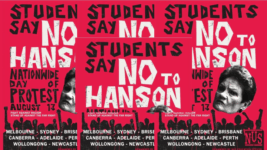
On Thursday, the National Union of Students is organising the “Students Say No to Hanson” walkout, which will involve tertiary students and secondary school students leaving their classrooms and lecture halls to gather in opposition to the rise of Pauline Hanson’s One Nation Party and its racist and divisive political agenda that it’s attempting to unleash locally.
Students will be walking out against the potential for a future One Nation governance in eight cities across the continent. The Sydney protest is gathering on Gadigal land before Sydney Town Hall at 1 pm on Thursday, 13 August 2026, whilst other groups demonstrating against racism and the rise of the far-right will gather in other urban centres.
The mainstream media has gone into something of a meltdown over the prospect of people under the age of 18 taking a political stand. Rightwing media commentators have been positing that this is an afront, and suggestions are further being made about the parents of these students, asserting that they’re to blame for raising kids who can obviously think for themselves.
Yet, the students are reacting to a situation that has seen Pauline Hanson’s One Nation rise to the top of the political polls for the last seven months, and whilst this has been put down to disaffected grassroots voters turning away from decades of major party politicking, this nation’s billionaire class has too thrown its support behind the divisive political leader over this same timeframe.
Future leaders of an equitable society
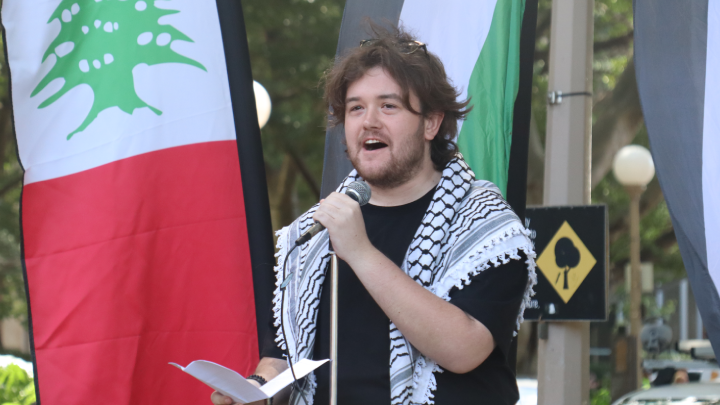
As Students for Palestine Sydney University member Ethan Floyd has reminded, students taking a stand against Pauline’s Hanson’s divisive politics has precedent, as such walkouts took place back in 1998, when One Nation was rising in popularity at that time. Although the Wiradjuri, Ngiyampaa, and Wailwan law student makes clear that what we’re facing in the present is much more dire.
One Nation has risen to the top of politics in the present, not just with the support of the local billionaire class, but this is too intimately linked to the rise of the US Trump administration, and Hanson has been locally asserting that the same sort of division being sowed in the States, especially around its mass deportation drive.
Sydney Criminal Lawyers spoke to Floyd about the threat that Pauline Hanson and her vision of a monocultural society is posing to this nation and its people, the fact that the shift towards far-right politicians occurring in this country is a global phenomenon and the alternative vision that the students who are mobilising have for a more equitable, multicultural and participatory society.
The National Union of Students is organising the Students Say No to Hanson National Day of Protests on Thursday, 13 August 2026. You will be taking part as a member of Students for Palestine Sydney University.
Ethan, what is it about the rise of Pauline Hanson and her One Nation party that warrants a nationwide action and effective strike on classes from students?
First of all, we have to look back to history. The last time One Nation were anywhere near the levels they are now, in terms of their popularity, polling and electoral success was in the late 1990s. In particular, I’m looking at 1998.
Nineteen ninety-eight marks a couple of important things. There was a Queensland state election, where One Nation picked up 11 seats. There was a byelection in Victoria, where One Nation actually went backwards in their votes in a Melbourne seat.
One Nation performed incredibly well in the 1998 Queensland elections. As a result, what you saw was Howard employing two political strategies at once. The first was to dump One Nation down to the very bottom of the preference deals for the Liberals in that federal election year.
Secondly, Howard had the Liberals absorb all of One Nation’s key policies, such as implementing mandatory detention, implementing temporary protection visas, abolishing ATSIC and gutting out the Native Title Act.
Pauline Hanson is on record at the time, calling herself “the Minister for Everything”. That is because she observed the phenomenon that when she was getting on the news and making enough noise about something, Howard would get spooked and do what she said.
That is the power that Pauline wielded in the 90s. The response to that was students everywhere, high school students from around the country, in particular, in the places where Hanson was causing the greatest threat, in Queensland and in parts of NSW, walked out of schools en masse.
What was significant about those protests was that it wasn’t the case of the classic stereotype where the inner-city activist runs out to the regions, telling regional communities who is welcome and who is not.
Rather, this was grassroots organising. Students who lived in the areas where they were walking out organised the demonstrations due to the threat that they saw themselves.
But the situation we are in now is much worse than that of 1998. One Nation are polling at nearly double their peak in 1998. And we haven’t seen the broad strong leftwing movement that we saw in the 1990s, and that is due to a lot of reasons.
Our tolerance for the far-right is a lot higher than it was in the 90s. That is partly due to the Trump effect and the rise of fascism globally. So, the collective tolerance for the far-right is a lot higher.
Also, we are seeing the exact same strategy that Howard adopted being picked up by Labor. Pauline Hanson says, “Jump”, and Anthony Albanese says, “How high?”
We are seeing that with recent moves by immigration minister Tony Burke planning sweeping changes to Australia’s immigration program. We can’t see this as anything other than the threat that One Nation poses to Labor in seats that it has held for decades, like my home seat of the Hunter.
The Hunter has been a seat throughout the last elections that hasn’t been about a red-blue contest, it hasn’t even been a red-green contest, but it has been a red-orange contest.
So, why are students walking out? Because we can read history. We can see the patterns that have been reoccurring for a while now, only we recognise that the situation in the 90s was not as dire as it is now.
We are doing what students do, and using our position in society, as young people without mortgages or full-time jobs or family commitments of our own, which is take up a social struggle that is a clear and present danger.
This is a lesson throughout history, that if you are not on the side of the students, you will tend to end up not on the right side of history.
That is why students are walking out.
So, you’re saying we’ve been here before, and the students have walked out before.
Kind of…. this is one walkout. The walkout must be situated within a much broader movement. The anti-Hanson walkouts of the 1990s were incredibly powerful. They certainly did contribute to a turning away from One Nation in certain places, but there were places where One Nation was not in a position to make massive gains.
Take inner Melbourne, for instance, One Nation was never going to win seats there. But these mass protests contributed, in part, to a negative swing in those places.
These student walkouts won’t do everything, but they are significant part of a broader left movement.
The Greens can’t lead the charge. The Socialists can’t lead the charge. Certainly, Labor can’t lead the charge.
This needs a concerted effort from a broad net.
Hanson’s meteoric rise to the top of the political heap has only occurred over 2026, and it is often put down to disaffected grassroots Australians turning away from the bad politics of the major parties.
However, the rise has been accompanied by another shift in support towards One Nation, which involves Australia’s wealthiest people, which is a turn that has been led by the country’s richest person Gina Rinehart.
So, what would you say the support of the local 1 percent tells us about the sudden appearance of Hanson at the top of the polls?
There are a couple of things. There is a social phenomenon in Australia, when compared with other countries, which is we have very poor class consciousness in Australia.
A majority of Australians don’t necessarily see themselves as working class or middleclass, but a large swathe sees themselves through the lie of the Australian dream that has been sold for decades.
So, people see themselves as temporary working class on their way to becoming a billionaire, or of the 1 percent.
There is a very healthy aspiration to that, but what that does is obscure the fact that the average working class Australian, the average mine worker, the average shift worker in a hospitality job, has more in common with an asylum seeker or a Palestinian refugee, than they do with Gina Rinehart and Australia’s billionaire class.
Yes, there is some working-class support for One Nation. I recently did some polling in Victoria that showed about 26-27 percent of current union members in Victoria stated their intention to vote One Nation at the next Victorian election.
That is worrying. It cuts across the idea that One Nation is solely a party that appeals to billionaires and the wealthiest.
This is not the case, but what it does show is that One Nation is leveraging, weaponising and manipulating the very legitimate grievances of working people: people who have been stuffed over by the major parties.
For decades, the system has not been working for people. We have been told consistently that things are going to get better. But they get better so slowly, or not at all, that people feel that their standard of living, that their wealth, their financial security, their economic security, is backsliding.
One Nation is happy for that. And instead of offering a vision that is positive or offering a vision that says, “Here is the shit situation that we find ourselves in, but here is how we build something better that will work for working people”, One Nation take the low and easy road to say that, “Here is a group of people who are of a different colour, or they are from a different place, and you can identify and pick out on the street and blame all your problems on.”
That is why we get migrant scapegoating. And what it says about One Nation being in the pockets of billionaires is that they will always act in the interests of their backers, before they act in the interests of working people – the people whose votes they are trying to seek.
This speaks to something about how there are two things that shift power in this country, and lots of countries, but in this country, in particular, which is money and people.
Money moves power through the major party system, through the system of political donations and lobbying. But people power has also shaped the way in which Australian society has changed.
The reforms of the Whitlam years were not brought about because some cadre of one in a generation reformist politicians, it was brought because people elected a leftwing government and harassed them for years and forced them through collective power to follow through on promises they’d made.
The current situation is they – they being One Nation and whatever is left of the Liberal Party, the far-right – have the money and the political backers but writ large we have the people.
We oppose the far-right, and rather than point the finger and say it is somebody else’s problem, we want to take responsibility.
This is a very Australian thing to do: taking responsibility for your own life and taking steps to make it better.
There has been a lot of mainstream media and conservative commentator chatter criticising the nationwide student demonstrations slated for this Thursday, because it will mean high school students will be cutting classes, along with tertiary students, and it’s been repeatedly suggested that there is something wrong or even sinister about all these young people taking a political stand.
What are your thoughts on this commentary? Can you see any basis for what is being asserted by those behind this issue regarding students protesting?
No, certainly not. There is a large number of students that are going to be walking out on Thursday, who are people of colour, children of refugees and asylum seekers. These are the kinds of people that if Hanson had her way, would be deported and kicked out of the country.
If your calculus is between a student missing a day of school or Pauline wanting to boot a student out of the country because of the colour of their skin or the place of their birth or their parent’s birth, then that is a pretty easy algorithm for me to do, and I dropped math in year 10.
There is no basis for thinking there is something sinister about students protesting, particularly, in regard to protesting Hanson: you just have to look at the notion behind the protest and the demands that the protesters have.
The stand that the protest is taking involves students saying no to Hanson. What we are saying is students say no to a political force that seeks to take the problems that exist in Australian society and blame those problems on people, who by and large, contribute so much to Australian society and contribute so much to our collective culture and our collective society.
Students and young people are the ones who are going to inherit the problems we have, so it’s entirely appropriate that they protest about this.
Students are saying that they don’t want to be set up for failure and that they don’t want the far-right to be allowed to take hold in Australia, which would then make it ten times more difficult to survive in the future, with all of these steps that are being taken at the moment that ensure that our lives are going to be worse.
It comes down to this fact: young people in Australia, and Gen Z around the world, are one of the first generations really for whom our lives will be worse than our parents, and it is in an order of magnitude.
Most young people are facing the prospect of never leaving the rental market, of never owning a home and being locked in a system of renting for the rest of their lives.
We are dealing with the ongoing effects of climate change. Our Pacific neighbours may not be here in 30 or 40 years. This is what our students are up against.
Parents, adults and older generations should not see this as something sinister but should actually be proud of young people for taking this active stance and actually seeing themselves as having a stake in the future of the country and want to step up and do something about it.
You’ve been a prominent voice at the yearslong protests against the Gaza genocide that have taken place on Gadigal land in Sydney’s Hyde Park. You also took part in the last Global Sumud Flotilla, and you were one of those participants taken into Israeli custody off the coast of Greece.
You’ve also a Wiradjuri, Ngiyampaa, and Wailwan man, and over these last years of the genocide there’s also been a spike in racism in this country, and in particular that targeting First Peoples.
So, Ethan, how would you say the rise of Pauline Hanson’s One Nation party is linked to these other developments that are taking place here and right across the globe at present?
This is nothing new for First Nations people. This is a country, at its foundation, built on racism. It is a fundamental part of how this country was founded.
It doesn’t mean that we are forever tied to that. It doesn’t mean that this country will always be a racist one.
But it does mean that we need to speak honestly about how the systems in this country have affected First Nations people, and we see throughout Pauline Hanson’s political career and One Nation writ large today, that they seek to, not just minimise, but to ignore that fact, to ignore the impacts that colonisation has had on people, to ignore the systemic damage that it has done to our people and our community.
If we can’t even be honest with ourselves about the inception of this country, about its foundational belief: ‘Europeans above First Nations people’, then we are on a false start is what I am trying to say.
We can’t possibly seek to bring about justice and make a better world, if we can’t recognise and learn from the injustices of the past.
Islamophobia has always been, or at least for the past 20-25 years, has been one of the defining features of Pauline Hanson’s politics because, at its core, the politics of One Nation relies on an Other. It relies on a person or a group, who can be identified, who can be seen, who can be blamed for X number of problems.
At first, it was First Nations people. Then it was Asian people. And for the past 25 years, it has been Muslim people and people from Arab countries.
This all ties together to say that our solidarity is one of our most important tools against the far-right.
I said it before, the average working-class person has more in common with a Palestinian refugee, with a First Nations person living on title-living on sovereign land, someone in the interior, they have more in common with these people than they do with Pauline Hanson or Gina Rinehart.
The sooner we recognise that, the sooner we recognise who are friends are in this fight, who our allies are in our struggle against the far-right, the better position we will be in to actually take steps that will make people’s lives better.
I am not necessarily the believer in identity politics, but what I am a believer in is that structural inequalities have shaped this country, have shaped how class operates here, how our politics operate today, and we kind of have to roll with that and kind of have to recognise that, and through building bonds across communities, there is not just a need to build a political coalition but a cultural or a social coalition with people from all backgrounds, of all persuasions, who don’t want to see the kind of moves that Hanson is proposing, which will affect their way of life, their quality of life, their economic stability.
And lastly, a mass of students is taking to the streets on Thursday to say no to a future One Nation-led government.
So, what sort of alternative would you say these leaders of the future are envisioning to One Nation’s vision of a monocultural, homogenous society that also has a preference for fossil fuels over renewables?
The alternative does not belong to one political party or traditional persuasion. Like I said, the Greens can’t lead this charge. The Socialists can’t lead this charge. It has to be all of us.
It is less becoming a competition between the left and the right, and it is more becoming a competition between those at the bottom and those at the very top, and there are more of us on the bottom, than there are on the very top.
So, the alternative to One Nation is people power. It is people controlling and having a greater say over what happens to them in their lives.
The diatribe of Labor is ‘if you are not at the table, you are on the menu’, which is to say, ‘even though the system is cooked, if you don’t at least participate, then you are up for grabs’.
They manifest this every election cycle by saying, ‘if it is not us, it is the other guy’. This is a fear campaign; it is playing on people’s fears and not on people’s hopes.
It is preying on people’s worries about what the other guy is going to do to them. So, if you take the last election, they had corflutes and they were just Peter Dutton’s face with a bit of a creepy expression and they said, “Don’t risk Dutton.” That campaign was that you have either got to put up with Labor or you have to risk what comes with Dutton.
You will see in this federal election in 2028, Labor will do exactly that same thing, except rather than Dutton, it’s Pauline Hanson, and the diatribe will be, “It’s either us or Pauline Hanson.”
I actually say, I don’t want to be at the table or on the menu, I want to be in the kitchen. Many people want to be in the kitchen.
We want to be cooking the food. We want to be making the decisions that are going to affect our lives, not having them served up to us and we have to choose between what is being given to us, rather than building something new – that’s the fundamental alternative that we are proposing.
Main image: Say No to Hanson Walkout poster supplied
Paul Gregoire

Receive all of our articles weekly
Related Articles
 Hanson’s Slick Delivery of Her One Nation Vision for Australia Should Alarm Us All
 Hanson’s Speech Doesn’t Reflect What Australians Believe, or Does It?
 Hanson’s Burqa Stunt – Justified or Offensive?
 Pauline Hanson Loses Defamation Case
 As Rinehart Seeks to Gift Stolen Land to Israel, the MAGA Playbook Is Well Underway
 Pauline Hanson’s Dog Whistling on Muslims Sets Politics into Race to the Bottom