Criminal Offences That Apply to “Unauthorised Protests” in New South Wales
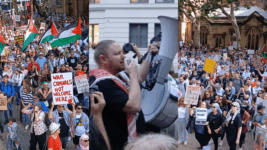
Israeli president Issac Herzog arrived in Sydney on Monday, 9 February 2026 as part of his official four day visit. The stated purpose of Herzog’s tour is so he can mourn with the Jewish families, who lost loved ones in the Bondi Beach massacre. Yet, as his nation has been engaged in a 27-month-long genocide, a massive protest is set to take place on Gadigal land in Sydney, yet it remains unapproved to march.
The 14 December 2025 Bondi Beach massacre resulted in a new law, which permits the New South Wales police commissioner to impose a 90 day protest ban on parts of the state following an incident being designated a potential act of terrorism. At time of writing, the Palestine Action Group protest is set to take place at 5.30 pm at Sydney Town Hall and within a preexisting protest ban zone.
The protest ban, or the public assembly restriction declaration (PARD), stipulates that anyone applying to conduct an authorised protest in the zone, via the request of a Form 1 to NSW police, will be denied it, which means that no street march can take place. But stationary rallies can occur, while police reserve the power to move it on if it’s assessed as a risk to safety or that it might cause fear.
At time of writing, the demonstrators protesting Herzog have vowed to march from Sydney Town Hall to NSW parliament. But the NSW police have threatened to arrest and charge those who attempt to march. There are a number of summary and criminal offences enlivened when protesters do take to the streets without approval, and these crimes are minor reflecting the nature of the acts.
However, last Friday, the NSW government declared the official visit of Herzog a major event, under section 4B of the Major Events Act 2009 (NSW), which unleashed a number of extraordinary policing powers, including the ability of “authorised officers”, a police officer or government official, to move civilians on from the area, in line with section 46 of the Act and via threat of a $5,500 fine.
Offences and powers triggered by unauthorised protests
The operation of the ‘major events move on power’ has given the authorities broad reach to insist most people leave a declared major event area, which coincides with the protest ban. However, the basic protest offences that unauthorised protesters are subject to on a regular basis will still be available for NSW police officers to press against civilians.
The most common offence that someone venturing onto a public street to conduct a protest march can be slapped with is obstructing traffic. This offence sits under section 6 of the Summary Offences Act 1988 (NSW). The maximum penalty is a $440 fine. In order to prove this offence, the prosecution must show that a person wilfully obstructed people, traffic or a vessel in a public place.
This offence is not confined to preventing people from obstructing traffic on the streets, but in a public place, which covers places “not covered by water” or “a part of a premises”, which are open to the public. A vehicle under the Summary Offences Act means a motor vehicle, a train, monorail or other railway vehicle, along with a caravan or anything else pulled by a motor vehicle or animal.
A summary offence is a less serious offence that is heard by a magistrate in the NSW Local Court and not by a judge and jury in a higher court. The maximum penalties applied by the lower court are capped at 2 years imprisonment and/or a fine of $5,500 for a single offence.
Another key protest offence is knowingly joining or continuing in an unlawful assembly, which is contrary to section 545C(1) of the Crimes Act 1900 (NSW). This offence carries up to 6 months prison time and/or a $550 fine. To prove this crime the prosecution must show that a defendant joined or continued on in an unlawful assembly, and they were aware it was illegal.
Subsection 545C(2) of the Crimes Act contains an aggravated form of the offence, which entails joining an unlawful assembly whilst armed with any weapon, or armed with anything likely to cause death or grievous bodily harm. This crime carries up to 12 months in prison and/or a fine of $11,000.
In terms of an “unlawful assembly” for a section 545C offence, this means five or more persons “whose common object is by means of intimidation or injury to compel any person to do what the person is not legally bound to do or to abstain from doing what the person is legally entitled to do”.
Another offence applied to unauthorised protest is the summary offence of resisting arrest or hindering police in the execution of their duty, which these days sits under subsection 60(1AA) of the Crimes Act. This carries up to 12 months or a fine of $2,200. The prosecution must prove beyond a reasonable doubt that a defendant resisted or hindered police or that they incited another to do so.
The standalone resisting police offence under section 546C of the Crimes Act was repealed in 2022.
Failure to comply with a direction is another key offence applied in unauthorised protest situations. This sits under section 199 of the Law Enforcement (Powers and Responsibilities) Act 2002 (NSW). The crime carries a fine of $220. The prosecution must prove that a defendant did not follow a correctly issued move on order, as per the move on powers contained in part 14 of the LEPRA.
Defence available to unauthorised protest offences
There are a number of defences that can be argued in court in respect of these offences. The defence of honest and reasonable mistake of fact can be applied to the offences of obstructing traffic and unlawful assembly. This consists of the position that the defendant understood certain facts existed, these were reasonable to believe, and if it had been correct, their actions would have been legal.
The defence of duress can be raised in terms of unlawful assembly, resisting arrest and failure to comply with a direction. This defence involves the defendant putting to the court that their crimes were carried out in response to a threat made against them or a loved-one. The threatened harm must be so great that it warrants breaking the law to avoid it.
Another general offence available to unlawful assembly, resisting arrest and failure to comply with a direction is the defence of necessity. This involves a defendant arguing that they broke the law in order to prevent more dire circumstances from eventuating if they had not perpetrated the crime.
The legal defence of self-defence contained in section 418 of the Crimes Act is too available to charges of unlawful assembly, resisting arrest and failure to comply with a direction. This means the defendant asserts that they perpetrated a crime to prevent an unlawful deprivation against themselves or someone else, which can include defending one’s own property or criminal trespass.
The right to protest under threat
The declaration of the Herzog tour as a major event represents the first time an official visit from a foreign government minister has been designated in this manner.
The measures not only permit the authorities to direct people to leave an area, or to move on, but they also permit NSW police to stop and search people without a warrant, officers can seize objects in the area, as well as close off or shut down places within the zone.
Much of the public oppose the presence of Israeli president Herzog because of the mass atrocities his government has been perpetrating for more than two years now, while rights advocates in NSW maintain that authorities do not have the ability to prevent public protest, as the right to protest or the common law right to peaceful assembly prevails regardless of any statutory limits applied to it.
Paul Gregoire

Receive all of our articles weekly
Related Articles
 The Offence of Unlawful Assembly in New South Wales
 NSW Protest Ban Extended for Genocidal Israeli President’s Visit
 Arrested Over Protesting Gaza: Wage Peace’s Margaret Pestorius on the NSW Antiprotest Regime
 NSW Government Ramps Up Offensive Against Protests
 NSW Supreme Court Hears Challenge Against Unjustified Anti-Protest Laws
 NSW Government Expands Antiprotest Laws to Cover Places of Worship