Iran Warns of Unprecedented “Global Economic Crisis”, if Trump Strikes Electricity Plants
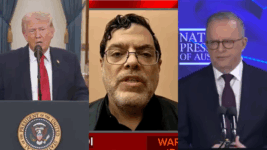
Australian prime minister Anthony Albanese called for a “de-escalation” in the US-Israeli war of aggression on Iran at the National Press Club on Thursday, 2 April 2026, as he considers the war objectives “have been realised”, while US president Donald Trump still plans on bombing Iran “back to the Stone Age”, and both leaders are ignoring that Tehran tends to have the upper hand.
In terms of the objectives of the war, which appear to be shifting, Trump says his nation’s “core strategic objectives are nearing completion”, but he’s contemplating taking out “each and every one of their electric generating plants”, if Iran doesn’t cut a deal to open the Strait of Hormuz. However, as far as the Islamic Republic is concerned, it hasn’t entered into any negotiations with Washington.
As Iranian academic Professor Seyed Mohammad Marandi told UK commentator George Galloway on 23 March, two days after Trump first threatened Iran’s civilian infrastructure, if Washington does move to strike its electricity generating plants, then the Islamic Republic is threatening to devastate the infrastructure of the Gulf States, which would lead to an unprecedented “global economic crash”.
Trump’s 1 April statements involve ending the war in “the next two to three weeks”, but only after he’s bombed Iran to prehistoric times, and his comments are further notable because in threatening to strike Iran’s electricity plants, the president is now declaring his intentions to commit war crimes, whilst officially addressing the US nation.
As for Albanese, he told the press club on Thursday that he wants to know “what the end point” with the Iran war is and “what the objectives” of Operation Epic Fury are. However, our prime minister is continuing to seek these answers from a directionless Trump White House, whilst the party that appears to be holding all the cards in this conflict is Tehran.
Keep those allies guessing
Part of the reason that our PM is questioning the objectives of the US-Israeli war on Iran five weeks into the conflict, is that the US objectives have never been clear. The White House has repeatedly changed its reasons, whilst the only solid western objective has been Israeli PM Benjamin Netanyahu’s plan to destabilise Iran permanently, so that Tel Aviv is the strongest regional power.
As Trump claimed during his 1 April address to the nation, his country’s objectives in warring on Iran have never included regime change, but instead they’re about “systematically dismantling the regime’s ability to threaten America or reject power outside of their borders”. But the mad king further added that regime change has been achieved anyway.
Yet, even with Trump talking about winding down the war, the US is continuing to deploy American troops to the Persian Gulf region. The US has been moving troops there since January, it has recently established three large new deployments in the region, which accounts for about 10,000 more troops than usual, bringing the total estimate of US troops in the Middle East to about 50,000.
So, whilst Trump and Albanese tell their constituencies that the war is coming to an end, there are also proposals for two potential US ground assaults on Iran. One of these is the proposed attempt to take Kharg Island, which is located in the Persian Gulf, close by the closed-for-some-nations Strait of Hormuz, as the island is important because it processes 90 percent Iran’s crude oil exports.
The other potential ground invasion the US is pondering is sending US special forces into Iran to seize the nation’s stockpile of highly enriched uranium. But this mission does appear to involve the White House having itself on, whilst its stated objective of allaying the Iranian nuclear threat has about as much substance to it as the US “weapons of massive destruction” excuse to war on Iraq did in 2003.
Despite the war coming towards its end as Trump insists, around 3,500 more US marines are slated to arrive in the Gulf region in the coming weeks. And if these troops that are being deployed to the region do attempt to invade Iranian territory, all of these suggested timeframes and fleeting objectives will fall by the wayside, and the conflict will become entrenched.
“Far worse than 1929”
Trump first threatened to “obliterate” Iran’s power plants on 21 March 2026, giving the nation 48 hours to “fully open” the Strait of Hormuz, so that 20 percent of the world’s oil that moves through there, as well as other resources, like fertilizer, can continue to do so, and the global petrol crisis that’s only just begun, comes to an end.
The US president went on to drop his initial 48-hour deadline but has since created several new ones, with the current 10-day deadline expiring on Monday, 6 April 2026, which at present, means if the Islamic Republic does not open the Strait of Hormuz, then the Trump White House plans on taking out Iran’s electricity plants next week.
Professor Marandi recently explained that “Iran is prepared for all-out war”, and “it has not shown its true power yet”. In response to the initial US and Israeli strikes, Tehran launched its own attacks on all the Gulf States that host US military bases, and he warns that those nations are “complicit in the war”, and therefore, strikes on Iranian civil infrastructure will result in attacks on theirs.
“So, if they strike Iran’s critical infrastructure, that will be the end of oil and gas in the Persian Gulf, and the same is true for the regime in Baku, which is a close ally of the Israeli regime, their oil and gas will no longer be exported in the near future,” Marandi made clear.
“So, Trump has to be very careful, because if this happens, then it no longer matters if the Strait of Hormuz is open or not. There will be no more oil or gas or petrochemicals and no ships to take those nonexistent oil and gas and petrochemicals. And that will lead to a global economic crash that the world has never seen in the last century,” the professor added. “It will be far worse than 1929.”
“Yes, sir. No, sir. Three bags full, sir.”
Albanese addressed our nation on 1 April. Trump and UK prime minister Keir Starmer also formally speak to their own nations on the same day. This had led to speculation that there was going to be an announcement in terms of all three nations’ escalating their involvement in the Israeli-inspired war on Iran. However, then all three leaders got up and delivered rather unimportant speeches.
“The war in the Middle East has caused the biggest spike in petrol and diesel prices in history. Australia is not an active participant in this war.” our PM declared both during his 1 April 3-minute address to the nation and as well, at the National Press Club on the day following.
At the press club, Albanese further added, “We did express support for the original objectives: preventing Iran from ever obtaining a nuclear weapon and degrading its capacity to endanger its neighbours.”
Albanese has continued his line, that our nation is not involved, despite him being the first world leader to declare support for the illegal attack on Iran. This nation is further implicitly involved due to intel from the local Pine Gap surveillance facility likely being utilised by the US and Israel, and it also deployed a surveillance plane, air-to-air missiles and 85 Australian troops immediately to the region.
Despite Albanese’s assurances this week, however, it was reported on Good Friday morning that 90 Australian SAS (special air services) troops have been deployed to the Middle East to be on standby if the war on Iran escalates. And it appears that these extra troops were sent to the region a fortnight ago.
Defence minister Richard Marles outlined on 3 April 2026, that the government doesn’t usually comment on the movements of SAS troops, so therefore, there is nothing suspicious about Canberra keeping a lid on this development. And besides, the minister was “absolutely clear” that “we are not having boots on the ground in Iran”.
“This comes after the US sent 5,000 marines and the elite 82nd Airborne Division to the Middle East in preparation for a potential ground invasion on some islands in the Persian Gulf, including Kharg Island,” explained a Channel 7 news presenter on Friday morning. “It is understood that the Australian SAS troops will not be involved in any potential US attacks.”
But it’s distinctly difficult to believe that Australia won’t follow the US into war, as it has done so on eight occasions since World War II, and whilst both our PM and the US president are talking about an end to the war, these troop deployments paint a different picture, and if the Pentagon does decide to take out Iranian electricity plants on Monday, well, it’s lights out for all of us.

Paul Gregoire

Receive all of our articles weekly
Related Articles
 Albanese Plants Australian Bodies on the Ground in Illegal US-Israeli War on Iran
 Australian Government Throws Blind Support Behind US-Israeli War of Aggression on Iran
 US Administration Says It’s Bringing on Second Coming of Christ with War on Iran
 Global War, Anyone? Trump’s Got One Brewing With Iran
 Australia Bans Entry to Iranian Visa Holders Who Are Fleeing the Illegal War
  Intelligence Sharing Arrangement with Israel Likely Lead to the Accusations Against Iran