Legal Challenge Launched Against Draconian Blanket Ban on Protests
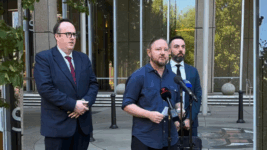
On the day following New South Wales police commissioner Mal Lanyon having extended the first ever blanket ban on so-called authorised protests in parts of Greater Sydney, three local social justice organisations lodged a legal challenge to the protest prohibition regime that was enacted on Christmas Eve 2025, as they claim the power to suspend the right to protest is a step too far.
Under the new “public assembly restriction declaration” or PARD regime, a protest ban was imposed across three NSW policing districts in Greater Sydney on 24 December 2025, which has now been extended until 20 January 2026, and could ultimately be renewed every 14 days until 24 March, as such prohibitions are capped at 90 days.
Representatives of the three plaintiffs – Palestine Action Group, Jews Against the Occupation ’48 and The Blak Cacus – appeared with their lawyers for a directions hearing in the NSW Supreme Court on Thursday, and Justice Julia Lonergan ordered that the case be adjourned until 29 January, so NSW Chief Justice Andrew Bell can determine whether a single judge or multiple should consider the case.
The plaintiffs, however, had been concerned that the matter be cleared up earlier this month, as the current initial two week extension to the blanket ban on authorised protests is already placing restrictions on a 16 January pro-Palestine rally, as well as an 18 January Aboriginal deaths in custody protest, while a further extension of the ban could impinge upon 26 January Invasion Day rallies.
In an opinion piece on 23 December, Australian constitutional lawyer Anne Twomey outlined that the new laws being rushed through parliament have come on the back of two other sets of hurriedly passed antiprotest laws since 2022, which have both subsequently been partially struck down following a court challenge as certain measures were found to be unconstitutional.
Challenging constitutional validity
“Not for the first time, Chris Minns has sought to exploit community fear, after the horrific Bondi attack, to launch an extreme erosion of our democratic rights and free speech in NSW,” said Palestine Action Group organiser Josh Lees out the front of the NSW Supreme Court, following the directions hearing on Thursday.
The Bondi Beach massacre occurred on 14 December 2025. It involved an ISIS-inspired father and son committing the mass murder of 15 civilians gathered at a Jewish Hanukkah event on Gadigal land, with the use of legally acquired weapons under the NSW firearms regime. The PARD framework was enacted into law just prior to Christmas, as a direct result of the attack.
“There is absolutely no basis to the preposterous claim that millions of people who have opposed and have marched against Israel’s genocide in Gaza can possibly be blamed for the Bondi attack,” continued Lees, who was flanked at the press conference by NSW Council for Civil Liberties president Timonthy Roberts and criminal defence lawyer Nick Hanna.
“This movement has been the most staunch opponent of all forms of racism, including antisemitism, and on top of that, of course, ISIS violently opposes the Palestinian cause and from what we know about these alleged gunman so far, it seems like they were radicalised several years before October 2023 and the mass movement that has erupted on our streets to save Gaza from genocide.”
In the wake of the Bondi Beach massacre, NSW premier Chris Minns insisted that the new antiprotest measures be enacted, as he asserted that the pro-Palestine/anti-Gaza genocide demonstration of the past 26 months had in some way provoked the mass killing at the iconic Australian site, despite the murderers ISIS affiliation casting a dark shadow over this conflation, as Lees pointed out.
Further, Lees and his legals are no strangers to the challenging of antiprotest laws that the Minns government has enacted on the fly, as they launched a Supreme Court challenge to a NSW police power to move on protesters near places of worship, which was another kneejerk legislating endeavour, and it resulted in the power being successfully struck down due to its unconstitutionality.
“There is equally no evidence for the preposterous claim that a blanket ban on all protests makes anyone safer,” Lees continued before the press on Thursday.
“How on Earth does an ISIS-inspired terrorist attack in Bondi lead, for example, from your grandma protesting about climate action in Katoomba? How on Earth do we get to banning workers protesting against cuts to workers compensation in this state? How do we get to banning protests against record levels of Aboriginal deaths in custody?”
The PARD regime
The protest ban that commenced on 25 December 2025 and will currently be reviewed for extension on 20 January 2026, is in place across three NSW policing areas, which include on Gadigal land in the NSW Police Central Metropolitan Region, as well as across Dharug land in the North West Region and on Dharawal, Dharug and Gundungurra land in the South West Region.
A protest that occurred on Gadigal land in the Sydney CBD last Sunday evening, 4 January 2026, to demonstrate against the US Trump administration’s illegal attacks on the nation of Venezuela clarified how the laws were operating.
NSW police is not approving Form 1s, which are documents seeking official approval of protests, while stationary assemblies can proceed but may be moved on.
The PARD regime was inserted into three pieces of NSW legislation on 24 December. A public assembly restriction declaration can be declared under new section 23B of the Terrorism (Police Powers) Act 2002 (NSW). The commissioner or a deputy can impose a PARD over the 14 days following an incident being declared terrorist-related, and it can remain in place for up to 90 days.
Top cops must review a PARD every 14 days to consider whether the conditions that warranted its imposition remain, which means they must be satisfied that “the holding of public assemblies in the area to which the declaration applies would be likely to cause a reasonable person to fear harassment, intimidation or violence, or for the person’s safety”, or that it risks community safety.
An imposed PARD then provides that, under section 27A of the Summary Offences Act 1988 (NSW), the Form 1 process, which allows protest organisers to submit notification of a rally to NSW police, and if law enforcement raises no objection to the event, it is then assumed to have been authorised, and therefore, regular summary offences relating to obstructing traffic don’t apply to protesters.
The last part of the PARD regime comprises of the move on power contained in new subsection 200(5) of the Law Enforcement (Powers and Responsibilities) Act 2002 (NSW), or the LEPRA, which provides officers with the capacity to move on demonstrators in an area where an active PARD is in place, which can apply to both motor and foot traffic.
When the PARD was imposed on 24 December 2025, the understanding was that a two week blanket ban was in place across the three policing districts, and it might be reimposed again after the two week period ended. Yet, when the police commissioner announced the prohibition would continue for another two weeks, it sounded like a ban is in place until March but it may be removed earlier.
Tensions set to rise
“The police commissioner should never have been given these powers and has demonstrated he does not have the restraint to keep them,” said NSW Council for Civil Liberties president Timothy Roberts on Tuesday following reimposition. “The prohibition declaration has a chilling effect on the community, who should not have to fear police intervention when they wish to assemble.”
“It is not the place of the unelected NSW police commissioner to make this call, it is a matter for the community to decide,” the respected lawyer added. “In using and extending the power, the NSW police commissioner suppresses the community’s freedom to assemble and politically communicate. This is an infringement on the people of NSW’s ability to engage in democracy.”
Organiser of a First Nations deaths in custody rally slated to take place on Gadigal land in Sydney’s Hyde Park on 18 January 2026, Paul Silva told the ABC on Thursday that he has vowed that his demonstration, which was called prior to the enactment of the PARD system, will go ahead as scheduled, and he plans to see it march upon the CBD streets despite the prohibition being in place.
The Dunghutti man added that he considers it “quite disgusting” that the authorities have suggested the First Nations demonstration cannot march on Indigenous land next week.
“Minns’ undemocratic move came on the back of a very shameless politicisation of the Bondi attack by the right in this country,” Lees continued on Tuesday.
“This is a campaign that was launched by the wanted war criminal Benjamin Netanyahu himself and is now being carried on by the Liberal Party, the billionaires and the multi-millionaires of the Business Council of Australia and unfortunately, most of the media.”
Paul Gregoire

Receive all of our articles weekly
Related Articles
 NSW Government’s Blanket Protest Ban: A Massive Gifting Away of Our Basic Rights for Xmas
 The Ban on “Authorised” Protest and Suppression of Political Dissent Continues in NSW
 NSW Police Commissioner Bans Protests, Suppressing Fundamental Democratic Rights
 Proposed Temporary Ban on NSW Protests Is a Slippery Slope to Permanency
 Sydney Rallies Against Trump’s Imperial Assault on Venezuela, Despite Protest Ban
 NSW Government Considers Banning Protests Due to Cost, While Opposition Flags User Pays System