No Immutable Force: Anticop Founder Tom Raue on the Modern Police Force

Right now, there is a blanket ban on “authorised” protests across three policing districts covering much of Greater Sydney. New South Wales police commissioner Mal Lanyon confirmed on 6 January 2026, that the “public assembly restriction declaration” imposed on Christmas Eve 2025 would continue for another two weeks, and in fact, it’s in place until 24 March unless he revokes it.
The Minns government enacted the protest prohibition laws on 24 December. But legal experts argue that the right to protest can’t be extinguished, and therefore, it’s only the ability of the NSW Police Force to enforce the ban that permits it to be in place, and in this case, the civilians making up the ranks of the police are acting in the interests of the state and against the rights of the people.
According to founder of online education resource anticop Tom Raue, modern police forces were initially established by ruling elites in the United Kingdom in order to protect their wealth against a rising and empowered working class. The first example of a modern police force is the London Metropolitan Police, which was created in 1829.
The NSW Police Force was established, via the Police Regulation Act 1862 (NSW), which ensured that preexisting law enforcement bodies, such as the NSW Mounted police, the Border police and the Native police, were amalgamated. While in June 2025, the agency had 15,887 active police officers, which makes it the largest law enforcement body on the continent.
The Murdoch press reported in March last year, however, that the NSW Police Force was continuing its ongoing trend of not being able to recruit enough civilians to fill its officer vacancies. At that point, the agency was 2,200 officers short of capacity, and the fear was that by now, the force would be 3,000 officers down.
To counter this depletion, the NSWPF last year launched the “You Should Be a Cop in Your Hometown” campaign, seeking new recruits in rural towns. Yet, anticop ran the “You Shouldn’t Be a Cop” countercampaign, which involved its members handing out flyers to prospective new officers out the front of NSW police recruitment offices.
As Raue explained last October, he considers there are reasons that NSW state law enforcement can’t recruit enough officers, and this includes that it’s “workplace is rife with bullying, sexual harassment and racism”. And another clear issue with the job is that NSW police officers are required to harass civilians with drug dogs and accompanying strip searches, which only serve to intimidate.
Sydney Criminal Lawyers spoke to anticop founder Tom Raue about how modern policing forces came into being, why he considers these law enforcement bodies may cease to exist one day, and the fact that many people these days simply assume that a functioning society must incorporate some sort of body to enforce the law.
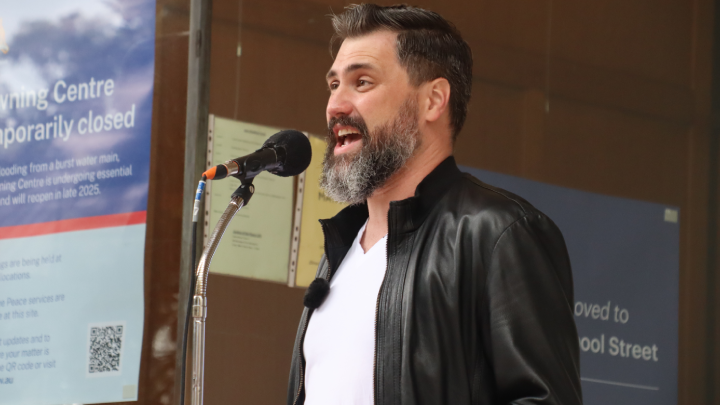
At the 11 December 2025 Watch the Cops rally at Sydney’s Downing Centre courthouse, you outlined that modern police forces are only about 200 years old. You pointed to the establishment of the London Metropolitan Police in 1829, as being the first example of one.
You further asserted that police forces were not established to protect the community as often understood.
So, Tom, why were modern police forces were created? And why were they established if it was not primarily to protect the people?
In England from the Middle Ages through to the Industrial Revolution, there was no standing police force. Unpaid constables could deputise militia when needed, and uprisings were put down by the military.
But largely the “policing” of antisocial behaviour was done informally by the community. There were no uniformed, professional police patrolling streets.
All that changed at the turn of the 19th century as three factors converged. First, the enclosure movement had kicked peasants off previously communal land. The peasants either converted to rent-paying farmers or left the countryside and settled in cities where they lived in poverty.
Secondly, the Industrial Revolution had begun, creating the workplaces and concentrated cities to utilise the cheap, abundant labour caused by enclosures.
And third, the French Revolution showed that radical political change was possible. The poverty and concentration of workers in the cities led to theft and violence, and workers also began to form unions and agitate for voting rights, which terrified the emerging capitalist elite.
To enforce the new class hierarchy, the government needed a large, professional armed body. Attempts to quell dissent with the military failed spectacularly, best demonstrated by the Peterloo Massacre in 1819.
Up to 50,000 workers gathered at St Peter’s Field in Manchester to demand electoral reform in the midst of artificially inflated food prices and poor working conditions.
Without a regular police force to disperse the gathering, local authorities relied on the army who were armed with swords, rifles with bayonets and cannons.
Cavalry charged the crowd leading to 18 deaths and hundreds of injuries. The public was outraged, and the press dubbed the massacre “Peterloo” to evoke the recent battle of Waterloo.
The London Metropolitan Police were established ten years later with the explicit aim of dealing with workers’ unrest more effectively.
Sir Robert Peel is considered to be the father of modern policing. He helped establish the London Metropolitan Police and at that time, he promoted his nine principles of policing.
These ethical principles conveyed the idea that police officers are friendly ‘bobbies’ out on the beat. Police officers are understood to be citizens seeking to protect the community, and they are doing so with community consent.
These Peelian principles still permeate ideas about policing today in Australia. What are your thoughts about this understanding of policing appearing at the same time as modern police forces?
The Peelian Principles were forced upon Peel due to widespread opposition to the police. When he first introduced the Metropolitan Police, they were rightly viewed as an occupying force.
In order to avoid this appearance, the police were dressed in blue instead of the military red and carried batons instead of swords and firearms.
The Peelian Principles broadly state that the police should start with persuasion rather than force, they shouldn’t usurp the judiciary, and they would police by “consent”.
But this was just a veneer of democracy – working class people didn’t have the right to vote when the police were instituted.
Notably, Peel didn’t introduce these principles when he established the Royal Irish Constabulary: an armed colonial police force that was halfway between an undisguised occupying army and the London Metropolitan Police.
While the Peelian Principles might seem better than naked oppression, they are mostly a fiction that disguises the true role of police. They were established to protect the elite and continue to do so.
They kill with near-impunity, and nobody is given the option to withdraw their “consent”.
The NSW Police Force was established in 1862. This involved the consolidation of the preexisting NSW Mounted police, the Native police and the Border police.
How would you describe the role of these earlier forces? Do their mandates still impact upon the policing of this state today?
The Mounted police are a good example because that unit of the current police boast about their 200 year history – clearly, they see continuity from 1825.
They were set up explicitly to fight Aboriginal people and drive them off their land. Initially, the Mounted police fought the Wiradjuri people near Bathurst, then the Gamilaraay and Wonnarua people in what’s now the Hunter Valley.
These campaigns included the murders of prominent Aboriginal leaders and massacres, such as Waterloo Creek, where up to 50 people died.
More broadly these early police forces were aimed at extending the colonial borders and maintaining the penal colony, including hunting down escaped convicts who had turned to bushranging.
The genocide of Aboriginal people is still ingrained in the NSW Police Force, even if it’s no longer explicit.
Aboriginal people are harassed and imprisoned at far higher rates than anybody else, and deaths in custody continue unabated.
In stating that the modern police force has only existed about 200 years, you further suggested that they, therefore, didn’t exist prior to that and will likely not always exist.
If you put ideas about a society without a police force to people living in NSW today, they often appear dumbfounded by the concept, as it does not appear to be possible that our society does not have armed policing patrolling it.
How can there be a time in the future without a law enforcement body when the idea now seems so ingrained in our society? How would it work without any police?
Capitalist institutions don’t give much airtime to police abolitionists, so it’s an unfamiliar idea for most people.
First of all, I wouldn’t suggest that we get rid of the police and leave the rest of society unchanged.
When you look at police history you can see how the institution evolved as a core part of capitalism.
People don’t accept massive wealth and power disparities without the threat of force. So, when I talk about abolishing the police, it’s part of a broader vision of a world beyond capitalism.
I understand that’s a big ask. But there are more moderate steps we can take in that direction. The data clearly shows that money spent on police and prisons does not effectively stop crime.
Measures that reduce inequality, like public education, housing, healthcare, and youth programs, are far more effective.
And of course, lots of “crimes” could be done away with entirely. Policing as a response to problematic drug use is an abject failure.
The police have never stopped anyone from using illicit drugs, but prohibition has made those drugs far more dangerous by handing manufacturing and distribution to gangs.
If we legalised and regulated drugs, money could be directed away from policing and into healthcare that is proven to actually save lives.
All positive social movements that threaten power are opposed by the police force. That started with unions and voting rights for the working class, and it continues today with the movements against climate change and genocide in Palestine.
The less power police have, the more chance we have of achieving a sustainable, free and equal society.
So, if you’re not up for the complete abolition of police and capitalism that’s fine, but there are lots of measures we can take right now to reduce the scope of policing which will improve lives.
So, in considering that modern police forces don’t need to exist, do you think institutions like the NSW Police Force understand this possibility? Do you think law enforcement institutions operate in a manner to reinforce their necessity?
I doubt there is a single NSW police officer who believes modern police forces may not exist someday. The necessity of the job is built into their ideology. But if they study history, they would know that nothing is static.
The police will never advocate for their abolition. In fact, these institutions constantly push for their expansion with higher budgets, more power and more cops.
The United States provides a good example. Police have demanded and received military equipment and increasing budgets even after the Black Lives Matter uprisings.
ICE was only formed in 2003, but now they are occupying whole cities, terrorising immigrants and murdering people like Renee Good in the street.
The police expand like a cancer unless we directly resist them.
And lastly, Tom, in the immediate wake of the horrific Bondi Beach massacre, raising ideas about law enforcement not being necessitated is almost tantamount to sacrilege.
How do you explain that the concept of a society that has abolished the police still pertains in the face of such violent incidents? How can we prevent such tragedies without a police force?
The attack in Bondi was a horrible tragedy. While I’m against the police generally, I certainly can’t fault officers for putting themselves in danger trying to stop a massacre.
Of course, it wasn’t only police officers who stopped the shooters – several victims and survivors who weren’t armed directly confronted the shooters and helped to stop more people being harmed.
While police officers responded admirably, we should be clear that the police didn’t prevent this tragedy.
Police can’t really prevent mass shootings – there will never be a cop on every corner looking out for a shooter, and I don’t think people would really want that anyway.
In a post-police society, you could still have an organisation that responds to things like mass shootings.
But that organisation should be democratically controlled by the community, and there’s no need for that organisation to also have broader arrest powers, for them to be putting down protests and enforcing capitalists class relations. They don’t need to be policed.
The political response to the shooting however, highlights the more common purpose of the police – repressing dissent.
The attackers were inspired by ISIS, who have nothing to do with the Palestinian struggle – and in fact, ISIS actively dismisses the Palestinian struggle.
But Chris Minns immediately blamed peaceful antigenocide protestors for the killings in Bondi. It’s a bizarre and false smear that is now being used to give the police more powers to shut down protests and potentially, ban phrases opposing the genocide, including banning Arabic words.
This is what the police do on a daily basis – protect the state and stifle dissent to an ongoing genocide.
The ruling class will use whatever opportunity they can to tighten their hold on power, including something as ghoulish as exploiting a mass killing.
So, while we should acknowledge the role police have played in responding to mass shootings once every few decades, we should also recognise their role in facilitating arms exports to the Israeli military who kill dozens of Palestinians daily.

Paul Gregoire

Receive all of our articles weekly
Related Articles
 AntiCop on Why Young People Should Not Consider a Career in the NSW Police Force
 Are the Boys in Blue Really There to Protect You?
 Who do you call when you need help? The police apologist’s mantra
 The NSW Mounted Police Has Turned Two Hundred Years Old
 Thugs in Blue Uniforms: Raptor Squad Raid Party, Assault Students and Trash House
 Police Brutality Escalates Under the Cover of COVID