Protesters Be Wary: The NSW Premier Is Launching a 24/7 Police State with Rifles
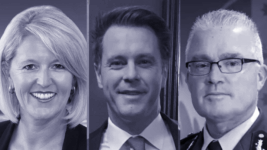
Following the state-sanctioned New South Wales police attack on pro-Palestinian protesters rallying against the official visit of Israeli president Isaac Herzog on 9 February 2026, NSW premier Chris Minns announced on 26 February the establishment of a new 250 officer 24/7 rapid response unit, designed to respond to apparently spiking hate crimes and the December 2025 Bondi massacre.
Announced on 26 February 2026, the new ‘Armed Response Command’ is an “intelligence-led unit” that will patrol “high-risk areas, places of worship, major events and mass gatherings”, including protests and sporting events. And implicit in this is the conflation NSW premier Chris Minns made in casually linking the Bondi terrorism incident with the long-term ongoing protests against the Gaza genocide.
“There will be a 24/7 presence across the metropolitan area with long arms capability. Something that has never happened before,” said NSW police commissioner Mal Lanyon, who has become a permanent fixture at NSW press conferences over recent months. “What we saw on the 14 December cannot happen again.”
The new unit is being formed out of Operation Shelter, which launched in October 2023, following the October 7 Hamas attacks and the outbreak of the Gaza genocide. Shelter aimed at combatting antisemitism and hate crimes. The enactment of new hate laws in early 2025 were predicated upon more than 700 antisemitic incidents reported to Shelter, yet broader scrutiny revealed only 367.
Wednesday’s announcement doesn’t just mark the simple establishment of an extra permanent NSW police unit, but rather, it reveals a drastic shift to high profile proactive policing in public places by officers equipped with rifles. And underpinning all of this is the ongoing attempt to cancel civil society protest, outcry and mere mention of apartheid Israel’s ongoing mass murder mission in Gaza.
Proactive policing
The 24/7 Armed Response Command will take 18 months to fully roll out, at a currently undisclosed cost to NSW taxpayers. The unit will include specially decked out rapid-response vehicles with long arm rifle storage holders. These changes have been informed with input from senior NSW Police Force staff, who travelled to Germany and the UK in January to consider their emergency systems.
A NSW government press release notes that the reforms will build upon preexisting measures to “improve community safety and protect social cohesion”, via recent gun control laws, bans on terror symbols and hate crime offences, along with the new public assembly restriction declaration (PARD) regime, or the capability to blanket ban protests for up to 90 days after declared terrorism incidents.
NSW police minister Yasmin Catley told the press on Wednesday that the number of multicultural liaison officers that state law enforcement already possesses will be doubled with an additional 30 MCLOs, or people from non-English-speaking backgrounds deployed to their own communities to be the eyes and ears on the ground of NSW police to curb crime plotting in non-English languages.
“They are really important when we talk about social cohesion. These are the people that will assist police in letting us know what is happening on the ground in any multicultural community,” Catley said in respect of the multilingual civilian agents. “They already provide that vital information, and we lean on them a lot and [are] looking forward to bringing more into the police.”
The NSW police commissioner said the move is about a shift from reactive policing, or responding to crime, to proactive law enforcement, which tends towards predictive policing and future crime. State law enforcement has been incrementally moving towards proactive measures with drug dogs, strip searches and more recently wanding laws. So, now there will be ‘big boy’ guns on the beat as well.
Enforcing cohesion
“This announcement has explicitly and deliberately misconstrued the political expression through protest as dangerous and extremist, akin to vile mass murders and terrorist events,” said NSW Greens MLC Sue Higginson.
“The premier has got to quit this. Chris Minns is making a habit of deploying state violence against political opponents and the community at large. This is dangerous to our democracy.”
“Creating dedicated police forces who will be rapidly deployed in the community with high calibre and rapid-fire weapons will not prevent people from engaging in protest, all it will do is put everyone at far greater risk of violence, harm and death,” the Greens justice spokesperson continued in a 25 February statement.
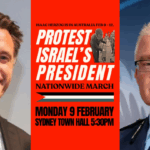
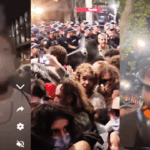
Higginson further recalled the 9 February Herzog protest rally that happened on Gadigal land before Sydney Town Hall. Minns, Catley and Lanyon all warned pro-Palestinian protesters not to attempt to march in breach of a PARD ban that was in place. Then, when 20,000 protesters sought to march on the night, 3,000 NSW police officers kettled in, assaulted, attacked and pepper-sprayed the crowd.
The senior ministers and the top cop then justified the violence in its wake. This occurred on the back of premier Minns having long been demonising pro-Palestinian protesters in the press, and after he’d suggested that their rallies had been “unleashing forces” that directly contributed to the Bondi Beach massacre. So, the NSW police brutality was unleashed upon a long-term foe of the premier and state.
“Seeking to arrest your way to some twisted vision of social cohesion is frankly fascist,” Higginson made certain on Wednesday, “and yet this NSW Labor government seems determined to take every bad step when it comes to caring for and healing our communities.”
Securing social division
Since late 2023, the NSW premier and his Labor government have been professing increasing concerns about social cohesion. Minns has repeatedly implied that social cohesion does not come easy to the state he presides over because it is multicultural in makeup, and therefore, our state doesn’t have the same free speech protections as in the United States.
These remarks have been repeatedly made in respect of mounting antiprotest and hate crime laws, commencing in February 2025, which have been incrementally chipping away at our rights to political expression. And in this rush to ensure that social cohesion is maintained, the leadership in this state has become increasingly authoritarian in its stance and legislating prowess.
Maintaining social cohesion in multicultural, multifaith NSW appears to have been on Minns’ mind from the moment he took the top office, as one of his first initiatives was the rollout of the NSW Faith Council, which seeks to bring state faith leaders together in order to promote cohesion between the faiths and to engage faith leaders in assisting in policy- and law-making.
Official considerations that there are issues with the multicultural nature of this state and there is a need to limit free speech in relation to that were not concerns in the years prior to the election of the Minns government, and yet now, the state has been specifically drafting laws to protect one religion and has sanctioned police brutality against one group because of their political position.
And now, coming into its fourth year in office, the Minns government is rolling out a high visibility, heavily armed policing squad to monitor public events, including protests, in order to maintain its increasingly skewwhiff version of social cohesion.
Paul Gregoire

Receive all of our articles weekly
Related Articles
 NSW Protest Ban Extended for Genocidal Israeli President’s Visit
 NSW Police Liberally Deployed Potentially Lethal Pepper Spray at Herzog Rally
 Sydney Rallies Against Trump’s Imperial Assault on Venezuela, Despite Protest Ban
 NSW Authorities Presaged and Later Affirmed the Police Brutalisation of Pro-Palestinians
 NSW Police Commissioner Bans Protests, Suppressing Fundamental Democratic Rights
 The Ban on “Authorised” Protest and Suppression of Political Dissent Continues in NSW