Sydney Man Dies After Being Pepper Sprayed by Police
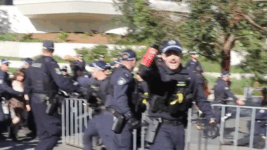
A man has died in hospital, after being sprayed in the face with OC (oleoresin capsicum) or pepper spray as New South Wales police officers attempted to arrest him in relation to a domestic violence callout. The 52-year-old man suffered a cardiac arrest at the scene that took place on Wangal land at a residence in the Sydney inner west suburb of Homebush at 8.30 am on Monday, 5 January 2026.
The man was treated by paramedics at the scene prior to being transported to Westmead Hospital, where he died at 8.30 pm that evening. A critical incident investigation has been launched, with Campbeltown Police Area Command leading the inquiries, which is being overseen by the NSW Law Enforcement Conduct Commission (the LECC).
“In terms of this particular incident, it’s very premature,” NSW police commissioner Mal Lanyon said on 6 January 2026 in response to a question about whether there is a direct link between the pepper spray and the death of the man. “The reason that we have a critical incident investigation is to look at that. There may well have been a medical condition that may have been exacerbated”.
“OC spray is a nonlethal option that police have, and it’s designed to make sure that we can police safely,” the top cop continued. “Tragically, a person has passed away. I think it’s fair that we allow the process to go through now, investigate that matter and allow the coroner oversight.”
Yet, Lanyon’s suggestion that OC spray is the only “nonlethal option” that NSW police has appears a questionable assertion prior to any assessment about the man’s cause of death, as applying the “crowd-control weapon” to a civilian’s face and triggering an underlying medical condition, namely a cardiac arrest, does seem to suggest that the ‘nonlethal’ descriptor is being misapplied.
On lethal nonlethal weapons
“Pepper spray is a chemical weapon, and we should treat it that way,” anticop spokesperson Tom Raue told Sydney Criminal Lawyers. “When pepper spray was first introduced, the police claimed it was an alternative to firearms which would reduce deaths. That was a lie. Police use pepper spray liberally to inflict pain, and as soon as there is real danger they pull their guns out.”
“In this case, the police commissioner admitted that the spray may have triggered an underlying medical condition, and in the next breath called the spray ‘nonlethal’,” the social justice advocate continued. “If you attack somebody with a chemical weapon that is especially lethal against people with a medical condition, the medical condition is not to blame for their death – you are.”
The NSW Police Force outlines that law enforcement agencies have been using pepper spray since the 1970s, while its own general duties officers have been trained in the use of the nonlethal or ‘crowd-control weapon’ since 1998, whilst since 2010, local police have used water-soluble and non-flammable pepper spray, which makes earlier versions sound that much more dangerous and toxic.
Raue raised a 2013 TED talk by academic Stephen Coleman, who outlined that when Queensland introduced the spray in 2000, an average of 6 people were shot dead by Australian police annually. Then in 2001 and 2002, QPS officers used pepper spray 2,226 times, which led Coleman to remark that officers likely wouldn’t have gunned down 2,226 people over that period.
Coleman added that in Queensland, authorities were clear that pepper spray was being introduced so that officers had an option between “shouting and shooting”. The academic further explained that pepper spray was being and is still routinely used “to deal with people who were violent, potentially violent and also, quite frequently, used to deal with people who were passively noncompliant”.
Sprayed directly into the face
The scenes involving Victoria police officers unleashing upon demonstrators protesting the October 2019 IMARC (International Mining and Resources Conference) with pepper spray stunned the nation, due to the liberal use of the nonlethal weapon on an unarmed crowd.
The outcome of a Victorian Supreme Court class action challenging the way in which VicPol officers were wielding the nonlethal weapon at the IMARC demonstration triumphed in December 2025, when it was found that officers, in twice pepper spraying lead plaintiff Jordan Brown in the face, were applying an unlawful use of force and further the act constituted the crime of battery.
“The batteries caused by physical injury to the plaintiff were a material contributor to the plaintiff’s psychological injury,” found Justice Claire Harris. The court further noted that the nonlethal weapon causes physical harm, such as extreme burning to skin, painful eye injuries, and it’s further known to cause breathing difficulties in those who have been sprayed.
However, ever since the September 2024 Disrupt Land Forces protests in Naarm-Melbourne, all the footage capturing demonstrations in that city reveal that the liberal use of pepper spray by VicPol officers has become the norm. At the Disrupt Land Forces protests, officers were simply running up to protesters and spraying them in the face for being present.
This same shift was further noted at the 4 November 2025 protest against the Indo Pacific Weapons Expo that was held on Gadigal land at Sydney’s International Convention Centre. Footage of that demonstration clearly showed NSW police officers applying pepper spray like it was mosquito repellent and directly into the faces of protesters, who then writhed about on the ground in pain.
Palestine Action Group spokesperson Josh Lees told SCL at the time that the “the severity of this weapon” should not be played down, as it “is basically a small-scale temporary torture device” that “inflicts extreme pain and blindness on people”. The activist was sprayed in the face himself that day, and he explained that the pain gradually becomes more and more intense, as if it will never stop.
“The police unleashed buckets of the stuff on protesters. They were very trigger-happy cops… looking for any excuse to spray demonstrators without any justification,” Lees outlined. “People who were already on the ground were sprayed. People who were trying to fall back from police lines, as we were under attack, were sprayed. It was indiscriminately sprayed into whole crowds.”
Lees also pointed to the irony that whilst the demonstrators were protesting the deadly weapons of all shapes and sizes being spruiked at the weapons festival, the pepper spray that police were applying to protesters outside is actually banned internationally in the theatre of war. The use of OC spray in battle is prohibited under the 1993 Chemical Weapons Convention.
Lethal crowd control
As news broke regarding the death in custody of a Homebush man following the use of pepper spray, footage was going viral on social media relating to aggressive interactions between a number of NSW police officers and a couple of civilians that took place last Friday night out the front of the Metro on George Street in the Sydney CBD.
The incident was already underway when one of the civilian men walked straight at the police officer with his arms outstretched. The officer was then seen to first shove the man to the ground, but as the civilian made to rise to his feet again, the officer sprayed him directly in the face twice.
This Friday night incident out the front of a music venue, involving an officer deflecting an oncoming threat with pepper spray, becomes that much more sinister if the weapon being used can actually trigger underlying and life-threatening conditions. Indeed, if that is the case the liberal use of the spray on peaceful protesters at the Sydney weapons festival was a risk to community safety.
“The recent judgment in the IMARC case shows that the way Victorian police use pepper spray is out of step with community expectations and existing law. NSW police have the same attitude,” Raue added on Tuesday.
“The police have never used pepper spray judiciously, and they never will,” the anticop founder said in conclusion. “They should be disarmed so nobody else has to suffer or die.”
Main image: Screenshot of a NSW police officer with a pepper spray canister at the Indo Pacific Weapons Expo captured by Sydney photographer Iyngaranathan Selvaratnam

Paul Gregoire

Receive all of our articles weekly
Related Articles
 When Can Police Use Pepper Spray in New South Wales?
 Cops Gone Wild: NSW Police Officers Consistently Commit Brutality with Impunity
 “The Police Attacked Us”: Activist Josh Lees on Protesting the Indo Pacific Weapons Fest
 Critics Call High Time on NSW Police as First Responders, as Labor Contemplates Change
 NSW Police Officer in Unmarked Car Chases 12-Year-Old Gomeroi Boy on Foot
 Victoria’s Anti-Racist Protesters Condemn Police Violence Against Them