Thorpe Moves Motion Condemning Ongoing Founding Colonial Violence
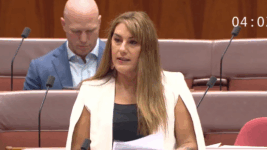
“All this silence matters and it is loud,” said Senator Lidia Thorpe, referring to the lack of attention given nationwide to an act of terrorism that occurred at a 26 January 2026 First Nations rally in Boorloo-Perth, which involved a 31-year-old white man hurling a potentially deadly homemade bomb into the crowd, and the device failed to go off.
“It sends a message that our lives are not valued, that our safety is not taken seriously,” the Gunnai, Gunditjmara and Djab Wurrung senator added in the chamber on the first sitting day of the year. The motion condemning the “potential mass casualty event” went on to pass unopposed.
The Boorloo attack was not the only recent high profile incident mirroring founding colonial violence, however, as in August 2025, a group of neo-Nazis raided and assaulted those present at First Nations sacred site Camp Sovereignty in Naarm-Melbourne, after the white supremacist attackers had been roaming the city’s CBD violently protesting immigration.
Thorpe’s motion too affirmed that federal parliament’s recent emergency sitting days held in January to pass a swag of hate crime laws, in response to the 4 December 2025 Bondi Beach massacre, were also “unambiguously… directed at First Peoples”. This provision reflected that the recent national focusing on curbing racial hatred has distinctly failed to do this.
But while the Boorloo and Camp Sovereignty incidents were heightened attacks that mirror founding colonial violence, more subtle forms of this brutality occur on an ongoing basis, which involves escalating Aboriginal deaths in custody, increasingly disparate Indigenous overincarceration and the excessive force that Australian police mete out to First Peoples on daily basis.
A prejudice ignored
In moving her motion on Tuesday, Thorpe had the chamber acknowledge that it hears First Peoples and believes them in recognising that the racism and hatred directed towards them “is real and rising”. And further the senator had her colleagues confirm that the recent and all-pervasive moves to stamp out racism should and do actually include her people.
In respect of the Boorloo attack, the senator further set out that the attempt to kill and maim First Peoples was “just the beginning of the harm” as the incident was then distinctly downplayed, and not approached as a hate crime or an act of terrorism, but rather the authorities appeared to lazily arrest the 31-year-old white man, while the media looked the other way.
Instead of grabbing headlines, news of the bomb incident did not break in the east of the continent until late on Tuesday, and it was only due to mounting outrage about the lack of urgency given to it over the next 48 hours that saw Western Australian police announce it was then being investigated as a potential terror incident on Wednesday evening.
All this is playing out as the government passed two emergency hate-curbing pieces of legislation titled “combatting antisemitism” last month, along with having just established a Royal Commission into antisemitism, and it is also implementing a nationwide combatting antisemitism plan. These measures are to stymie mounting prejudice against Jewish people during the ongoing Gaza genocide.
That the authorities are moving to stamp out racial hatred against minority groups is welcomed by all, but the issue is that the entire Australian state was founded on racial prejudice and violence towards the First Peoples of the continent. This violence continues, for the most part, unchecked and as Senator Thorpe points out, it is right now on the rise.
Ongoing settler colonial violence
One of the starkest forms of ongoing colonial violence against First Peoples is the crisis that is Aboriginal deaths in custody. Last year saw 33 First Nations people die in the custody of either Australian police or corrections, and this is the highest number since records started being recorded in 1979/80.
A 43-year-old First Nations man died in the custody of Western Australian police after being pepper sprayed and tasered on Marlinyu Ghoorlie land in the WA town of Kalgoorlie on Sunday. This marks one of five Aboriginal custody deaths that occurred in the first month of 2026. The incident too marks yet another death due to application of increasingly used pepper spray.
WA police have advised that officers had responded to reports that the man was carrying a knife and acting erratically at an intersection in South Kalgoorlie. Officers then located the man at a residence on President Street with a self-inflicted wound, and attending police explained that he kept acting aggressively, so they tasered, OC sprayed and restrained him.
This man’s death marks the fifth Aboriginal custody death already this year. Indeed, there have now been 622 Aboriginal deaths in custody, since the Royal Commission into the crisis handed down its final report on 15 April 1991, which included 339 recommendations. Yet there has been a lack of political will to implement these reforms ever since.
Aboriginal custody deaths are often caused by excessive force or neglect. However, only one police or corrections officer has ever been convicted in relation to one, and that involves a NSW police officer being convicted on a count of dangerous driving causing death last November, in respect of the death of Dunghutti teen Jai Kalani Wright.
Condemning racism consistently
Thorpe further outlined that the casual arrest and undercharging of the white man over the Boorloo incident were not the only issue, as there was broader violence committed to all First Peoples when the PM held no emergency press conference, the press did not pursue the incident, and the courts protected the assailant by suppressing his name.
The Gunnai, Gunditjmara and Djab Wurrung senator said that “racism and hate directed at First Peoples are real, rising and must be taken seriously”, and she pointed out that reactions to other events, including the Bondi Beach mass murder, have revealed the completely different approach Australia takes to ongoing attacks on First Peoples compared to non-Indigenous peoples.
The 3 February motion further acknowledged that First Peoples are continuing to “face entrenched racism, racially motivated hate and threats of violence, and that any instance of this is unacceptable”. Further, it “calls for governments to continue to take urgent action to address racism, discrimination, hate speech and violence against First Peoples”.
“Decisions were made in newsrooms, in ministerial offices, in the daily rhythms of power about whether this was urgent, whether it mattered, whether our lives mattered,” Thorpe said in moving her motion in the parliament last Tuesday.
“This motion is about bringing this country together. It’s about recognition and responsibility. It is about condemning hate and racism consistently, no matter who the victim is or what colour their skin is.”

Paul Gregoire

Receive all of our articles weekly
Related Articles
 Calling Out the Government’s Claim that Hate Group Laws Won’t Criminalise Criticism of Israel
 The New Federal Hate Group Laws: Further Empowering the Government to Silence Dissent
  Stamping Out Hate with Draconian Laws Is a Rush to the Bottom in Terms of Rights
 Federal Government’s Antisemitism Hate Bill Threatens to Further Erode Civil Liberties
 There is Broad Social and Political Agreement on the Need to Reform NSW Firearms Laws
 The Tricky New Laws Designed to Respond to Rising Neo-Nazism in New South Wales