Social Media Giants are Deleting Lifesaving Drug Warnings: Interview with AIVL’s Molly Howes
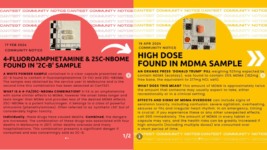
Social media companies, like Meta and TikTok, have been removing the drug warning alerts that local harm reduction organisations have been posting on their social media pages, despite the fact that these are warnings about bad batches of illicit substances, and engagement with a post that specifically warns people about identified toxic drug batches may prevent fatalities.
The Australian Injecting and Illicit Drug Users League (AIVL) alerted the public to this matter a fortnight ago. The actions taken by social media companies have included the removal of warnings about dangerous drugs circulating in the community, suspension of harm reduction organisations’ accounts and in one case, an administrator of an organisation’s page had her own account shutdown.
Community drug alert warnings are a relatively new harm reduction intervention for Australians. However, in Europe publics have been warned about potentially lethal batches of illicit substances in the community for decades. The posts simply display the drugs that have been found to be adverse and then warn people who use drugs not to take them. So, this is lifesaving information.
Harm reduction organisations, like AIVL, NUAA and Pill Testing Australia, have been posting these warnings on their social media pages for about five years now. But it only appears to be recently that the algorithms have started identifying these health warnings as promoting drug use, and the fact that companies running these platforms are American likely influences these interpretations.
Pioneering harm reduction
Being established in 1992 makes AIVL one of our longest running organisations focused on reforming drug laws and promoting the health and rights of people who use drugs in this nation. AIVL is also based in the Australian Capital Territory, which has of late introduced mobile and fixed location drug-checking services, and it’s also implemented decriminalisation or ended drug possession as a crime.
But to highlight how this nation’s attitudes to the illicit drug question have been trailing behind others, the Netherlands first introduced drug-checking services in 1992, and due to this initiative and the broader health practices and developments that follow on from it, the Dutch have been warning their citizens to stay away from specific batches of deadly drugs for around 30 years.
Sydney Criminal Lawyers spoke to AIVL director of operations and communications Molly Howes about what has actually been occurring in respect of posts warning people to stay away from certain drugs, the reasons why these messages are so important for the community, and the fact that the Australian government agrees that these warnings are of benefit nowadays.
Molly, when we were arranging this interview about the issue involving social media platforms removing the drug warning alerts that harm reduction organisations, like AIVL and Pill Testing Australia, post online, I mentioned that a decade ago, all the drug law reformists used to highlight these types of alerts in reference to pill testing, which have been used in Europe since the 1990s.
Back then, Dr David Caldicott, clinical lead at Pill Testing Australia, used to wax lyrical about the Drug Information and Monitoring System (DIMS) in the Netherlands, which is a massive 1990s established database about street drugs, that has been serving to assist in warning the public about bad batches of drugs being sold on the streets, amongst other things.
But now you’ve mentioned the fact that there is one of these systems now operating here in Australia. So, could you fill us in on how that’s come to be?
We have this early warning system in Australia now, which is run by the National Centre for Clinical Research on Emerging Drugs (NCCRED), and it’s known as the Prompt Response Network (PRN).
This Early Warning System (EWS) is run by all different types of organisations and people, including those working in emergency departments, people working on wastewater analysis and drug checking services.
AIVL is involved in NCCRED as a community representative, and we help chair and support that system.
What comes out of all of these organisations working together are these drug alerts. Drug alerts are the public-facing component of Australia’s early warning system, which serves a critical public health function.
The PRN was in planning since 2018. It became completely funded by the Commonwealth Department of Health, Disability and Aging in 2022, and it was publicly launched last year, in 2025.
NCCRED is federally endorsed, and all the state and territory health departments are part of it as well.
The PRN shares drug alerts generated by frontline service providers (like PTA and CanTEST), ensuring timely communication of emerging drug-related risks to the community.
These frontline service providers also share drug alerts to their communities, like the ones you’ve mentioned from NUAA.
Early Warning Systems are a recognised global public health tool, with similar systems operating internationally, like DIMS in the Netherlands.
So, this sort of operation is up and running in Australia. However, big tech appears to be intervening in the public drug alerts, so it’s now hit a bit of a glitch?
Yes. The drug alerts that you see on social media are the public-facing communication arm of this early warning system, but we are hitting this wall.
We have this amazing, well-functioning system, but the communications of it are being blocked in areas where the audience for this information actually is.
The drug alerts go up on different websites. They go up on the AIVL website. They go up on other community org websites. But on social media, that’s really where these drug alert warnings get the most traction.
So, having them taken down or removed from social media is obviously a big issue.
AIVL started speaking to the media a few weeks back about this problem with the social media platforms starting to intervene and remove these warnings about bad batches of drugs circulating in the community, which are supposed to allow people who use drugs to avoid them.
Can you give us a rundown about what has been happening, and who’s being affected?
This has happened over the last few months. Pill Testing Australia had content removed from Instagram and Facebook, and they’ve also been banned and reinstated multiple times on TikTok with no consistent reasons as to why this is occurring. CanTEST was also suspended from Instagram for a week.
We also partner and have a good relationship with Know Your Stuff NZ, which is a national drug-checking service in New Zealand.
They’ve had their Facebook page repeatedly taken down and then reinstated. Then the communication lead, who manages that Facebook page, had their personal account deleted. Obviously, that then makes it tricky, or in fact, impossible for her to do her job.
One of the takedowns from the Know Your Stuff NZ Facebook page followed a warning about high risk synthetic cathinones being sold as MDMA in New Zealand. And once that was taken down, it was appealed, but this was then ignored.
We have also noted that other drug harm reduction organisations in New Zealand have been affected as well.
The thing is the posts being flagged by Meta just include straightforward harm reduction advice to prevent overdose. For example, they can be about double strength MDMA that is going around and letting people know how to reduce their dosage, as well as how to stay safe if they are using MDMA.
There was another case where Pill Test Australia also had a warning taken down about strong MDMA and nitazenes, which were present in some drugs. Nitazenes are extremely strong synthetic opioids that are even more potent than fentanyl.
If people are unaware that nitazenes are in their drugs, it is a huge concern, because even a small amount can cause a fatal overdose.
Pill Testing Australia had these warnings up on their social media ahead of the Canberra Spilt Milk festival last December. The warnings were removed three days before the festival. They appealed the decision of Meta to reinstate the posts, but that was rejected.
You’ve touched on this already, but when these organisations are appealing to the social media platforms are they receiving adequate feedback?
No. What is occurring is there is no opportunity to appeal, or if there is, it still gets rejected at the end of that.
The recent reports in the media suggest that the posts are being removed from social media because they’re drug-related and this is even though they’re warning people not to take certain drugs. So, it appears they’re being misconstrued as encouraging the taking of drugs.
What are the companies conveying to these organisations about their posts being removed?
When you get a notice that something has been taken down, or you have been banned, normally, what you will receive is a message of what community guideline you have broken, and the guideline is usually around ‘promoting drug use’, yet none of these posts are doing that.
As I said, they’re letting people know about toxic supply and they’re offering harm reduction advice. None of it is promoting drug use. But what happens when these services spell that out to the social media companies in the appeal, they then continue to be rejected.
Pill Testing Australia operated the nation’s first drug-checking trial at the 2018 Groovin the Moo festival. The fixed site drug checking service, CanTEST has been operating in Canberra since mid-2022.
So, what sort of contribution would you say these harm reduction interventions have been providing to the community? And how do these services factor into the public health warnings currently under threat by big tech?
The drug checking services enable the production of the drug alerts and the drug information, which saves lives. So, this is the ultimate service to the community.
They save lives. They keep me safe. They keep us safe, and they keep our loved ones safe.
Australia has the most adulterated drug market that has ever existed. So, without a serious shift in policy towards the legalisation of drugs, so that they can be regulated, and a safe supply is ensured, this dangerous issue is set to increase.
The regulating of these drugs would be similar to how we approach alcohol and more recently, medicinal cannabis.
The drug alerts and the infrastructure around them, the PRN system, play a crucial role in public health and public safety.
So, we require the support of big tech to continue on with them, so we can reach the community where they’re at.
So, going back a decade ago, when the government wasn’t sponsoring a system that could save lives via alerting them to dangerous drug batches being sold on the streets, Australian governments were rejecting pill testing outright.
But as you say, the PRN, which was only officially released lately, has been developed over the same time that local governments were shifting their opinions on the value of permitting pill testing services being rolled out.
Definitely, and this is because part of the success of drug checking services is their ability to put out these drug alerts.
All of the drug-checking services are funded by the state governments. So, they are all endorsed, supported and funded by the government.
So, if the government permits a service to test just one pill at a festival that turns out to have the potential to be fatal, that just hasn’t saved one person’s life, but it has the potential to save heaps of people’s lives out there in the community?
Yes, that’s correct. They’re able to do the one-on-one connection, but because of these drug alerts, they can talk to whole states, and sometimes, it is even appropriate to share beyond state lines.
We’ve seen cases where one state has a drug alert, and community reports from another state involving pills that look similar, so they can then also share that warning among the community of the other state.
So, they have a massive impact across Australia.
You said that Australia has the most adulterated drug market its ever had right now. So, what does that entail?
We’ve seen things shift significantly over the last few years due to the introduction of more and more of these novel psychoactive substances (NSPs), which we haven’t seen before.
It’s now not uncommon for CanTEST or another drug checking service to test something and find a completely new substance that we have never seen in Australia before.
So, obviously, we don’t then always know what the risks of these new psychoactive substances are. We are seeing more and more of this, and things aren’t going to change until we establish a system that regulates drugs in the same way as we regulate alcohol and medicinal cannabis.
Then we would know what substances these products have and how much is safe to take. That would mean that something that someone buys in the ACT would be the same as what someone buys in Queensland.
As an aside, drug decriminalisation has been operating in the Australian Capital Territory since 28 October 2023. Since this was implemented, however, the rest of the nation has hardly heard anything about it.
So, how is the policy of drug decriminalisation going in Canberra? And what sort of impact has this had on the community of people who take drugs?
AIVL just realised a new short film on this subject called Experience Matters: Canberra’s Decriminalisation Journey, and we’ve also just made a podcast all about it as well.
But overarchingly, drug decriminalisation in the ACT has been all about supporting people who use drugs and not punishing them with criminalisation and offering people some health support, which they might want to take up.
This has also allowed police to put their resources where they are most needed, and it has freed them up to deal with community issues that the community really want them to be doing.
It is interesting that you say that you haven’t heard anything about it, and that’s because there is only really a good news story to tell there.
This is a quiet success story, which has been ticking along for the last couple of years, and it is doing really well. We hear from people about how it has reduced fear and discrimination that people are experiencing.
We also have heard from the police, which you can see in the film and the podcast, that it is increasing their understanding of and their compassion towards the ACT’s community of people who use drugs.
All of that contributes to people’s health and wellbeing.
But an evaluation of the ACT’s decriminalisation system is being done. It started last year, and it is being conducted by UNSW’s Drug Policy Modelling Program. But it is not public yet. It will be released soon. It will have a lot of figures relating to the scheme and it also involves lots of interviews with people with different perspectives and experiences.
So, you are saying that the implementation of drug decriminalisation has changed the attitudes of ACT policing towards the drug situation and harm reduction?
It definitely has. The way that they brought about decrim in the ACT involved a collaboration between the police and different community orgs. So, that work started at the beginning.
They explain in the film that police did stigma and discrimination training with CAHMA, who are part of CanTEST.
And lastly, Molly, AIVL has been in touch with the eSafety Commissioner about this issue of the removal of drug warnings from social media. So, what’s the next step for here in getting this issue sorted, according to AIVL?
It is ongoing. We have to engage with all the parties involved, especially the social media companies.
We need to have some productive conversations with those companies about the messaging to help them to better understand the nature of our work and to get their support.
Once those conversations are underway, and we are in dialogue, I am really optimistic about the outcome of that.
What is happening at the moment is that the social media organisations are flagging those warnings because they contain the names of drugs, and once they are able to understand why they contain the names of drugs and it is not to promote them, then I’m optimistic that we will be able to fix the algorithm.

Paul Gregoire
Receive all of our articles weekly
Related Articles
 Harm Reduction Coalition Aotearoa’s Dr Julian Buchanan on Legalising All Illicit Drugs
 Just Test the Damn Pills: Sydney Rallies in Support of Harm Reduction
 Rehab and Harm Reduction: An Interview with WHOS director Garth Popple
 2017 Drug Law Reform in Australia: An Interview with Harm Reduction Advocate Nick Wallis
 Australia Pioneered Drug Harm Reduction and Must Continue
 A Pioneer of Harm Reduction: An Interview with Dr Ingrid van Beek