Minns Condemns Court’s Overturning of His Unconstitutional Protest Ban with Flawed Logic
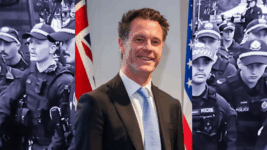
In the wake of the blanket ban on protest marches being struck down by the state’s highest court on 16 April 2026, New South Wales premier Chris Minns has doubled down on his refusal to accept the ruling on his rushed unconstitutional laws, and instead, he’s retorted that courts and lawyers have it easy, whilst on the ground, these laws actually allowed NSW police to keep the community safe.
The NSW Court of Appeal ruled that the public assembly restriction declaration or PARD law was unconstitutional, as it illegitimately stamped out all types of protest within a declared area in order to protect the entire constituency from certain political ideas, which illegitimately burdened the implied freedom of political communication in the Australian Constitution.
Minns predicated the law banning all street marches within a declared area on the 14 December 2025 Bondi massacre, despite no link between the mass murder and civil society demonstrations, and the violence he keeps referring to in reference to his PARD law now, is that which the NSW Police Force unleased upon 20,000 protesters rallying against Israeli president Isaac Herzog’s official visit.
Not only did 3,000-odd NSW police brutalise the large crowd gathered on Gadigal land before Sydney Town Hall on 9 February 2026, but the premier, the NSW police minister and the NSW police commissioner have refused to apologise for the mass bashing of civilians. And now, Minns is raising this as justification for his law, even though it had nothing to do with why it was struck down.
Right now, the premier is treating the public as unthinking as he posits these irrelevant excuses, because the law was struck down as it undermined democracy, according to the judges. And in critiquing this ruling, Minns is once more showing his contempt for the foundational principles that underpin our democracy, as he plainly considers that the executive’s position should be absolute.
Undermining the judiciary
“This idea that the only reason there were violent scenes on the night is because the protest declaration was in place, and it somehow spurred them into a violent confrontation – I mean, if you believe that, I’ll sell the clock on top of the Town Hall,” the Herald reported the premier as saying. “What a load of utter garbage.”
But the real rubbish on display is the chimera the premier is conjuring, as he asserts the courts were wrong in striking down the PARD law that passed on 24 December 2025, because he’s justifying it on violence that occurred six weeks later, which involved a mass of people stuck and unable to move due to his unconstitutional law, which then led police to bash up civilians for holding their ground.
Since NSW police brutalised part of the constiuency with a point of view the premier opposes, officers have dawn raided and arrested at least 17 protesters over the rally, seemingly in an effort to frame victims as assailants. Yet, this striking down of the law, has left a legal quagmire, because the police violence would not have occurred without an unconstitutional PARD being in place.
There were two main laws at play during the Herzog protest: one was the PARD law, which banned marches in Sydney’s CBD, while the other was the Major Events Act 2009 (NSW) that served to enhance police powers on the night and enlivened a number of crowd control offences. This latter law was invoked as the official visit of the Israeli president was deemed a major event.
Herzog’s visit was being protested by 20,000 locals because the United Nations had declared the Israeli president complicit in inciting the genociding of the entire Palestinian population of the Gaza Strip.
NSW police commissioner Mal Lanyon has said that the ongoing arrests are being reviewed in light of the ruling that the blanket banning of protests was unconstitutional, but he’s further explained that the criminal offences that activists have been charged with are contained in either the Major Events Act or the Crimes Act 1900 (NSW).
But neither the PARD nor the major events law stipulate that police can brutalise the public. So, as Lanyon ponders whether any arrests are illegitimate, the charging of these people in the wake of the event appears to serve to deflect from the excessive use of force by police, and none of this would have occurred without the imposition of the PARD, as the crowd would have simply marched on.
PARD quandaries identified in court
“Various participants in the assembly were pepper sprayed by police, twenty-seven people (including the first and third plaintiffs) were arrested and nine people were charged with offences,” explained the NSW Court of Appeal justices in their 16 April 2026 findings. “There is some ambiguity about the powers that were exercised by NSW police in dispersing the crowd on that occasion.”
The court also heard that the first plaintiff, Blak Caucus member Elizabeth Jarrett, and the third plaintiff Paul Silva, also of the Blak Caucus, were both touched by officers and arrested at the protest. The police did this in respect of a law only enlivened due to the PARD. And while they weren’t charged, there are concerns that they might be along with others still being raided after the fact.
The three justice bench then explained that whether the potential arrests would be in breach of the law could not be ascertained by the court as the authorities state “that constitutional issues ought not be decided unless there is a state of facts which makes it necessary to decide those issues”.
The court also cited an earlier January 2026 protest that took place in Hyde Park while the PARD was too in place, as there appeared to be the potential to argue that an assault had taken place involving the second plaintiff, Palestine Action Group’s Josh Lees, as police had prevented him from moving across the park, which wouldn’t have happened without the PARD.
Trumpian logic
Minns’ key comment on Monday involved him positing that the idea that the “protest declaration” being in place “was the only reason there were violent scenes” was a ridiculous suggestion. And he further ridiculed the idea that the PARD being in place had “somehow spurred them into violent confrontation”.
But the logic of these soundbites doesn’t stand up to what thousands of regular constituents bore witness too on the night, as they experienced an hourlong peaceful rally opposing a two-year-long mass slaughter of our fellow human being, and if the PARD had not been in place, then it would not have prevented them from peacefully marching on to NSW parliament as they’d sought to do.
When the premier refers to “them” being “spurred… into violent confrontation”, he appears to mean the protesters. But the demonstrators weren’t seeking the confrontation, as they simply wanted to march.
But if Minns had, however, stated that the police had been “spurred… into violent confrontation” because of an unconstitutional law, then he would have been spot on, because that’s what the mass of constituents on the ground experienced.
On Tuesday morning, Greens Senator David Shoebridge summed up the entire scenario regarding Minns’ public rejection of the court’s findings succinctly, when he wrote that it’s “funny how the law-and-order guys never think it applies to them. He’s again blaming the courts, the protesters and those attacked by police all for his appalling and illegal attempts to ban dissent.”
Paul Gregoire

Receive all of our articles weekly
Related Articles
 NSW Police Commissioner Bans Protests, Suppressing Fundamental Democratic Rights
 The Ban on “Authorised” Protest and Suppression of Political Dissent Continues in NSW
 NSW Government’s Blanket Protest Ban: A Massive Gifting Away of Our Basic Rights for Xmas
 “A Blunt Tool”: NSW Court Quashes Government’s Blanket Ban on Protest Marches
 NSW Protest Ban Extended for Genocidal Israeli President’s Visit
 The Blanket Ban on Protests in NSW Has Been Lifted, But the Damage Has Been Done