Police Thuggery Is the New Blue in Ever-Creeping Authoritarian Australia
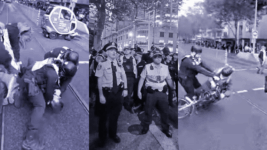
A social media frenzy erupted on the afternoon of Sunday, 10 May 2026, when footage emerged of a Victoria police officer forcefully pushing over an elderly protester on a bike and moving in on top of him, and when another younger demonstrator ran in to assist the older man, the officer and another held him down and punched him in the face several times.
And in coming across the viral footage, Sydneysiders who’d participated in the anti-Herzog protest were momentarily retraumatised.
Victoria police has been going hard on antiwar and antigenocide protesters in Naarm-Melbourne since around the time of the September 2024 Disrupt Land Forces protests, but footage usually shows heavily uniformed riot police pepper spraying, throwing flashbang grenades at protesters and even firing rubber bullets, and all this is normal police procedure in Victoria in the mid-2020s.
But the 10 May 2026 incident involved an officer pushing an old guy off his bike and as he moved in to deal with the old man in manner that suggested the 79-year-old was about to cop one, a young man in his 20s pushed the officer to protect the elder man, and he was then thrown to the ground and the officer and another held him down, and the first cop laid in about three punches to his face.
This holding down of civilians and punching them was seen on a large scale at the 9 February 2026 protest of the official visit of Israeli president Isaac Herzog, which was held on Gadigal land before Sydney Town Hall.
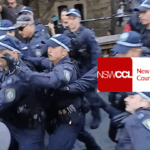
New South Wales police officers on that occasion punched on with civilians and held them down as they did. Officers manhandled protesters en masse in a manner that resembled street brawling, and not law enforcement, which has its limitations.
This police thuggery is fast becoming the new blue, however, when it comes to loud and disruptive but nonviolent protests. The mass brutalisation at the Sydney protest has repeatedly been confirmed as state-sanctioned excessive use of force. And in the current “nobody better criticise genocidal Israel” climate, cops bashing up protesters with the wrong opinion appears to be the norm.
Reasonable force
The police officer “came straight at me, pushed me to the ground and I think he was getting ready to punch me, when in fact, one of my comrades intervened,” the older man called Bob told the Green Left Weekly following the assault. “And the whole group of cops rushed over and grabbed my comrade and arrested him.”
“We should stop funding these uniformed thugs that we laughingly call police, and we should start funding NDIS properly,” the Socialist Alliance member continued. “This cop just went berserk. By the way, he was not wearing a body cam and nor did he have an identification pin on.”
The officer involved alleges that Bob spat at him and that the younger man tried to punch him. From the footage, any spitting cannot be verified or denied. But Bob says he’d approached the police to complain about a woman who was being arrested over having heckled a politician. And as for the younger man, the footage shows him pushing the officer off Bob and not attempting to punch him.
“Both the man and woman were taken from the scene, processed and released,” a Victoria police spokesperson said in a statement. “The man on the bike was not arrested and police are investigating.”
Section 462A of the Crimes Act 1958 (VIC) does allow a Victoria police officer to use “reasonable force” to prevent or stop an indictable offence. Spitting at a police officer is considered to be an assault on an emergency worker, which is an indictable offence that carries up to 5 years, under subsection 31(b) of the Crimes Act. This offence, however, can be tried summarily.
But reasonable force for a VicPol officer is not shoving a man off his bike and trying to punch him, even if he did attempt to spit on them. Reasonable force when an officer is dealing with unarmed protesters is not punching them, especially when they’re held down. And the post-arrest images of the young guy who saved Bob reveal that “reasonable force” can certainly mess up one’s face.
The Protect Our NDIS Alliance had organised last Sunday’s rally, and it released a statement later that day, condemning the “arrests and the use of excessive police force following” the “peaceful Melbourne/Naarm rally against proposed cuts to disability supports”.
Use such force as is reasonably necessary
The NSW police has power to “use such force as is reasonably necessary”, as per section 230 of the Law Enforcement (Powers and Responsibilities) Act 2002 (NSW), when exercising a function contained in that legislation, which is also known as the LEPRA. And section 231 of the LEPRA provides that an officer can use such force as is reasonably necessary when arresting someone.
Yet, considering the enormous amount of footage online related to the police response to the 9 February anti-Herzog rally, one would be hard pressed to argue that there was anything reasonable or necessary about the force used. Yet, this excessive force on the part of NSW police officers was unleashed at the same time as a coordinated plan to disperse the protesters commenced.
Law enforcement had devised a plan to disperse the crowd, as a blanket ban on street marches was in place in the Sydney CBD. After the protesters held a stationary rally, they were blocked from marching to NSW parliament by police due to the ban. But when they stood their ground and sought to exercise their right to march, the police unleashed upon them.
However, the protest ban law has since been struck down by the courts as unconstitutional.
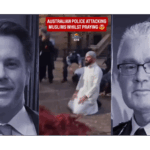
Incidents that went viral included multiple officers punching on a man in business attire, a young man held down by two officers whilst one delivered a barrage of kidney punches, an officer yanking at a scarf wrapped around a woman’s neck, Muslim men praying being picked off the ground and thrown back down into it and a member of parliament was punched in the face.
One older man had the skin of an elbow torn, whilst an older woman ended up in hospital with a fractured vertebrae after being pushed over. Much of the crowd was made to leave via George Street moving in the direction of Central Station, and police officers followed the civilians down the thoroughfare, pushing and shoving at them if they didn’t seem to be evacuating fast enough.
There were senior officers on duty that night, so if the excessive force had been of concern, orders could have been given to stop it straightaway. But rather than stop it, the excessive use of force was permitted to stroll down George from Town Hall to Central and apply itself whenever it fancied.
A similar incident happened on a much smaller scale when the first Mardi Gras parade, which was a protest march, took place on Gadigal land in 1978. The police officers bashed an array of LGBTIQA+ people because they were openly demonstrating their diverse sexualities. And this incident has hung over the city ever since as a notorious example of police brutality.
Those 78ers present at the anti-Herzog rally said that it reminded them of the same violence the NSW police applied to their protest march nearly half a century ago. However, the recent incident of mass police brutality was on a much greater scale and appears to have been not only because an illegitimate protest ban had been in place, but also, because the crowd were pro-Palestinians.
Nonlegislative expansion of police powers
The NSW police response to the anti-Herzog protest continues to shock and cause debate. This has recently been heightened by the NSW Supreme Court decision to strike down the protest ban because it impinged on the freedom of political communication in the Australian Constitution. But a key aspect as to why it continues to cause controversy is because it has since been justified.
NSW premier Chris Minns, NSW police minister Yasmin Catley and NSW police commissioner Mal Lanyon have repeatedly been called upon to apologise for the police violence by politicians and the press, but they’ve consistently refused to do so and have instead repeatedly confirmed that the NSW police officers did as they were asked to do that night.
As anticop’s Tom Raue told Sydney Criminal Lawyers a fortnight ago, the lack of an apology from the state for the violence and top ministers having deemed the excessive force applied by NSW police officers as their having acted in the manner in which they’d been asked to, effectively means that the threat remains that this sort of police brutality may be applied to the public again.
The NSW mounted police present at the anti-Herzog rally ran their horses directly into the crowd. But this is a practice has been going on since at least since the turn of the century, and while there is no law governing or permitting this crowd control measure, it appears to be understood that running horses into crowds is reasonable use of force simply because it’s been happening for so long.
Those at the Herzog protest were mortified by the unbridled use of pepper spray by police. Yet, this same level of shock wouldn’t have been replicated by at Melbourne rally, as officers in that state have been liberally spraying the liquid around as if it was mosquito repellent, at least going back the 2024 Disrupt Land Forces protest, so it now appears to be understood as reasonable use of force.
So, the dilemma that the NSW and Victorian constituencies are now currently facing is both NSW police and Victoria police have been using brawling tactics on civilians protesters of late, and if this continues on it may simply become understood as a reasonable use of force.
Indeed, if the official reaction to the unprecedented police violence unleashed upon the 9 February anti-Herzog protest by the NSW premier, the police minister and the police commissioner is anything to go by, the thuggish behaviour by the local cops that night was an expression of the reasonable use of force, and street fighting tactics may increasingly be employed at nonviolent protests.

Paul Gregoire

Receive all of our articles weekly
Related Articles
 Victim of Police Brutality Commences Legal Proceedings
 Police Brutality at Disrupt Land Forces Protests Goes Unchecked in Victoria
 Can’t Help Themselves: An Eyewitness Account of Police Brutality After the Black Lives Matter Rally
 “Actively Increasing the Divide”: NSWCCL’s Timothy Roberts on the Lack of Apology for Police Violence
 The State Set the Scene for Police Brutality: NSWCCL President Timothy Roberts on the Herzog Rally
 No Apologies: Threat of Police Violence Stands After Protest Ban Ruled Unconstitutional