Substantial Video Evidence Supports Assertion that Police Brutalised Anti-Herzog Protesters
Despite delays to the Law Enforcement Conduct Commission’s public hearings into Operation Makalu,the first hearing went ahead on the 19 October 2026. This inquiry is into the alleged misconduct of NSW police at the 9 February 2026 protest against Israeli president Isaac Herzog’s visit, and the hearings come after the NSW police commissioner had attempted to railroad them.
Before calling upon senior counsel assisting the LECC, Kirsten Edwards SC, to address the hearing, LECC chief commissioner Peter Johnson SC set out that the 29 September 2026 decision of the LECC to go forward with public hearings would be proceeding in terms of senior police officers, following civilian witnesses and low-ranking police officer testimonies taking place in private.
On taking the stand, Edwards outlined that the hearings would consider the “clear disagreement” that emerged when protesters who wished to march were refused by police. The lawyer noted that NSW police had anticipated this and the LECC will consider whether police planning was sufficient, if it communicated properly with the crowd and whether the subsequent police response was lawful.
Sydney Criminal Lawyers was aware that civilian witnesses were questioning why the September hearings were being delay. Yet, when the LECC released its decision to proceed and reasons for this on 8 October, it revealed that NSW police commissioner Mal Lanyon had contacted the LECC in early September demanding the hearings not take place, despite first being notified about them in March.
In delivering their opening remarks both Edwards and Johnson highlighted that the public had captured much evidentiary footage revealing the brutality on the night and indeed, the inquiry now has before it a sizable amount of these video clips. And tipping Lanyon off about the LECC’s “substantial body of material” last month may have been the reason he attempted to end hearings.
Footage capturing police brutality
“On the evening of Monday, 9 February 2026, a lawful protest was held at Sydney Town Hall jointly by the Palestine Action Group and Jews Against the Occupation ’48,” Edwards said as she embarked on detailing the parameters for the inquiry. “The protest was directed towards the visit to Sydney of Israeli president Isaac Herzog. Approximately 500 police officers were tasked to attend the protest.”
Edwards then set out that the extensive nature of the police brutality circulating online had led the LECC to establish its inquiry on 12 February. And right now, the watchdog has 400 official complaints before it, which are drawn from 800 reports, and it’s also conducted a review of over 1,000 pieces of footage captured by civilians, CCTV and NSW police body-worn cameras.
The senior lawyer made two further matters clear. The first is that Operation Makalu hearings are “not a corruption investigation”, so regular LECC inquiry procedures will not be involved. The second point was that the LECC has been approaching the inquiry in a manner that involves collaboration with the police commissioner, and that’s why he was able to view much of the footage beforehand.
“This is not an exercise in retrospective blame for its own sake,” Edwards told those present. “A central purpose of the commission’s examination is to ensure that any systemic issues are identified and for there to be lessons learned from the events of 9 February, so that peaceful protests may continue to occur in NSW.”
The lawyer further confirmed that widespread concerns have been raised about NSW police conduct on the night, which involved officers kettling people into a confined area with no exit, frequent use of OC spray, including upon those corralled and the vulnerable, officers pushing and shoving, police charging protesters in formation and the use of “gratuitous force” during arrests.
Before the inquiry
Prior to asking the senior counsel assisting the LECC to address the room, Johnson emphasised the extensive nature of the video evidence the watchdog has before it. He also set out the major themes of the inquiry, which comprise “the use of OC spray and documentation for use of OC spray, alleged excessive use of force by police officers and alleged improper use of arrest powers.”
“As I said earlier, the commission has received a large volume of complaints about the police response to the Town Hall protest. Not all of those complaints can be dealt with as part of the examinations which are about to commence,” the LECC chief continued. “The commission investigation into these complaints is ongoing and will continue in 2027.”
The initial hearings related to witness and low-ranking officers will take place over the next five to six weeks. The chief commissioner determined to shift these from public to private in his 29 September reasons, to protect witnesses and shield rookie officers from exposure. Then the questioning of senior commissioned officers will be held in public, which will also take up to six weeks.
Johnson SC added that a report about the hearings will be produced and released to the public following their completion, despite the inquiry continuing on in its investigation at that point. And he further explained that police officers are responsible for performing their duties and functions at protests and this should be done according to the law and in the interests of the entire community.
“The commission investigation can also serve the public interest by identifying lessons to be learned from the events of 9 February 2026 which may support the making of recommendations to improve policing practice concerning protests,” the LECC chief commissioner added. “This is especially important at a time when protests are a common and potentially increasing part of community life.”
Bashed and brutalised
SCL bore witness to the 9 February 2026 anti-Herzog rally on Gadigal land before Sydney Town Hall. Preventing protesters from marching was the since-struck-down PARD law that permitted bans on street marches in a declared zone following an act of terrorism. And after an hour of negotiations between organisers and senior police, the operation to disperse the crowd was unleashed.
The view from before Town Hall steps, which was not the only one, involved the mounted police riding horses into the crowd, followed by a line of officers emerging from behind the animals to again run into the protesters, pushing them backwards, and at that moment, the crowd realised that it had been kettled in from behind, so it couldn’t disperse and it was made to bear the brunt of the charges.
Officers punched on protesters. At times, multiple officers assaulted one civilian. The elderly and people with disabilities were fair game for the cops. Civilians were pushed back and over fixed street furniture. Others were wrestled to the ground. And the liberal use of pepper spray meant those who could not disperse simply copped the chemical weapon in the face.
The scene further involved a group of Muslim men praying in the far corner of the square at Sydney Town Hall, being set upon by multiple police officers who pulled them off the ground in mid-prayer and then tossed them back down into the concrete surface.
The state response in the wake of the widespread police violence that was witnessed in person or online has involved the NSW premier, the police minister and commissioner Lanyon all refusing to issue an apology for the likely illegal police violence and instead maintained that officers were simply following orders. Premier Minns even refused to apologise for the violence against the men praying.
These events further occurred as the premier has been waging a campaign of ongoing criticism and accusations of provocative behaviour against the sizable local Palestinian solidarity movement over the then two-year-long Gaza genocide. So, the police effectively beat upon the group of antigenocide demonstrators, of whom Minns had been and continues to demonise in the public sphere.
And whilst the NSW police watchdog has senior NSW police management breathing down its neck, if Operation Makalu doesn’t find that the NSW police officers did act in a manner beyond their powers on 9 February this year, then vast numbers in the community, who witnessed the police brutality firsthand or whilst scrolling online, are going to further lose faith in the NSW system.
“It is fair to say that members of the public have already watched some of the footage available online,” Edwards SC further set out on Monday, “and there have been questions raised in public forums about whether the conduct people have seen depicted online is endemic in the NSW Police Force or was in some way sanctioned or encouraged by senior officers on the night.”
“This is a question that the commission also intends to explore.”
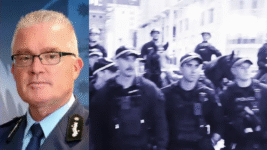
Image: Official photo of NSW police commissioner Mal Lanyon. NSW police officers by Paul Gregoire.
Paul Gregoire

Receive all of our articles weekly
Related Articles
 NSW Police Trapped and Brutalised Anti-Herzog Protesters, Report Confirms
 Leaked Footage Reveals NSW Police Intentionally Brutalised the Public at Herzog
 Police Watchdog Announces Top Cops Will Be Publicly Examined About Brutality at Herzog Protest
 NSW Police to Continue Raiding Herzog Protesters to Sully Police Watchdog Inquiry
 NSW Premier Ignores Civilian Evidence Regarding Police Brutality at Herzog Protest
 The State Set the Scene for Police Brutality: NSWCCL President Timothy Roberts on the Herzog Rally