Police Watchdog Announces Top Cops Will Be Publicly Examined About Brutality at Herzog Protest
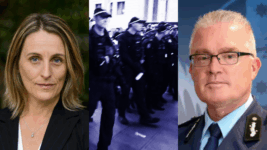
New South Wales police oversight body, the Law Enforcement Conduct Commission announced on Thursday, 8 February 2026, that its delayed public hearings into the NSW police use of excessive force upon a group of civilians protesting on Gadigal land in Sydney on 9 February 2026, or Operation Makalu, will be going ahead after the NSW police commissioner attempted to railroad them.
The police brutalisation of a mass of constituents protesting the official visit of Israeli president Isaac Herzog, during his nation’s ongoing commission of the Gaza genocide, was controversial because demonstrators witnessed attending officers suddenly flip the script from regular policing of the protest crowd to instantly apply coordinated and aggressive physical force upon the public.
LECC public hearings into NSW police inquiries are no anomaly. And they’ve occurred more than half a dozen times. But prior to commencement of the public hearings on 21 September 2026, the LECC announced on 15 September that the hearings would be delayed without any clear reasoning. And Sydney Criminal Lawyers had heard from witnesses who were distressed about this development.
The watchdog, however, then released the details behind the delay on Thursday, to reveal that the lawyers representing Lanyon had contacted the LECC just 12 days prior to the public hearings that were first announced in March about whether they were viable. The lawyers then provided a written submission positing their reasons, followed by taking part in a 23 September hearing on the issue.
And on Thursday, the LECC released a 63 page document detailing the reasons that LECC chief commissioner Peter Johnson SC has delivered, which have resulted in the rejection of Lanyon’s argument that the public hearings were not permissible based on the Law Enforcement Conduct Commission Act 2016 (NSW), and further, that the hearings risked undermining social cohesion.
The top cop’s argument
The LECC chief commissioner’s reasons set out that the watchdog wrote to Lanyon on 23 March 2026, informing him of the schedule of hearings and police solicitors responded on 19 May, to inform that they’d be representing the police commissioner “at public and private examinations”. The private examinations of eight particular officers then took place over 26 June to 2 July 2026.
The LECC then presented the solicitors with a “substantial body of material” that they’d be referring to on 7 September, ahead of the first public hearings. The watchdog was not required to do this, and then on 9 September, the LECC was first told that Lanyon was questioning the legitimacy of the public hearings, and the delay in raising this dispute was predicated upon the 7 September exchange.
Chief commissioner Johnson then pointed to the 23 April 2023 Operation Mantus decision on LECC public hearings that determined they can be held in response to systemic policing issues.
Lanyon subsequently put to the LECC that public hearing powers under the LECC Act should be contrasted with those found in the Independent Commission Against Corruption Act 1988 (NSW) (the ICAC Act) and accordingly, be considered more limited and confined.
Further concerns progressed by Lanyon involved that those subjected to public hearings being allowed to undergo private sessions first, that holding public hearings midway through such an inquiry is “unconventional”, and that section 63 of the LECC Act provides that private hearings should be the default, unless the LECC considers it “appropriate” that some witnesses testify in public.
The police solicitors further provided reasons why publicly examining certain top cops would be inappropriate. And they refuted that counsel assisting the LECC should be able to give a public statement at the head of the hearings.
Lanyon instead considered that the next step involved in the inquiry should be a private counsel assisting the LECC address, private questioning of witnesses and warnings for top cops of any public hearings. And the police commissioner further insisted that absolutely none of this should be livestreamed to the public.
LECC determination
In his 29 September 2026 delivered reasons, Johnson set out that the top cop’s arguments regarding examinations under division 3 of part 6 of the LECC Act, which can be held in circumstances of alleged “serious misconduct or serious maladministration”, and he refuted that the ICAC Act had any bearing on his own inquiries, and certain top cops will be examined in forthcoming public hearings.
“The approach advanced by the commissioner of police does not sit comfortably with the proper and effective operation of investigatory powers, exercised flexibly, to advance the objects of the LECC Act in the discharge of the commission’s part 6 investigatory powers,” the LECC chief commissioner made certain, and added that such an approach would undermine the objects of the LECC Act.
In terms of the counsel assisting the LECC opening statement being publicly broadcast, this was found to be the correct procedure, as it serves to assist and inform the presiding commissioner, the police commissioner’s counsel and “any other persons listening” on the forthcoming proceedings.
Johnson then reconsidered whether public hearings are appropriate in the case of Operation Makalu. In its examinations, the inquiry will have to consider the violence at the event, the fact that the since-struck-down PARD law was in place, along with the provisions of the Major Events Act 2009 (NSW), along with two NSW Supreme Court cases examining the use of the PARD and Major Events laws.
“This is a volatile time in Australian history,” chief commissioner Johnson continued in his reasons. “The right to peaceful protest is a fundamental part of our democratic system. What is common to all protests in NSW is the role and responsibility of the NSWPF to perform their duties and functions concerning protests according to law and in the interests of the whole community.”
Ultimately because the serious police misconduct that occurred in public and has been the subject of much controversy, LECC chief commissioner Johnson found that the slated LECC hearings involving top officers should continue to take place in public, whilst further civilian witnesses and low-ranking police officer testimonies should be held private rather than in public due to their sensitive nature.
The LECC further confirmed on Thursday that the opening statement of counsel assisting the LECC will take place publicly on 19 October 2026, and a number of public examinations will then proceed over the five weeks following those remarks.
Attempting to conceal misconduct
“The police have known for more than six months that there would be public hearings into their conduct at Town Hall, but they waited until just 12 days before hearings were due to begin before trying to derail this critical transparency work by the independent police watchdog,” said NSW Greens MLC Sue Higginson, in an 8 October press release.
“This was an extraordinary attempt by the police to suppress the public examination of allegations of serious misconduct by uniformed police officers, and to prevent public scrutiny of the political decisions and command structures that led to police violence against protesters,” the lawmaker continued.
Higginson condemned the actions of Lanyon as a “public disgrace”, considering that the footage of the widespread police assault and brutalisation of the public was aired globally. She further confirmed that the LECC had also determined that the police commissioner’s tactics were an attempt to undermine the statutory powers governing the police watchdog in the LECC Act.
The Greens justice spokesperson further set out that whilst Lanyon had attempted to prevent the entire “opening address” and all witness testimonies from being held in public and being livestreamed, this was essentially an attempt from the state law enforcement agency to hide the details of what took place at the protest from the public.
“It is deeply disappointing that the outcome of this intervention is that the community members who allege they were assaulted by police will now give their evidence behind closed doors,” Higginson said in concluding.
“The decision means the people who experienced the violence will not have the same opportunity to publicly give their accounts as the senior police officers responsible for the operation.”
Image: Photo of Sue Higginson supplied. Official photo of NSW police commissioner Mal Lanyon. NSW police officers by Paul Gregoire
Paul Gregoire

Receive all of our articles weekly
Related Articles
 Recent Sydney Drug Sentencing Success Stories
 Do We Need New Technology Laws in NSW?
 NSW Police Officers Charged Over Shooting
 COVID-19 Powers: Police Need to Use Common Sense When Exercising Their Discretion
 “Cautiously Optimistic”: NSW Council for Civil Liberties Josh Pallas on Albanese
 National Anti-Corruption Commission Hearings Will Continue to Be Held in Secret