Nations Call on Citizens to Stockpile for War, Cyberattacks and Extreme Weather
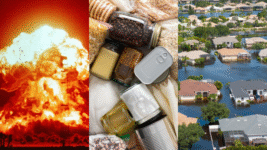
At least thirteen nations across the planet have recently issued directives to their publics, calling on households to stockpile goods in preparedness for emergencies or disasters that involve the collapse of supply chains or critical infrastructure. And such nations include the United Kingdom, France and Japan.
Most of these directives have involved nations advising their people to prepare for a period of up to 72 hours in which they can’t source the basics for life. Some countries, like Sweden, recommend stockpiling for up to a week. However, the much-cited figure online of 33 nations having recently issued such directives, includes governments who’ve had such initiatives in place for longer periods.
Many, on learning of these directives, assume that they’re in respect of the threat of war, especially with multiple military conflicts raging across the planet. Yet, in these directives, governments aren’t simply warning about the prospect of war, as potential terrorist incidents, as well as cyberattacks and ever-rising extreme weather events are further reasons to be loading up the pantry.
The United Kingdom launched its Be Ready campaign on 22 October 2026, which advises 72 hours, or 3 days, worth of supplies. Ireland did the same in August. French officials in Normandy called for 3 days of stockpiling on 27 October. Japan issued its residents with the similar advice on 2 November. And Public Safety Canada has reiterated its standing 72-hour stockpile advice, following the trend.
The BBC reports that the UK government is recommending the following goods be stockpiled in homes: nine litres of drinking water per person per day, extra water for cooking and washing, enough nonperishable food for three days, along with torches, batteries, blankets, sleeping bags, clothing, medicine, first aid items, hand sanitiser, wet wipes, soap, an FM radio and cash.
However, while much of the warnings are highlighting cyber assaults and extreme weather events, UK defence secretary Wes Streeting has implied that locals ought to be stockpiling due to the threat of state-sponsored terrorism coming out of Russia, and he’s further warned that the public should be ready to go to war against Moscow within the next 1,000 days.
Stockpiling for pending war
In Europe, preparedness for potential geopolitical conflicts, cybersecurity risks and extreme weather have been underway for longer. The European Union established the Preparedness Union Strategy in March 2025. And this involves European households stockpiling for 72 hours, as well as building closer ties between civilian and military authorities and ensuring governments are on the ready.
Sweden has a history of whole-of-society preparedness going back to the Cold War. So, from 1943 to 1991, it distributed survival booklets, with stockpiling recommended. This recommenced in 2018, and a 2024 reissue, highlighted preparedness for war, along with a need for a week’s worth of stockpiling. And Norway too, when it issued its directive last month, called for seven days’ worth.
US secretary of war Pete Hegseth unveiled FORTRESS in September this year. This is an initiative to have US bases stockpiling all things needed to operate for up to three months, for scenarios like the grid going down or supply chains being cut. The beleaguered secretary outlined that this was needed because modern warfare increasingly involves cyberattacks, long-range missiles and sabotage.
In terms of cyberthreats, hacks on companies that involve sensitive data are now common, while the threats to electricity grids or water supplies are of increasing concern. However, of late, high profile cyber incidents have involved attacks on freezers and fridges across retail outlets in Europe, which have seen the temperature being turned up high to destroy millions of dollars’ worth of food.
And rising military threats are also of concern. US president Donald Trump has repeatedly warned that he’s going to strike Iran again, and after his defeat at the midterms, the fear is this might be a nuclear strike, while Russian grey zone warfare operations are spreading across Europe, with long-term fears that the war in Ukraine might spread across Europe only escalating.
Stockpiling down under
The Australian government has not issued any recent warning to its people about stockpiling for a disaster. However, all states and territories have created emergency preparedness initiatives that involve recommendations to constituents on how to prepare for emergencies. So, Queensland and the Northern Territory recommend stockpiling for three days with 10 litres of water per person.
The New South Wales government first issued The Preparing for an Emergency pamphlet in 2020, pre-COVID. The pamphlet online today is the March 2023 updated version. The NSW Health initiative recommends planning for 14 days without electricity or running water. And the pamphlet includes a checklist of recommended items for constituents to stockpile.
YouTuber Prepared Australia explains that if the electricity grid goes down, then eventually the water will stop running because it’s propelled by electric pumps. He further sets out that the first thing households should do if the power goes down is to fill as many containers with water as possible. And this popular survivalist channel is proof that many are thinking along such lines these days.
Politics and the climate are heating up
A 28 October 2026 Newsweek report is the source of the figure of 33 nations having issued stockpiling directives to their publics. But its list of 30-odd nations includes those that have issued warnings for longer periods. So, New Zealand and Australia are listed as nations that have issued directives about stockpiling, which is correct, however, this has not been of late.
The clearer picture is that around a dozen nations have warned their populations to heighten household preparedness for disasters, which includes the UK, Ireland, France, the Netherlands, Norway, Denmark, Sweden, Finland, Poland, Austria, Canada, Israel and Japan. And the EU again called on its people across its 27 member states to stockpile for 72 hours on 3 November 2026.
Given that the thirteen nations that have issued new stockpiling directives or have reiterated their standing orders to their publics over September and October 2026, are all allied nations to Australia, such news is likely to prick up the ears of Australian constituents.
And as for preparedness down under, this continent has long been warned about the coming war with China being foisted upon us by the US, whilst the 2019 Black Summer bushfires and subsequent mass flooding events along the eastern seaboard have left many wary of this summer’s super El Niño climate event, and there’s been a 20 percent rise in cyberattacks locally over the past year.
Image: The BADGER explosion on 18 April 1953 is in the public domain. Stockpiled goods and flood zone from Shutterstock

Paul Gregoire

Receive all of our articles weekly
Related Articles
 The Protection of Police Informants and Prison Inmates: New Information Surrounding the Death of Carl Williams
 Police Caught Planting Evidence
 When sending a ‘dick pic’ is not sexual harassment
 The Offence of Sexual Assault
 What Does ‘Beyond Reasonable Doubt’ Mean in the Criminal Law?
 Proceeds of Crime Laws Are Now Being Used to Target Climate Activists