Attempted Terrorism Attack at Boorloo-Perth First Nations Rally Deplorably Downplayed
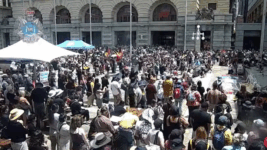
A 31-year-old white man threw a homemade bomb into a crowd of 2,500 people at a Boorloo-Perth Invasion Day protest on 26 January 2026. The authorities then labelled the incident a “potential mass casualty event”. However, the targeted attack against First Nations peoples and their allies was subsequently treated like a trifle matter, until public outcry resulted in a more serious approach.
Racial tensions were on high this 26 January, as antiimmigration/white nationalist March for Australia rallies were being held alongside regular Aboriginal protests, which mark the date the British commenced the violent invasion of this continent.
This act by the white man replicated the founding violence of the settler colonial nation, which goes in part to explain the lack of adequate action by the authorities.
This scenario has played out repeatedly over the past 27 months of the Gaza genocide and the local moral panic around antisemitism that’s accompanied it. Ongoing violence perpetrated against First Peoples has been downplayed while that against others has not been. The starkest example of this was the neo-Nazi attack on First Peoples site Camp Sovereignty in Naarm-Melbourne last August.
The Boorloo attack has all the hallmarks of a hate crime and a likely a terrorism offence, as a white man tossing a bomb at a First Nations protest on the controversial date, 26 January, was potentially politically motivated. This occurred during heightened tensions after the deadly 14 December 2025 Bondi Beach attack targeted Jewish people.
The news of the attack on a First Nations event involving a potentially deadly device didn’t break in the east of the continent until late on Tuesday, and after 48 hours of outcry, it was announced on Wednesday evening that the event is now being investigated as a potential terror incident, while the name of the suspect, who lives on Whadjuk land in the Perth suburb of Warwick, has been withheld.
“Potential mass casualty event”
The bomb incident occurred on Monday at 12.15 pm in Forrest Place on Whadjuk land in the Perth CBD. The man threw the bomb from the mezzanine area of the public square down into the Invasion Day crowd, when well-known Noongar elder Herbert Brophy was speaking on the stage. The police identified and caught the assailant, although the device itself was not located initially.
The explosive device consisted of a glass container filled with volatile chemicals, along with ball bearings and nails. Western Australian police consider that the man had attempted to light the fuse of the device, but this had failed to ignite the bomb. If it had exploded, the metal pieces within the device would have served to maim, and perhaps even kill, bystanders.
Prime Minister Anthony Albanese told a Garramilla-Darwin press conference on Tuesday that the authorities “should throw the book” at the suspect. However, following the PM’s theatrical passing of federal hate crime laws a fortnight ago, plus the determination to shutdown extremism post-Bondi, the charges laid against the currently remanded man don’t quite reflect the PM’s sentiment.
But after vocal public outcry about the disparities with which a targeted violent crime against First Nations people was being dealt with, it was announced on Wednesday evening that the Western Australian Joint Counter Terrorism Team is now investigating the matter as a potential terror attack. The JCTT is made up of WA police, along with officers from the AFP and ASIO.
Charges fail to reflect nature of crime
The individual who sought to maim and perhaps kill innocent strangers has been charged with two crimes.
The first count is unlawful act with intent to harm, under section 304 of the Western Australia Criminal Code Amendment Act 2004 (WA), which carries 2 years prison time and an $8,000 fine. The second is one count of making explosives in suspicious circumstances, contrary to section 557 of the Criminal Code Act Compilation Act 1903 (WA), which carries up to 3 years gaol and a $36,000 fine.
These crimes represent the alleged criminal actions of the man now in police custody, but they likely do not reflect the targeted nature or intent of the crime.
A hate crime is a criminal offence perpetrated against an individual or a group because of their identity. Producing a bomb and then attempting to explode it among a group of First Nations people and their allies, during an event representing the concerns of Indigenous peoples over past and ongoing violent and racist behaviour, suggests a hate crime, and such crimes carry steeper penalties.
Under Australian law, a terrorist act is an act designed to progress a political, religious or ideological cause. This is achieved via violence or the threat of it, so as to intimidate the public or government to act in a certain manner.
In terms of last Monday, 26 January First Nations actions currently have much greater support than a decade ago, and an action against such an event has been, and would certainly be if successful, perceived as an attempt to stymie this cause, which seeks to advance Aboriginal and Torres Strait Islander rights, sovereignty and self-determination.
Penalties for terrorism offences are much steeper than the criminal acts themselves, when there is no political, religious or ideological motivation behind them. Terrorism crimes also carry much harsher penalties than hate crimes.
“Not taken seriously”
“I just want to make a comment about the attempted bombing attack on Noongar Boodja Country otherwise known as Perth, on our day of mourning – on Invasion Day,” said Senator Lidia Thorpe over social media on Wednesday. “Clearly, this was an extreme act of violence, and luckily no one was hurt this time.”
“But politicians are silent. When there is an attack on us you don’t hear from the politicians,” the Gunnai, Gunditjmara and Djab Wurrung senator continued. “You hear a little couple of words coming out of the prime minister’s mouth, but nothing like what you see when there are attacks on other communities.”
Thorpe asserted there needs to be a thorough investigation of the policing, the motivations behind the attacks and the lacklustre response to it in general. She further suggested that there needs to be an approach to stamp out white supremacy in this country. Indeed, one interpretation that can be read of the attempted bomb attack is that it sought to maintain white supremacy.”
The 31 August 2025 attack on Camp Sovereignty in Naarm-Melbourne involved neo-Nazis unleashing violence upon people attending the sacred site. This was in the context of the assailants having just attended an antiimmigration rally, which aimed to uphold white supremacy right across this continent.
Despite this overt hate crime in a time of rising white nationalism, the nature of the crime was overlooked.
“We have a very big problem with racists and neo-Nazis, who are emboldened every time something is not investigated or taken seriously,” Thorpe made clear.
“Now, our lives do matter. Black lives do matter in this country. The government doesn’t think so. The politicians don’t think so. And it doesn’t seem the authorities think so.”
“If they did,” the independent senator added in finishing, “we would see action, like we’ve seen after Bondi. We would see action. So, why are our lives lesser than? We saw what happened at Camp Sovereignty and still that was not considered a hate crime.”
“So, we need to see this government do more to stamp out racism in this country and to develop a framework that ensures that these attacks and racism/white supremacy is not part of the fabric of this country.”

Paul Gregoire

Receive all of our articles weekly
Related Articles
 Extremists Treated Differently Based Upon Religion
 Sovereign Citizens and Other Far-Right Extremists Pose a Far Greater Threat Than Muslim Teens
 Right-Wing Extremists: The Real Terrorism Threat
- Police Should Target Sovereign Citizens and Other Right-Wing Extremists, Not Muslim Youths
 Failure to Label the Wieambilla Far Right Killings as Terrorism is Unacceptable
 Terrorist Act Against Pro-Palestinian Not Regarded as Terrorism at All