No Apologies: Threat of Police Violence Stands After Protest Ban Ruled Unconstitutional
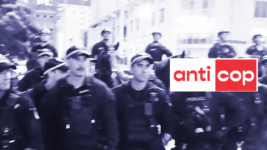
New South Wales premier Chris Minns’ blanket ban on street protests was struck down by the NSW Supreme Court on 16 April 2026. Such a prohibition being in place on 9 February this year, prevented 20,000-odd constituents from conducting a march on Gadigal land through the Sydney CBD. And as protesters stood their ground, 3,000 NSW police officers bashed them.
There has been no official state apology for the police brutalisation, even after the prohibition, or the public assembly restriction declaration or PARD law, has been struck down.
Sydney Criminal Lawyers has been banging on about this lack of an official apology for three months now, because, as anticop’s Tom Raue has concisely explained this week, no apology for an illegal and coordinated use of excessive force upon civilians from the state means the threat of more police violence remains, and as this still stands after the law was found illegitimate, it’s just belligerence.
For those who’ve been watching, the scenario is well known: Minns, NSW police minister Yasmin Catley and NSW police commissioner Mal Lanyon have repeatedly refused to apologise and have even confirmed that police did as they were told. But for those not paying attention, they’re yet to realise that police brutality is greenlighted in NSW at present given the right set of circumstances.
NSW Greens MPs have been on this from the start. Cate Faehrmann pointed out to Lanyon that he’d issued a non-apology, and he smirked as he admitted as much. Jenny Leong was expelled from the chamber for confronting Minns with community accounts of police brutality. And Sue Higginson put it to Catley that “sweeping antiprotest laws” had caused the police violence.
NSW police bashed and brutalised protesters gathered before Sydney Town Hall to protest the official state visit of Israeli president Isaac Herzog. The UN has charged him with complicity in genocide. This means the protesters were pro-Palestinians. And the other thing about this lack of an apology is the premier has made it very clear over the 31 months of the Gaza genocide that he despises this crowd.
Police brutality is “a blunt tool”
“The police at the Herzog rally knew the government had given them free rein to pepper spray and bash peaceful protestors,” said anticop spokesperson Tom Raue. “It’s disgraceful for the government to defend this mass state violence.”
“While the PARD prevented marching, it was still legal for people to attend a stationary protest in a public square,” he told SCL. “But the other purpose of the PARD and Major Events Act, which is still on the books, was to delegitimise protestors, give the public the impression that any protest was criminal and pave the way for police violence.”
The Minns government predicated the law on the 14 December 2025 Bondi Beach massacre. It provided the NSW police commissioner with the capacity to ban street marches in declared areas within Greater Sydney for up to 90 days, after an incident had been declared potentially an act of terrorism.
The link between a mass murder by followers of ISIS and nonviolent street protests, however, was a little murky, to say the least.
The three-justice bench of the NSW Supreme Court, which included NSW Chief Justice Andrew Bell, found that the PARD law was unconstitutional because it “impermissibly burdens the implied constitutional freedom of communication on government and political matters”. Their Honours further described it as a “blunt tool” that tried to shield the entire state from certain opinions.
If the PARD law had not been in place on the evening of 9 February, the anti-Herzog protesters would have marched from Town Hall to NSW parliament. And the crowd stood its ground seeking to exercise its constitutional right. Then, as Raue has noted, NSW police kettled in the crowd of protesters and set upon them with all manner of excessive force and the liberal use of pepper spray.
Criminalising the victims
Minns refused to look at the more than 100 community testimonies of the police brutality that constituents either suffered or witnessed that Greens MP Leong attempted to provide him with in parliament, and he instead announced that he would be waiting for the report from NSW police watchdog the Law Enforcement Conduct Commission after its completed its inquiry into the incident.
The bizarre aspect to this wait on the LECC report, which likely won’t paint a very pretty picture, is that, whilst the premier won’t even consider constituents’ eyewitness testimonies, the NSW Police Force, the institution widely accused of brutalising the public en masse, has been going around town and dawn raiding people who were part of the 9 February anti-Herzog protest.
These raids are serious too. Amongst the 17 arrested by 12 April, one woman had the police use a battering ram to enter her premises at dawn whilst she was still sleeping, then riot officers arrested her and took her down to the local copshop for charging. This “hardened criminal” is alleged to have thrown a water bottle at a police officer and threatened another officer not to touch her.
“The police commissioner has said that charges from the rally are under review in the wake of the PARD laws being struck down,” Raue further explained on Thursday. But that contrasts with the actions of his police force – harassing protesters and intimidating people who otherwise might come forward to provide evidence to the LECC’s investigation into police actions.”
“Ultimately, the charges stem from illegitimate protest restrictions, so they should all be thrown out,” underscored the anticop educator on all things law enforcement.
Icarus in flight
Following the court ruling that the PARD law was unconstitutional, premier Minns publicly rejected the ruling saying that judicial officers and lawyers have it easy, which seems to imply that in the heat of the moment post-Bondi massacre there was a necessary, yet illusive, reason to prevent street protests, whilst stationary rallies were okay in the same areas covered by the PARD.
“This idea that the only reason there were violent scenes on the night is because the protest declaration was in place, and it somehow spurred them into a violent confrontation – I mean, if you believe that, I’ll sell the clock on top of the Town Hall,” the premier put eloquently. “What a load of utter garbage.”
That moment when Minns made that comment could’ve been the point where the premier backed down and apologised for the unconstitutional law, but more so, to admit that it was wrong for the NSW police to have pushed and shoved, punched and tackled those who were gathered to raise issue with genocide, which is the mass killing of a particular people. But the premier didn’t do that.
Not apologising or conceding fault is a key tactic that US president Donald Trump uses. Critiquing the ruling, when the courts were actually striking down the second unconstitutional law that Minns has passed to prevent constituents from protesting within a six month period, is not only acting like a sore loser, but it undermines public trust in the judiciary.
A further matter involved in the police violence on the night of 9 February 2026, is that NSW police officers attacked a group of Muslims praying in the far end of the square next to Sydney Town Hall, and footage of this went viral. The NSW premier specifically refused to apologise for this as well. And this is creating a chasm between the local Muslim community and the NSW government.
“Chris Minns presents himself as a ‘law and order’ premier, but by flouting the constitution and making no apology for it, it’s clear he doesn’t really value the law,” Raue made certain.
“And he has overseen mass police violence and chaos on the streets, not order,” the anticop founder clarified in ending. “He is essentially saying that the police brutality will continue so long as he remains premier.”
Paul Gregoire

Receive all of our articles weekly
Related Articles
 No Immutable Force: Anticop Founder Tom Raue on the Modern Police Force
 Legal Challenge Launched Against Draconian Blanket Ban on Protests
 Minns Condemns Court’s Overturning of His Unconstitutional Protest Ban with Flawed Logic
 “A Blunt Tool”: NSW Court Quashes Government’s Blanket Ban on Protest Marches
 The Blanket Ban on Protests in NSW Has Been Lifted, But the Damage Has Been Done
 AntiCop on Why Young People Should Not Consider a Career in the NSW Police Force