NSW Police Commissioner Refuses to Apologise for Unprecedented Brutality
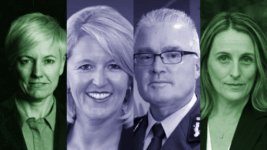
On addressing a 27 February 2026 NSW parliament budget estimates hearing, NSW Greens MLC Cate Faehrmann turned to NSW police commissioner Mal Lanyon to remind him that “a couple of days after the police incident at Sydney Town Hall, where the police ripped Muslim worshippers off their feet and one was thrown onto the ground”, he issued an apology, to which the top cop agreed.
“I issued an apology for any offence taken, Ms Faehrmann,” the commissioner clarified. Faehrmann said,” Yes, for any offence taken.” And she then asked, “Commissioner, do you know what a non-apology is?” Lanyon smirked, as he replied that he thought he did know what a non-apology was, but he was happy for the Greens member to explain, and his wry grin soon soured.
In an unprecedented move, the NSW Police Force unleashed 3,000 police officers onto a crowd of 20,000 NSW constituents on 9 February 2026, who were protesting the official visit of Israeli president Isaac Herzog. The NSW premier, the police minister and Lanyon had warned protesters not to gather on Gadigal land at Sydney Town Hall and especially, not to attempt to march on city streets.
The reason the police operation proved so divisive was when police determined that pro-Palestinian protesters did intend to march in breach of a prohibition, officers set upon them with their ‘gloves off’ and excessive use of force was liberally applied. Those in the crowd, who’d endured the police beating at the first Mardi Gras parade in 1978, recalled the same behaviour then on a smaller scale.
In the wake of this assault upon the citizenry, premier Chris Minns and police minister Yasmin Catley have refused to apologise for the police overreach, whilst Lanyon gave his non-apology.
And after close to a month on, NSW Greens MPs are the only ones pointing out that a lack of any adequate apology, means the excessive force has been justified, and it could be on the cards again.
Schooling those in power
On quizzing Lanyon on non-apologies, Faehrmann then produced a definition of a non-apology from the Merriam-Webster Dictionary, which outlines that it is “a disingenuous or insufficient apology” provided in the place of a real one. And when NSW Labor MLC Greg Donnelly countered that the Merriam is an American dictionary, the Greens member looked entirely unimpressed.
Faerhmann then put to the top cop that his saying that he was sorry for any offence taken by the community, in terms of NSW police officers wrenching kneeling and praying Muslim people off the ground to throw them back down upon it, was no apology at all. She insisted that apologising directly for the police assault on Muslim worshippers would be more appropriate.
Lanyon then raised the context he spoke in. “The context was that I was apologising for any offence taken to the actions of police as it was deemed to be aimed at a religious practice,” he explained. “However, it was put in the context because what I actually said in addition to that was the police were operating in a very dynamic operational environment and had issued move on directions.”
On the top cop insisting that his non-apology was kosher in the context, Faehrmann then turned to police minister Catley, querying whether she might issue a true apology. But the minister responded that while she is “really sorry” for people who attended thinking it would be a “peaceful protest” that then turned into a “riot”. However, this too appears to be a bit of a non-apology as well.
Faehrmann then suggested to Catley that perhaps she should have “brought down some definitions of ‘gaslighting’ as well”, for the budget estimates hearing.
Letting the overreach slide
The scenes of the NSW police assault upon the pro-Palestinian crowd demonstrating against Herzog shocked the nation, as officers rumbled, punched and bashed civilians seeking to march on city streets nonviolently. The new PARD law having been triggered meant that there was a prohibition on street protests at the time, so instead of protecting the public, officers beat them.
This conveyed to the public more broadly that pro-Palestinian/antigenocide campaigners are bad or criminalised people. The official message displayed to watchers at home was the NSW government and its law enforcement arm consider people gathering with these views worthy of mistreatment. And this is only a step away from others taking matters into their own hands.
After receiving permission for some Muslim people to pray in the square beside Town Hall, some officers attacked them, as well as an onlooking Greens MP. The scenes of the incident across all media platforms showed law enforcement violently ripping Muslims praying off the ground and pushing them around. This display reflected the messaging, ‘It is okay to harm Muslims at worship’.
These actions being broadcast across the nation reveal the authorities beating on followers of Islam, at a point in time when anti-Muslim sentiment is spiking in the community, which is being fuelled in part by a grassroots white nationalist/antiimmigration movement in this country, which has centred on Muslim immigrants as a prominent target.
Without an official apology, this has all been sanctioned by the state. The premier, police minister and the police commissioner have all balked at the suggestion of an apology for the overall police operation, and too, to say sorry for the attack on Muslim worshippers, unless you take into account Lanyon’s purposefully placed non-apology.
And no apology forthcoming also threatens a repeat of this behaviour, which could be felt when Pride in Protest members gathered in Hyde Park South last Saturday night, after the Mardi Gras parade banned them from marching, due to their pro-Palestinian position. Riot squad officers deployed did appear as a potentially violent threat, with the memory of the police riot fresh in mind.
“The reason this is so important… is because unless there is a genuine apology… that that shouldn’t have happened and that the police acted wrongly in that situation then it sends a message that that is okay,” Faehrmann underscored.
“Then it just sends a message that attacking Muslims is okay because the police did it.”
A brave new disorder
NSW Greens MLC Sue Higginson was chairing the police budget estimates hearing last week, and she opened proceedings by putting to the NSW police minister, whether she agreed that premier Minns’ “intolerance for protests” and the government’s “sweeping antiprotest laws” had caused the police violence at the 9 February 2026 Herzog protest.
Catley countered that to put the incident in further context, it was taking place after “a couple of years” of “terrible unrest” against “our Jewish community”, and the fact that the 14 December 2025 Bondi Beach massacre has seen 15 people murdered, meant that the “parameters put around the protest” had been “absolutely necessary”.
After top ministers and cops all refused to apologise to the community that was set upon, the NSW police minister added that state authorities had been attempting to end or move the protest from the vicinity it was being planned for, through negotiations with protest organisers: the Palestine Action Group and one of its spokespeople Josh Lees.
So, basically, the NSW authorities are not taking any of the blame for the hundreds of NSW police officers that blatantly assaulted members of the public, and rather, they’re laying the blame at the feet of civilian protest organisers, in a grand show of the NSW state shirking on its responsibilities.
Paul Gregoire

Receive all of our articles weekly
Related Articles
 NSW Police Bash and Brutalise Herzog Protesters into Submission
 NSW Police Liberally Deployed Potentially Lethal Pepper Spray at Herzog Rally
 Protesters Be Wary: The NSW Premier Is Launching a 24/7 Police State with Rifles
 The State Set the Scene for Police Brutality: NSWCCL President Timothy Roberts on the Herzog Rally
 The Blanket Ban on Protests in NSW Has Been Lifted, But the Damage Has Been Done
 Criminal Offences That Apply to “Unauthorised Protests” in New South Wales