“Another Site for Resistance”: Mparntwe for Falastin Activists on Their Pine Gap Blockade Prosecution
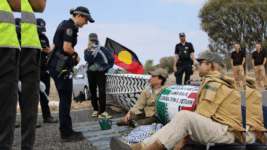
The Mparntwe for Falastin activists arrested as part of the 9 October 2025 blockade of the road into US spy base Pine Gap are about to appear in court. Their direct action aimed at calling out the Pine Gap intel being used to guide Israeli forces in perpetrating the Gaza genocide. And the activists are clear that their trial is another opportunity for resisting Pine Gap assistance in the mass killing.
Jorgen Doyle and Yul Scarf are both appearing before Alice Springs Magistrates Court on 14 September 2026. The pair are facing one count of ‘failing to cease to loiter’, contrary to subsection 47A(2) of the Summary Offences Act 1923 (NT), which carries up to 6 months prison time and/or a $2,000 fine.
The pair are being represented by criminal defence lawyer Nick Hanna. And they’re also submitting two expert witness statements. One is from UN Independent International Commission of Inquiry on the Occupied Palestinian Territory commissioner Chris Sidoti and the other is from Nautilus Institute senior research associate Richard Tanter.
The October 2025 Mparntwe for Falastin direct action is the third such protest that the group has staged since October 2023, and these have all involved the blocking of the road into the US intelligence facility, which is jointly run by Australian staff, and these demonstrations were spurred by the outbreak of the Gaza genocide, as the base located in the Red Centre assists in the murder.
The 1960s established US spy base gathers signals and electronic data from around the planet. Four satellites cover the globe, and it’s understood that three of them are able to surveil the Gaza Strip. The facility is the most important US spy base outside of the United States. The understanding is that intel sent to the US is then promptly passed onto Tel Aviv.
Doyle and Scarf’s case is coming after the recent Pine Gap Convergence, which saw over 600 concerned constituents from across the continent descend on Mparntwe and Pine Gap in order to hold two days of workshops in respect of Gaza and the US spy base. And Arrernte Traditional Owners the Hayes Family issued a formal letter to government addressing the macabre use of their land.
Sydney Criminal Lawyers spoke to Mparntwe for Falastin activists Jorgen Doyle and Yul Scarf about why they’ve risked their liberty and locked on to a barrel full of concrete in the middle of a public road for an entire day out in the desert, along with how Pine Gap is contributing to the Gaza genocide and how the use of Arrernte Country is impacting the Traditional Custodians.
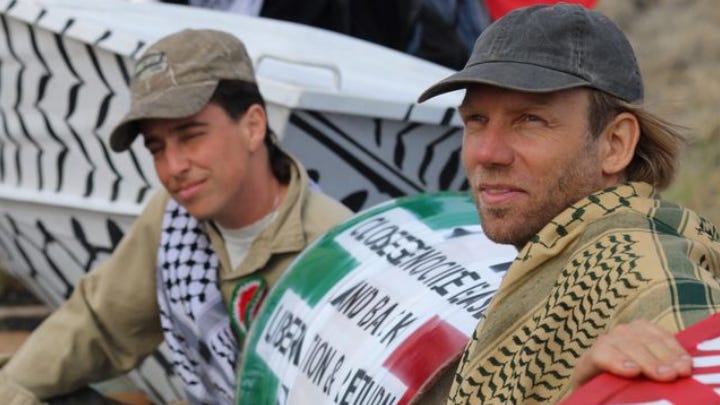
Jorgen Doyle:
Jorgen, in October 2025, Mparntwe for Falastin staged its third road blockade demonstration, which obstructed the road into the US Pine Gap intelligence facility. The action blocked around 800 US and Australian personnel entering, and due to the way the base is used this ought to have stifled Israeli military actions in the Gaza Strip.
So, this was not your first time taking part in an Mparntwe for Falastin direct action blocking Hatt Road on Arrernte land, which leads to the Pine Gap facility. So,what was the motivation for this third instance over recent years of obstructing the road?
Jorgen: As you say, it was the third blockade involving a 44 gallon drum filled with concrete on Hatt Road, the road that leads into the Pine Gap military intelligence facility.
We did this blockade on 9 October 2025, which was roughly a fortnight after our comrades, Carmen and Tommy, who’d undertaken the previous blockade had just been through court for undertaking the second blockade in November 2023.
The court case and the outcomes were relatively fresh on my mind at the time we took that direct action. The court case was quite effective in highlighting Pine Gap’s role in the genocide in Gaza.
The police prosecutor even conceded that there had been a “systematic annihilation of the Palestinian people” since Israel was founded in 1948. But then she went on to argue that the genocide in Gaza was ultimately unrelated to the action that Carmen and Tommy took.
This was likely the first time that both parties during Australian court proceedings had asserted that a genocide was taking place in Palestine.
When we blocked the road on 9 October 2025, it was also three weeks after the UN Independent International Commission of Inquiry found that Israel had committed four of the five genocidal acts as defined by the 1948 Convention on the Prevention and Punishment of the Crime of Genocide.
Obviously, this was before any so-called ceasefire. The accelerating genocide of Palestinians was going full throttle. This was in the middle of the so-called Gaza Humanitarian Foundation’s operations in Gaza, where we were watching Palestinians trying to get some subsistence food from these four food depots in Gaza, and being gunned down by Israeli soldiers as they were gathering to get food.
This was also around the time that we were all seeing the footage of a Palestinian child with the remains of his murdered brother in a backpack. This was at the time that anonymised human flesh was being apportioned in weight in plastic bags for burial by family or friends. There was 70 kilos for an adult and 30 kilograms for a child.
I had been watching the murder of journalists in Gaza, as well as the remaining journalists offering heartbreaking eulogies for their journalist comrades, when knowing that they would probably be murdered next.
I was really haunted by the possibility that those journalists in Gaza, that I had really grown to hold so dear, were being geolocated by cell phone intercepts, via Pine Gap controlled satellites.
This was something Carmen raised when they went to court. They spoke to Richard Tanter’s evidence, indicating that Pine Gap targets civilians. They said this leaves us with the haunting question that rests on all our shoulders: how many Palestinian lives could have been saved if the data was prevented from falling into the hands of the Israeli military?
This is a question and a responsibility that we, as a country, are going to have to wrestle with for the rest of our lives.
There was no sign that any pressure was being asserted on Israel to end its genocide, and on the contrary, our government and almost without exception all western governments, were participating in the Gaza genocide, and creating conditions for it to be prolonged.
This action also took place at the time when the Global Sumud Flotilla was trying to break Israel’s illegal siege on the Gaza Strip, and when we took action, we did so explicitly in solidarity with the people on those boats trying to break the siege on Gaza and trying to act where their governments wouldn’t.
Along with being represented by criminal defence lawyer Nick Hanna, you will be providing the court with two expert statements from Nautilus Institute professor Richard Tanter and UN Commission of Inquiry on the Occupied Palestinian Territory and Israel commissioner Chris Sidoti.
So, can you give us a bit of a rundown on what they’ve set out for the court?
Jorgen: Chris Sidoti is a senior Australian human rights lawyer. He is a commissioner for the Independent International Commission of Inquiry on the Occupied Palestinian Territory. It produced the mid-September report, which found that Israel has committed four of the five genocidal acts as defined by the 1948 Genocide Convention in its actions in Gaza.
This is the most authoritative report on Israel’s conduct in Gaza, before the International Court of Justice eventually hands down its findings into the genocide case against Israel, which was brought by South Africa.
In his affidavit in support of our case, Chris reiterates what was set out by the inquiry: that Israel is committing a genocide. And he also raised the obligation of third party states, such as Australia, to take all measures within their power to end genocide and to ensure that they are not participating in it, via, for example, the transfer of weapons and military intelligence.
Secondly, we have an affidavit from Richard Tanter, a security studies professor with the Nautilus Institute. He is widely regarded as the foremost expert on Pine Gap. And in his affidavit, he details the incredible level of intelligence sharing between the US National Security Agency or the NSA, which operates out of Pine Gap, and its Israeli counterpart, the Israeli National Signals Intelligence Unit.
As well as the NSA, other US security agencies operate out of Pine Gap, like the US National Reconnaissance Office and the CIA. Tanter sets out the relationship those entities have with the Israeli National Signals Intelligence Unit.
In his affidavit, the professor is relying on a number of sources, including a memorandum of understanding between the US National Security Agency and the Israeli Signals Intelligence Unit. This was leaked by Edward Snowden, the whistleblower, in 2013.
In those leaked documents, it was revealed that the NSA routinely shares raw unfiltered intelligence material with Israel. This means they do not vet the data to decide what should be passed onto Israel.
At the time, it was widely reported that the unfiltered data being passed onto Israel includes information on US and Australian citizens.
One of the leaked documents says, “A dedicated communications line between the NSA and the Israeli National Signals Intelligence Unit supports the exchange of raw material, as well as daily analytic technical correspondence”. So, this intelligence sharing is daily, and it is unfiltered.
Around the time that this information was leaked, Glen Greenwald, the journalist, said, “The NSA has extensive multilevel cooperation with the Israeli military and intelligence agencies as part of a broader American policy that actively supports and enables Israeli aggression and militarism.”
The affidavit by Richard Tanter goes on to describe some specific instances where intelligence from Pine Gap may have been passed on to Israel to aid it.
The professor cites a Wall Street Journal article published on 15 November 2023 that claimed US signals intelligence was behind an assessment that Palestinian militants were using Gaza City’s Al Shifa Hospital, and Israel went on to bomb that facility as the very first of their infamous seizures upon the hospitals of Gaza.
This led to the assassination and kidnapping of a whole lot of health workers. A few days after this siege, the World Health Organisation documented a mass grave containing the bodies of at least 80 Palestinians.
Pine Gap is technically well suited to contribute that sort of intelligence.
Concerns around Pine Gap have risen since the October 2023 outbreak of the Gaza genocide. This is because the spying facility supplies intel to Israeli forces via the US.
So, you’ve already touched upon this, but can you talk about some further ways that it’s considered the Pine Gap facility does play a role in Gaza? And do you more broadly consider the jurisdiction of the Northern Territory is also complicit in the genocide?
Jorgen: Richard Tanter also details a long series of intelligence sharing agreements that exist between Israel and the US.
There are at least eight intelligence agreements between the US National Security Agency and the Israeli Signals Intelligence Unit. And we have already mentioned that the NSA is a major agency at Pine Gap.
A quote I have been using to show the intensity of intelligence sharing between the US and Israel, and the likelihood that this includes information being shared from Pine Gap, on 8 October 2023, Jack Sullivan, who was US national security advisor under Joe Biden, said publicly that US intelligence support to Israel was “not tied or conditional to anything else”.
Sullivan further said that US intelligence to Israel “is not limited, and he added that the US is “not holding anything back. We are providing every asset, every tool and every capability.”
About a month later, there was the Israeli military spokesperson, Rear Admiral Daniel Hagari, who said in his 30 years in Israel’s military, the level of intelligence and military cooperation between Israel and the US had never been higher. Hagari added that they were experiencing “unprecedented levels of intelligence cooperation”.
Another quote that we have relied on a lot was former senior intelligence analyst at the NSA, David Rosenberg, who worked at Pine Gap for 18 years, and told Declassified Australia in November 2023 that “the Pine Gap facility is monitoring the Gaza Strip and the surrounding areas with all of its resources that gathering intelligence assessed to be useful to Israel”.
Rosenberg supports the existence of Pine Gap. He published a book about his time working for Pine Gap, which was approved by the NSA. And he is not someone likely to have lied or exaggerated the facility’s role in Gaza.
In terms of the other ways that the Northern Territory has participated in the genocide in Gaza, on at least two occasions in 2025, F-35 fighter jet parts were sent from RAAF base Tindal, the huge US and Australian air force base just outside of Katherine, to the Williamtown base outside of Newcastle.
The parts were then transferred to a Thai Airways commercial flight to Tel Aviv. This met parts shortages with the F-35 there and allowed these jets to continue to be used in the bombing campaigns on Gaza, southern Lebanon and Syria and Iran.
The reason those parts were being sent from Tindal in Australia to Israel was because a court case in the Netherlands found, as the country holds one of the regional parts warehouses for the global F-35 supply chain, that this was complicity in potential genocide in Gaza and those parts could no longer be shipped to Israel. So, Australia picked up the slack.
One final thing on Pine Gap, not about the involvement in the genocide but it is more forward looking, is there is a bill currently before US congress, which is the United States-Israel Defence Technology Cooperation Initiative. This initiative is an effort to merge the US and Israeli military industrial bases and insulate US and Israeli military cooperation into the future, at a time when US domestic support for the relationship is plummeting.
This initiative also involves US-Israeli military intelligence sharing enhancement, which mandates “it would further promote combining US intelligence streams with Israeli ones that could then be used by the Israeli military for targeting”.
So, this makes intelligence sharing the default position for the US and Israel, and it would only be under extreme circumstances that the US president would be able to step in and prevent that intelligence sharing on a case-by-case basis.
That bill is currently before US congress and if it is passed, then basically intelligence sharing from Pine Gap would become absolute, and it would be mandatory that all of it is shared with Israel.
So, if the US and Israeli military merge happens, then we might have Israeli military personnel in northern Australia, where the US military now has an increasing military presence.
Jorgen: Yeah. That seems like a possibility. It’s occurred to me that it may be something that already happens.
Yul Scarf:
Yul, you and Jorgen locked onto a barrel from about 4.30 am on 9 October 2025 until 2 pm that afternoon. You’re appearing in court on 14 September. So, what sort of charges are you facing and what did you hope to achieve by putting yourself on the line in this way?
Yul: We’re facing charges of ‘failing to cease to loiter’. We were really hoping to participate in a global movement of resistance to genocide in Gaza – in Falastin. This is happening in so many ways with direct action globally.
For us living here in Alice Springs-in Mparntwe, the glaringly obvious target is Pine Gap, which is only 17 kilometres away from us here in town, and it is one of the most significant military bases outside of the US.
We believe that direct action is an essential part of resistance, alongside many other forms of resistance.
We wanted to make it clear, both globally and locally, that the links between the Pine Gap facility and genocide are obvious, and that the base must be shut down because of it.
What about the charge of ‘failing to cease to loiter’? Is this a serious charge? Do you have concerns about the court outcome?
The charge is fairly minor. Going through the court is really another site of resistance. Another important place where genocide has been resisted is in the courts.
We are very lucky to have the representation of Nick Hanna and his team. More than being worried about any outcome for us individually, I am more looking forward to seeing what Nick and his team can do in the courts to further amplify the message.
The Arrernte Traditional Owners of Pine Gap have said publicly that they never consented to the construction of the base and the occupation of their land by a military facility that commits violence abroad.
Pine Gap is on Arrernte land. It is specifically on an area known as Kuyunba. And it is on the land that the Hayes family has custodianship over.
How has the Pine Gap facility affected the local First Nations people? How does it continue to impinge upon their lives today?
Yul: Look, I can’t begin to know the ways that the Pine Gap military facility impacts upon First Nations people’s lives.
I am a settler here, so all I can really do is pass on what is being communicated by me. But that is the very edges of the experience.
So, Pine Gap sits on Kuyunba, which is an incredibly sacred site. It is the site of ceremony. It is no coincidence that it is such powerful land that has been coopted by this agreement between the Australian government and the CIA that removed Aboriginal people from their ceremonial grounds.
These people no longer have access to the site.
Also, people speak very clearly and often about the sickness that comes back to First Nations communities, when their land is coopted to perpetrate violence, and the sadness that people are being destroyed overseas with apparatus located on Country here, is shared over and over again by people who can speak for the land.
It is also really important to talk about Irrkerlantye, which is the place where many people who speak for Pine Gap now live. That is a small settlement, which doesn’t have access to running water, and it doesn’t have enough electricity.
The settlement has some access to solar panels, but the living conditions are absurd. These are people that can longer access their own Country because of the displacement they’ve experienced because of the installation of Pine Gap.
If anyone in the city could see the living conditions they are under, they’d be so ashamed.
And lastly, Yul, this is the third time Mparntwe for Falastin has blocked road access into Pine Gap since late 2023. The group is raising awareness about the activities of the secret US spy base.
So, ultimately, what does your group want to see happen in terms of the operations at Pine Gap?
Yul: We’re backing local First Nations folks who speak for that Country, and we are saying shut it down. We are saying give land back to people whose land it really is.
We want to see the same kind of abundant investment that flows towards this genocidal entity to be redirected into the futures of First Nations kids living on their own land.
We want to see justice and reparations. We think that is the way to a safer and secure future.
Main photo is of 9 October 2025 Mparntwe for Falastin blockade of the road into Pine Gap. Photo credit Sarah Dalgleish
Paul Gregoire

Receive all of our articles weekly
Related Articles
 What is a Habitual Offender, and Can a Drink Driving Lawyer Help?
 Why is Misuse of Public Office so Serious?
 Women Imprisoned for Being Too Noisy During Sex
 Far Right Wing Politics – Fanning the Flames of Hate
 Coronavirus: A Convenient Distraction From the Real Issues
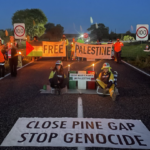 “Pine Gap Is a Place of Aggression”, Say Peace Activists in Court Over Blockading the Facility