“Railroading Community Opposition”: Greens MLC Abigail Boyd on the Emerging Datacentre Crisis
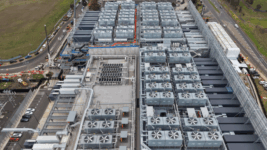
There is a datacentre crisis emerging in this state, as overseas big tech interests are racing down under to build facilities to store foreign owned data. However, most Australians haven’t got a clue about why this is happening and have rather, only half-noticed the imposition of strange large windowless buildings that hum in amongst suburban neighbourhoods and regional areas.
And while most of us continue to be blissfully unaware of this crisis, the New South Wales government has just progressed new datacentre guidelines, which are said to transfer the costs of renewable energy and water infrastructure needed to power these facilities onto the foreign tech companies, who, if they adhere, will then receive fast-tracked approval to build more centres.
On top of fast tracking the statewide move to build more data storage facilities, Australian defence minister Richard Marles was in the United States last week, squaring up deals with Silicon Valley artificial intelligence companies, which ultimately aim to have entities, like Anthropic and OpenAI, establishing new datacentres on this continent.
Due to this onslaught of operators keen to construct further datacentres in this state, the NSW parliament convened the NSW Legislative Council Public Accountability and Works Committee Inquiry into Datacentres, which is considering the ways in which the imposition of these facilities is going to affect the general public in terms of employment, environmental impacts and housing.
The imposition of datacentres on the local environment is set to be severe, in terms of not only energy but further water usage. And the other major impact that the datacentres are set to have is that people are going to start losing their employment, as artificial intelligence learns to perform the tasks that make up an ever-increasing number of jobs.
So, as this state rushes to outbid other players for the benefits that are suggested will be reaped by this ever-growing datacentre bonanza, an increasing number of regular people will start to find themselves without employment and left with the hope that the artificial intelligence companies that will soon be raking in the benefits of this shift, will allow the windfall to trickle down to them.
Sydney Criminal Lawyers spoke to the chair of the NSW inquiry into datacentres, Greens MLC Abigail Boyd about why people are suddenly noticing more and more of these facilities dotting the landscape, whether datacentres and AI are the inevitability that the public is being told they are, and how she considers the negative aspects of this windfall ought to be highlighted before it’s too late.

Abigail, you’re chairing the January established New South Wales Legislative Council Public Accountability and Works Committee Inquiry into Datacentres. The inquiry is delving into the scale of the proposed datacentre network in NSW, along with impacts such as power consumption, water usage, local environment, land use and housing.
The datacentre crisis has crept up on the public. It appears like these large data storage and processing facilities started being established some time ago. But all of a sudden, there is now a movement underway to build many more in both residential and regional areas in this country, and these buildings filled with IT infrastructure further eat up increasingly scarce resources.
So, can you explain how this datacentre crisis has descended upon us? What is the current point the local debate is at? And what sort of environmental impacts are we looking at?
We have had datacentres for a couple of decades now. But they have been different types of datacentres. And where this explosion in datacentres has come from is purely about AI.
We’ve had ChatGPT being released at the end of 2022. The computational demands and the increase in content being produced, particularly with all the rubbish that we see on social media these days, and the training requirements of those large language models, has really exploded since then.
So, when you look at them, it ís somewhere in the region of 84 to 90 percent of new datacentre projects are for AI workload.
That tells you a lot of what you need to know. There is nothing inherently bad about datacentres. But the demand and scale requirements of AI datacentres is pretty excessive. It’s out of proportion. It fails to justify its resource demands.
I say to people, we already have plenty of them. We already have over 100 of them in NSW. The local debate in this country is getting kind of loud and more concerned as people learn what they are, what they mean for local amenity, for the environment and for some of the future economic development of their regions.
I point particularly to the area around Lane Cove and East Ryde. They are dealing now with 15 that are being built or have been built already, in what is a very suburban area. And I read somewhere recently that there is going to be up to 29 in that area.
That is a massive amount. This is right next to schools in some cases. It is replacing other viable uses of industrial land. It has crept up on people, and now people are understanding that they have lived with the impacts of the construction of the existing datacentres and now they are dealing with a whole bunch of new ones rapidly being established in their area.
Some people are coming to this issue because of that impact on their local community amenity, but for other people it is classic opposition to massive AI companies and technologies coming in, threatening jobs, poisoning our minds and degrading our cognitive abilities.
People are coming together with different bases for opposing the datacentres, but ultimately, they all agree on the fact that government seems to be railroading community opposition.
We saw in NSW, just last month, the sneaky little passing of regulations that make it doubly hard for communities to object to a datacentre. You have to now get not just 50 submissions against a project, but you now need 100 before it will get reviewed by the Independent Planning Commission.
When you look at the environmental impacts, there is that immense water consumption that is associated with them. Overseas, we see waterways being poisoned by datacentre activity.
We are seeing millions of litres of diesel being used for backup generators, just for testing, let alone if they ever get turned on, even for a couple of minutes, because these things need to run 24/7.
We are seeing the explosion of energy demands that accompanies them, and that is driving the creation of new fossil fuel projects. And certainly, this is resulting in the extension of coal-fired power generation, in order to service energy demands.
There has been a lot of talk about getting datacentres to build additional renewable energy, but you don’t just create that out of nowhere. Ultimately, we have a certain amount of energy that we are trying to replace as quickly as possible with renewables to get up to 100 percent renewables in terms of supply.
But all of the time, we are increasing demand by what is estimated to be somewhere between 11 and 20 percent. This is after decades of trying to drive down energy demand.
What you are looking at is a bigger amount of supply we are going to have to try and meet with renewables, and whichever way you dice it, that means it is going to take longer to get to 100 percent renewables, which means we are going to be reliant on coal and gas for much longer.
So, it is not an overstatement to say these AI datacentres are directly imperilling climate targets.
A lot of people in the community are aware of these datacentres and that people don’t like them, but they’re not so aware of what they do. Datacentres appear intimately linked to emerging AI but that doesn’t seem to be their only purpose.
During the inquiry hearings over May and July, you’ve heard from a number of industry players, academics and concerned citizens.
So, what are datacentres being used for, and why are they a necessity? How many do we have in NSW and how many are in the pipeline?
This is the golden question. When I speak to people about datacentres, this is what I ask them. Because most people didn’t know what a datacentre was a year ago.
The industry will tell you, and their talking point is, that these datacentres are for critical national interests. These are for things like health records, banking details, driver licences, tax information and how we keep planes in the sky.
Look, we do need some datacentres for those services that we currently have, and we have had those records and those storage demands for that information for decades, and it has been extremely manageable.
We already have well over 100 datacentres in NSW. What we are talking about here is at least 84 percent of new datacentre developments being for AI use, and we can tell that because it is characterised by high density GPU clusters and really intense cooling requirements, which come as a byproduct of those increasing chip densities.
So, what you are looking at here is that you have all of these additional datacentres being proposed, including really large hyperscale ones. And these are purely for us to be able to meet the needs of AI.
If you said to people, should we have a datacentre that is environmentally damaging for something as critical as health records, people would probably say yes.
But if we put it to people whether we should imperil our climate targets and remain reliant on coal and gas for longer just so we can have more pictures of Trump thinking he is Jesus on the internet, most people would say no.
There are also the in between uses of it. Is it worth the opportunity cost of handing over land to datacentre development, instead of housing or infrastructure, just so that we can have these workplace algorithms that are leading to people losing their jobs.
So, at the end of the day, we don’t need any more datacentres. We have plenty for what most people would think of as critical national infrastructure, but what we are talking about now is this explosion of datacentres to be able to compete in the national market for the hosting of AI.
That then leads us to consider that if we are hosting this data for international AI use, who are we hosting it for?
Do we have any sovereignty over our AI? We don’t right now. We are using other people’s large language models. We are using other people’s tech that provides ways for doing things.
But also, the companies that are coming in and are having their data hosted in these datacentres are large international companies that are not obliged to leave any of the benefit behind.
And certainly, they’re not obliged to keep Australian data sovereign in the case of some sort of World War III scenario.
So, long story short, what are they being used for? All sorts of things.
Are they a necessity? Only some of them.
How many do we have? More than enough to cover what is necessary.
If we want to hand over our land and resources to these large international tech companies for them to run large language model AI slop, then we need to actually get something back for that, and no government has yet worked out how to do that.
Okay, so AI uses more water and besides the old ones, our new datacentres are assisting overseas entities in perfecting artificial intelligence?
Yes. Pretty much for their own use and their own models. We are not talking about having a secure place to host our data securely. We are not talking about our driver licence details. We have already had that for years.
When it comes to military data, the government already has very detailed and secure arrangements with particular datacentres, where it holds that information. That is what we already do.
What we are talking about with these massive hyperscale centres – which will absolutely wipe out our climate targets, as they are using up to 20 percent of Sydney’s water – is use for AI slop.
So, what is the benefit for society of that?
The planet is aware that the United States and China are in a race to produce the best artificial intelligence. United States politics is now ever-increasingly influenced by Silicon Valley tech bros committed to AI and datacentre expansion.
So, is there a sense that NSW and the rest of the country are having this datacentre drive foisted upon us by overseas interests? And if this is the case, who are these interests, do they have local accomplices, and how are they operating?
Australia has been chosen by these essentially American AI companies. They want us to be one of the largest datacentre regions in the world. It is not just because of our huge amounts of land, our historical willingness to give away our resources for free, as we see with oil and gas and coal.
But it is also because of the way we are intertwined with American foreign policy, and one of the things that doesn’t get talked about as much are the Pillar 2 aspects of AUKUS, which obliges Australia to have developed weapons technology for use by America, and there is the military use of datacentres.
When you are talking about drones being used to murder innocent civilians in Gaza and other places, all of that is driven by AI technology – very sophisticated technology. So, there is a need for datacentres to back that up.
So, there is a large question around our involvement in that and our complicity with the American war machine. That is definitely a part of this datacentre drive, and it is something that doesn’t get talked about as much.
But also, there is a real kind of wanting Australia to recognise the productivity benefits of AI, and they then conflate that with the so-called productivity benefits of datacentres.
Now the so-called productivity benefits of datacentres are purely on the construction costs. There is a certain amount of money that gets added to the GDP figures.
But ultimately, what goes into those datacentres is imported from other countries. So, we have to query the benefits of just that initial construction phase, the labour and the materials for the external shell of the datacentre, but then long-term, they don’t leave behind many jobs.
So, there’s a question mark over the so-called productivity benefits of the datacentre itself, particularly, if we are not getting any contribution back and all of the profits are going offshore.
But then this idea of Australia wanting the productivity gains of AI, what that is in Australia is squeezing more amounts of work out of each labour unit. We are talking about people. We are talking about people losing their jobs and not getting another one in a better place.
Those so-called productivity benefits have not been assessed properly. And no one has consulted the Australian public about the impact of those things.
The average person does not consider it is a cost benefit to host AI datacentres that are replacing their jobs, sucking up all of our water and making noise 24/7, and they’re a danger to us because of the amount of diesel they hold.
No one has put this to us. No one has asked the public what they think.
So, you’re saying that while the imposition of datacentres appears pronounced in Australia, that is because it really is pronounced here compared with other places around the planet?
Yeah. We are a deliberate target. You see politicians, like the NSW treasurer, absolutely fawning over tech companies, like Anthropic and OpenAI.
We have been tracking the ministerial diaries and there are meetings with the people, involving the premier and the treasurer, and then a few weeks later, a new fast-track process is announced, where all of the normal planning obstacles that would apply to anyone else gets wiped away and there is a red carpet out for these people.
It is quite extraordinary. This is part of the AUKUS arrangements. This is part of our political naivety when it comes to our relationship with America.
But it has also been this real hoodwinking of Labor at the federal and state level by these tech companies that are able to throw around billions of dollars, promising the world and saying this is going to solve all of your productivity problems.
They are falling for their spin.
Is there a sense that the datacentre drive is being motivated by a race for the best artificial intelligence, and whilst this is destroying the planet for humans and all other life forms, this is also going to result in great numbers of people being unemployed, and they are then going to have to rely on the generosity of billionaires who run AI to survive after their input into the economy is no longer necessitated?
Yeah. This is an acceleration of economic inequality. We have these tech bro fascists building this walled garden for themselves.
AI is this antisocial technology that will destroy our quality of life. It will undermine the ability for life as we know it on Earth to exist.
It’s this kind of technological advance for technological advances sake.
I have heard people talking about the inception of nuclear technologies and capabilities and imagining that if back then it was not a race between countries to develop that technology, but a race between companies, or tech bros.
But this is what we have now, a technology that is absolutely in the hands of private interests, with a lot of these companies having more resources available to them than most countries, and we are handing them all of our data and the keys to change society in unthought of ways.
We are giving up our power every day to these companies and datacentres are a physical manifestation of that. When people are fighting against these datacentres, they often fighting against the concept that just because we can have AI doesn’t mean we should have it.
AI is beneficial in some places. It is useful for health applications and other things like that. I can see its use there. I can see its use in trying to set these things on trying to find a cure for cancer.
But what we have instead is AI being used for often quite nefarious purposes, for weapons technology and to replace humans without any thought about how you then socialise the gains of that technological increase to the society as a whole.
If this technology was in the hands of government in an ideal world, you could see a situation where an increase in so-called productivity through AI use would lead to a four-day working week for people on the same salary. That is the utopian vision of technology creating more leisure time in our lives.
What we have instead is just giving up all of the benefits from AI to the large tech companies and the billionaires, while all of the risks are born by government and public, and we are just letting it happen.
So, there are going to be a lot of superfluous people?
Yeah. Which would be great if the robots were doing all the work, while the rest of us sit around in luxury. But that is not what is going to happen.
What we have is technology working for the billionaires, while the public are getting poorer and poorer and governments don’t have the resources to provide for the people anymore.
It is a dystopian nightmare.
And lastly, as noted before, the datacentre drive is now being positioned as an inevitable, as if this is the only direction humanity can head in, and the drive was well underway prior to the broader public becoming aware of this, so it’s as if the people missed the train on datacentre imposition and it’s too late to turn back.
So, Abigail, after what you’ve been hearing at the inquiry proceedings, do you consider the acquiring of more and more datacentres inevitable? And are we too far down the track to pull out of this process?
Nothing is inevitable, and the public can always be louder, and the public can also be louder than invested interests when it comes to voting in elections.
So, the task here is to inform people about what is happening. The government here is very good at just telling us what we just have to have.
We were told that we have to have AUKUS, and now we are being told that we have to have that datacentre growth.
We don’t have to have either of those things. There are lots of alternatives.
I know that the government knows it is doing the wrong thing when it railroads opposition. The way in which they have at both federal and state levels pushed out these industry talking points, have deliberately mislead and used all of the same points, like critical infrastructure, and then changed the planning system to make it even easier for datacentres to grow, that is all evidence of a government that is aware that it is not really doing the right thing.
If people really knew about it, there would be an uproar. So, our job is to make people angry and get people interested and knowledgeable about the issue, so they can push back and say no.

Paul Gregoire

Receive all of our articles weekly
Related Articles
 Five Eyes Alliance Declares AI Is the Best Way to Combat Increasingly Dangerous AI
 The Australian Defence Minister’s AI Bonanza Is All About US Sovereignty
 How Tech Bro Peter Thiel, Palantir and Secret Society Dialog Are Shaping Futures Down Under
 Australian Integration into Palantir’s Global Surveillance Panopticon Is Not Inevitable
 All-Pervasive Palantir-Built Surveillance System Is Monitoring Australians
 The Brave New and Inaccurate World of Artificial Intelligence Policing in New South Wales