How Tech Bro Peter Thiel, Palantir and Secret Society Dialog Are Shaping Futures Down Under
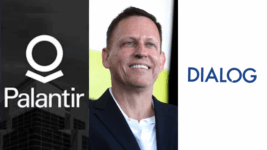
Supermarket shopping in Australia has become dystopian. Strolling down the aisle at Coles involves CCTV cameras glaring down at shoppers, monitoring their every move, whilst the supermarket giant has incorporated Palantir platforms into its operations, meaning its collecting data on every shopper. And the imposition of this rights-eroding system links back to Silicon Valley tech bro Peter Thiel.
Thiel is a German American billionaire venture capitalist, who founded Palantir Technologies circa 2004. Fostered in its early days by the CIA, Palantir develops artificial intelligence-powered data mining platforms that government departments and private businesses, including an increasing number in Australia, are utilising for efficiency.
However, it’s also considered that this work contributes to the construction of a vast surveillance network, of which the US Trump administration is helping to facilitate and is keen to achieve.
Thiel is not only behind the company that repeatedly denies it’s developing this all-pervasive panopticon or mass surveillance system, but he’s also been in the headlines of late, as details relating to Dialog, a secret society he founded in 2006, have been leaked to the press, which has revealed some of the “CEOs, founders, public intellectuals”, politicians and investors making up its ranks.
Of course, there’s nothing wrong with individuals getting together in their spare time to spit ball ideas. But the makeup of Dialog represents an extreme concertation of power, and what their motivations for holding this forum might be is starting to raise concerns, especially as the society is seeking to establish a base close to Washington DC, and it’s already sending delegations to Pakistan.
An invite-only community of CEOs
Thiel made his early fortune on selling PayPal, the online payment system, in 2002. He then founded Palantir and became an early investor in social media company Facebook. Palantir systems merge and analyse data to create new data points, and its 2008-launched Gotham assists government, defence and police, whilst rolled out in 2015, Foundry is a platform for commercial entities.
CIA venture capital nonprofit In-Q-Tel was the first investor in Palantir systems. Indeed, the US intelligence agency was its only client until 2008. The CIA invested in the company, after US congress blocked a Pentagon initiative to build an all-seeing domestic surveillance system post-9/11. And Thiel and Palantir have close connections to the Trump White House.
Thiel donated to the first Trump election campaign in 2016. He is also understood to be the reason JD Vance is US vice president. And president Donald Trump signed a March 2025 executive order to eradicate various US government information silos, so that all separate databases could be merged to form fresh data points. And the MAGA White House has been utilising this new information.
Axios reported on Dialog in August 2025, as the secret invite-only forum was understood to be seeking to buy property and build a headquarters in the suburbs of the US capital of Washington DC. Prior to this development the media-shy society had been meeting annually in various locations since its foundation in 2006, and the concerns of its discussions are for-the-most-part unknown.
Dialog grabbed headlines in June 2026, when Swiss hacktivist Maia arson crimew leaked the forum’s directory, they located on its website. WIRED also received a list of 222 individuals who were set to meet at this year’s Dialog forum, which was supposed to take place last week, from 12 to 16 August 2026, in Ireland. But after the leak, the venue hosting the event had been attempting to cancel it.
Figures involved in Dialog include tech trillionaire Elon Musk, US special envoy for peace Jared Kushner, US Republican Senator Ted Cruz, US treasury secretary Scott Bessent, YouTube CEO Neal Mohan, Xbox president Sarah Bond, OpenAI president Greg Brockman, Anthropic global affairs chief Michael Sellitto, Fortress Investment Group principal Pete Briger, as well as various celebrities.
The session topics set for discussion amongst this gaggle of elites included Bring Back Nuclear, Build-a-Cult, Navigating WWIII, Build-a-Party, Money (Does?) Buy Happiness, How’s Your Sex Life, It’s Fun to Be in Charge, Disinformation and Deepfakes, Battlefield Technologies, Democracy Under Surveillance, Taiwan and the AI Race and Three Predictions in Iran.
The understanding of how Dialog and its members might consider the organisation shifted in November last year, when Pakistani site NewzShewz reported that the forum that was founded by Thiel and angle investor Auren Hoffman had sent a delegation of members to Islamabad in Pakistan to meet with the federal minister for finance and revenue Senator Muhammad Aurangzeb.
The Dialog delegation that went to meet with senior officials in Pakistan included UK House of Lords member Simon Stevens, Draw.Solutions founder Veit Valentin Dengler, Microsoft advisor Fatima Kardar, MultiFaith Alliance CEO Shadi Martini, EducationSuperHighway CEO Evan Marwell and Norway MP Himanshu Gulati. Dialog has been engaging with Pakistan since 2024.
Private city-states
Thiel recruited university acquaintance Peter Karp to become the CEO of Palantir in 2004. And the chief executive raised further questions about what the US tech bro vision of the future might be in April this year, after he posted a 22-point manifesto online, in which he suggests that the private entities from Silicon Valley are merging with the US government to defend the nation together.
US journalist Gil Durán recently published The Nerd Reich: Silicon Valley Fascism and the War on Democracy, in which he probes the emerging force that he terms “tech fascism”, and he posits that whilst Thiel and his ilk refer to themselves as libertarians, a clearer description of them is that they’re fascists and authoritarians.
Durán explained to Democracy Now this week that Thiel and a number of other powerful tech bros consider that US democracy is collapsing and that technology will surpass it. Further, once artificial intelligence develops to a certain point, the economy will be destroyed because most jobs will become obsolete and extreme wealth will be concentrated in the hands of a few.
A potential outcome of this shift envisions the formation of a network state in the US, which would involve a series of different and linked “corporate-owned mini-countries” or “fiefdoms”, that would include new governing structures run by corporations, with CEOs acting as kings or autocratic rulers. Although this situation does lead to questions about what will happen to the vast majority of people.
This concept of privately-run cities is another key preoccupation of the tech elite. It includes the seasteading movement, which began at the turn of the century and seeks to create floating cities. Thiel has been involved with startups relating to private cities and seasteading. He’s also invested in a private city in Honduras and Greenland is seen as a potential location for another corporate state.
Groups representing startup or freedom cities had been meeting with the US president last year. And since 2024, Trump has been considering the development of ten freedom cities across the US, that would be exempt from certain federal laws. And it’s considered these zones would be ripe for antiaging trials and nuclear startups, while construction wouldn’t be subject to federal oversight.
Dystopia down under
In terms of the Silicon Valley tech industry merging with government, the Trump administration has long been moving in this direction. This is not only revealed in Trump’s opening up of the data terrain for Palantir and his commitment to freedom cities, but it was further seen when Elon Musk was tossed the keys to the most important databases in the States, when he was the head of DOGE.
To consider that these shifts in governance in the US, coupled with a turn to no-holds-barred surveilling of the public, won’t affect Australian communities, is to ignore the fact that the US is heavily invested military-wise in this country’s north, and that the Trump administration has already flagged that it’s monitoring Australian migrant populations for criminal offences they might commit.
The Australian Defence Force has been increasingly reliant upon Palantir since 2011, and in February this year, it entered into its largest ever contract with it. Other government departments are utilising Palantir, such as the Australian Criminal Intelligence Agency, AUSTRAC, and the Australian Signals Directorate, while private companies like Rio Tinto and WesTrac also use Palantir platforms.
Digital Rights Watch has warned that there are no guarantees or restrictions set in place as to how Palantir is itself using or storing any of the data its platforms are collecting about Australian constituents, and this is despite the fact that the aim of this data analytics multinational is to increasingly merge all databases to gain ever more insights about subjects.
But it doesn’t have to be this way, as French prime minister Sébastien Lecornu announced in June that his nation’s domestic security agency was ending its contract with Palantir, whilst Germany’s security agency announced it was doing the same the month prior. National security and sovereignty were cited as concerns, and both agencies instead went with French data company ChapsVision.
So, the next time the reader looks up to note a monitor hanging from the ceiling in a Coles supermarket to see their own image being captured by a CCTV camera to be broadcast on the screen before them, they might want to consider that not only are they being surveilled as a potential thief in real time, but Palantir is also taking a record of their purchases and the details of how they pay.
Main image: Peter Thiel by Gage Skidmore is licensed under CC BY-SA 3.0. Palantir and Dialog logos are in the public domain.
Paul Gregoire

Receive all of our articles weekly
Related Articles
 All-Pervasive Palantir-Built Surveillance System Is Monitoring Australians
 Australian Integration into Palantir’s Global Surveillance Panopticon Is Not Inevitable
 The Principle of Policing by Consent Is Falling Across Australia
 Governments Likely to Use Bondi Massacre to Justify AI-Powered Mass Surveillance
 The Thought Police Are Using the Protection of Kids to Justify the Expansion of Surveillance
 Big Coles Is Watching You and Collecting Information While You’re Shopping