NSW Police Force Is Back to Raiding LGBTIQA+ Licensed Venues on Oxford Street
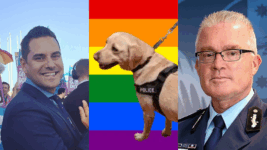
New South Wales police has again raided LGBTIQA+ venues on Gadigal land around Sydney’s Oxford Street, with sniffer dogs in tow.
This is the second set of raids on the fabled queer district, with the first taking place in June’s Pride month. And as a pattern starts forming, comparisons to 1970s Sydney have been raised, which was a time when aggressive policing of people with diverse sexualities and genders was the norm.
Groups of NSW police officers with drug dogs descended upon 14-odd Oxford Street precinct queer venues last Saturday night, 12 September 2026. The NSW Police Force has deemed this an “intelligence operation”, and it resulted in 65 clubgoers being searched, with 28 drug detections, 12 fines issued, along with six cannabis cautions, one move on order, and absolutely, no supply charges.
These raids have again traumatised regular people out for the night, just as the 13 June 2026 Pride march raids did. Images from last weekend’s raids reveal NSW police officers appearing to enjoy the distress they were causing. And the raids too follow the NSW police commissioner asserting in March budget estimates that he wasn’t aware of the practice of officers running dogs through venues.
This tactic by police appears distinctly planned. And the shift to raiding queer venues marks a backflip by NSW police, which had attempted to move past its assault on the 1978 Mardi Gras march, as well as having gone easy on the queer bashings and murders of the late 20th century, and its attempts to fix its relationship with community, after violent policing marred the 2013 Mardi Gras.
And the denials that the raids had targeted the LGBITQA+ community from NSW police deputy commissioner Peter McKenna have fallen flat, as police have specifically raided Oxford Street venues twice now and top brass is well aware of the optics and the history involved. And McKenna’s further assertion that the raids are needed to catch drug suppliers aren’t reflected in the outcomes.
Trashing Sydney nightlife
Among the LGBTIQA+ venues that were raided last Saturday night were Arq, Kinsella’s, Palms and The Beresford. Some of these venues were too raided during the 13 June Oxford Street operation, which saw 93 people searched and 42 drug detections, with only one drug supply charge laid. The reason a lack of supply charges is significant is that supply crimes are the stated purpose of dog operations.
On both occasions, packs of around a dozen NSW police officers descended upon licensed venues at around midnight, with an accompanying drug dog, and people indicated by a canine were then searched. NSW police officers accompany pat down searches that turn up nothing, after a drug dog indication, with a strip search, just to make sure they didn’t miss anything on the feel up.
Arq patron James Twigg told ABC Radio on Monday that he witnessed a dozen officers with a dog flooding into the club at about midnight on Saturday, and the commotion reminded him of images of how NSW police historically dealt with the queer community back in the 1970s. He added that it made clubgoers “very, very uncomfortable” and he didn’t agree that officers were helping the public.
The shock that rang out following the June raids was heightened because it was Pride month, which is a time when tourists descend upon the globally renowned LGBTIQA+ party precinct. And the success rate of the searches following a drug detection dog indication during the June raids, was less than 1 percent.
Critiques this week revolved around the fact that not only were patrons being traumatised, but local businesses were also being affected, at a point when Sydney nightlife is still recovering from six years of the 2014 established Sydney CBD lockdown laws, which restricted the operations of licensed premises in the city, and had a negative knock-on effect on many businesses in the lockdown zone.
But deputy commissioner McKenna has too suggested that criticisms of the way in which the raids were performed and the targeting of mainly people who use drugs in these venues rather than drug dealers, are unfounded, as he considers all illicit drug activity is interrelated, and he doubled down on the point that just because queer venues were raided, LGBTIQA+ people weren’t being targeted.
Calling on the watchdog
NSW police carried out these raids last Saturday just a day after a roundtable was held in Sydney to discuss the impact that the June raids had upon the Oxford Street community and its nighttime economy. This meeting involved NSW police minister Yasmin Catley, nighttime economy minister John Graham, City of Sydney councillor Jess Miller and Sydney Independent MP Alex Greenwich.
Greenwich has told the press in the wake of the latest raids that he understands that groups of 12 to 20 NSW police officers raided venues, and the operation made its way deep into neighbouring Surry Hills. The independent MP thanked the community for all the information they’d provided, and he said he’d be collating it and passing it on to the police watchdog investigation already underway.
Sydney lord mayor Clover Moore and Greenwich lodged a letter of complaint to NSW police oversight body the Law Enforcement Conduct Commission on 18 June, calling on the LECC to investigate the Pride month raids, as the pair had been “inundated” with complaints – the “most in 10 years” – which involved descriptions of police “saturating venues” to aggressively bail up patrons.
The LECC took up the request to investigate the raids and it, ultimately, directed the NSW police to conduct an internal review. The force then announced in August that it had ended its investigation, as it found that no police misconduct had been involved. But the watchdog disagreed, and it invoked some of its statutory powers to require the agency to reopen and carry out the investigation.
Reconnecting with its reactionary roots
The shift towards NSW police once more targeting the LGBTIQA+ community, follows on the back of 3,000 police officers having beaten and brutalised 20,000 pro-Palestinians at the 9 February 2026 anti-Herzog rally on Gadigal land before Sydney Town Hall. This incident involved officers turning on the public in a preplanned manner, which saw unbridled excessive force unleashed on the people.
This was a huge incident that commenced at Town Hall but then spread out across the CBD, due to the manner in which NSW police forced protesters to disperse. Footage of officers punching, wrestling, running down and pepper spraying civilians who had gathered to oppose genocide, despite a since revoked law prohibiting street marches, went viral.
However, even though the entire constituency is able to simply log onto a device to view the police brutalisation evidence, NSW premier Chris Minns, police minister Catley and NSW police commissioner Mal Lanyon have all denied any wrongdoing occurred, and instead, have suggested that officers were just following orders, and they’ve also refused to issue an apology as well.
The police assault on the anti-Herzog crowd was unprecedented in living memory, and the only incident that comes close was the bashing that NSW police unleashed on the first ever Mardi Gras parade in 1978. Those in the crowd at the Herzog incident, who’d been involved in the 1978 Mardi Gras parade, testified that this was the same violence, but this time, on a much greater scale.
Taken together, these two incidents, the Oxford Street raids and the aggressive policing of the anti-Herzog rally, tend to suggest that the NSW Police Force is taking a more reactionary approach to pro-Palestinian demonstrators and it is returning to openly displaying its distain towards people with diverse sexualities and genders.
And just as the Minns government has stood beside law enforcement officers after they unleashed upon the anti-Herzog protesters in February, it wouldn’t be too surprising to find that NSW Labor stands behind the raids on Oxford Street LGBTIQA+ nightclubs, which would be in line with the general shift to a more authoritarian approach to governance being experienced across jurisdictions.
Image: Sniffer dog image supplied by Sniff Off. Rainbow flag is in the public domain. Alex Greenwich is licensed under CC BY SA 4.0. Mal Lanyon Official Photo 2025 by the NSW Police Force is licensed under CC BY 4.0.
Paul Gregoire

Receive all of our articles weekly
Related Articles
 Should We Get Rid Of Police Prosecutors?
 Marriage Equality: An Interview with Former High Court Justice Michael Kirby
 Sydney Criminal Lawyer Charged With Assisting Extreme-Risk Inmate Run Drugs
 The National Digital ID Will Fail Just Like the Others, Says Dataveillance Expert Dr Roger Clarke
 Sydney Criminal Lawyers® Weekly Rundown – Articles from 9 to 15 March 2026
 The NSW Surveillance Bill Is Set to Impact Us All, Regardless of Any Guilt