Prohibition Causes Gangland Violence, Not People Who Use Drugs
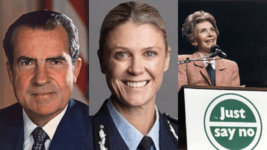
Australian federal police commissioner Krissy Barrett has suggested that the Australia public ought to have a discussion about drug use and organised crime, as she considers that people who use drugs are complicit in the spike in gang-related violence in major cities, when rather, as any harm reduction expert will counter, it’s the drug war that’s to blame and the hopeless policing that accompanies it.
The top cop asserted her baseless equation in The Nightly on 14 September 2026, and she posited that “Australians take too many illicit drugs”, which is merely her opinion.
Barrett adds that five issues warrant the debate, which include “more potent and dangerous synthetic drugs” being available, that “state actors” are involved in the drug trade and make it a national security issue, AI is assisting criminals in evading the law, crime is now being carried out by gig criminals and the rising challenge of “illicit commodities” leaving and arriving via the Pacific.
But none of this has anything to do with people who use drugs. The problems of stronger drugs and state actor involvement are failures of century-old global drug prohibition and were heightened by US president Richard Nixon’s 1971-launched drug war. And the last three points regarding crime fighting have nothing to do with people who use drugs, regardless of how frustrating that may be.
As the esteemed former heads of state and cultural figures making up the Global Commission on Drug Policy made certain in their first report in 2011, “the global war on drugs has failed”, and in fact, prohibition has made drugs more widely available and increasingly stronger and risker, while it has further led to the creation of vast criminal networks that have infiltrated governments.
The AFP commissioner says she’s been told “too many times that the war on drugs never worked”. But she asserts that police can’t surrender. However, to simply continue on with failed prohibition and its policing will allow crime to blossom, while the gradual shift to legalisation and regulation of illegal drugs would end related organised crime and improve the health of people who use drugs.
Prohibition breeds violence
Fifty-odd gangland shootings have taken place in Greater Sydney over 2026. This pattern has too been occurring in Naarm-Melbourne. Barrett adds that most organised crime networks are “commodity agnostic”, which means they will sell anything illegal regardless of what it is, as long as it is profitable, and she points out that the same networks are now selling illegal tobacco.
The example of illegal tobacco is telling as the turf war over it that commenced in Naarm in 2023, is not the result of smokers, but rather, it’s due to the ever-increasing government excise on tobacco, which aimed to reduce consumption, yet when that tax became too high, people still dependent and unable to afford legal tobacco were then left with no choice but to use illicit products.
The government started making significant hikes to tobacco prices in 2010, in order to encourage people to stop smoking, and it worked at first. Yet, at some point along the way, when tobacco price hikes were so steep, those still smoking and feeling the pinch turned to black-market tobacco, with the demand surging to such a point that the profits to be made were worth fighting a turf war over.
A similar process occurred with illicit drugs globally, following the establishment of the 1925 Geneva Opium Convention, as with substances like opium and cocaine suddenly being banned for recreational use, a black market opened up, as people weren’t about to stop using them, as they have been for millennia, either for their pleasurable effects, or because they drown sorrows.
The failure of the drug war is not that it didn’t stop people taking drugs, but rather, it was the fact that it couldn’t curb supply. And now that the AFP boss has recognised that law enforcement is powerless to stop the flow of illicit drugs, she’s turning her attention to demand, which is the most futile aspect of the market to curb, as the “just say no” to drugs line failed back in the Reagan era.
The legalisation panacea
Lowering demand, or the “just say no” approach that Barrett wants to debate, is highly unlikely to succeed. When prominently used drugs started being outlawed a century ago, people didn’t stop using them. Nixon’s 1971 drug war escalated law enforcement efforts to stop drugs and it failed. And US first lady Nancy Reagan launched the original “Just Say No” campaign in 1986, which didn’t work.
Indeed, the national debate that the AFP boss is calling for ought to make itself familiar with the ongoing harm reduction debate that began forty years ago. This line of thought recognises that prohibition leads to more dangerous drugs, it pushes people with dependency into the shadows, the illegal trade breeds violence, and a shift towards legalisation and regulation would end all of this.
These days, the local harm reduction debate has a focus on drug decriminalisation, or the removal of criminal sanctions against drug possession and use. The Portuguese government dramatically decreased its drug issues and the related harms, after it implemented decrim nationwide in 2001, and further invested heavily in treatment and rehabilitation.
Although the Portuguese model has been an overwhelming success, it does leave two matters unaddressed, which are that drugs are still illegal, so organised crime continues, and as criminals don’t abide by best practice regimes, there is no quality control.
However, pill testing or drug checking services can be used to examine the quality of street drugs, which allows people who use them to make an informed choice and sensibly, three Australian jurisdictions have rolled out such services over recent years.
Ironically, on Ngunnawal and Ngambri land in the Australian Capital Territory, where the AFP is headquartered, the most enlightened drug laws in Australia are now in operation. Drug decriminalisation has quietly been operating since October 2023, with no major problems, and since mid-2022, CANTest, a fixed drug checking service, has been operating in the nation’s capital as well.
The legalisation and regulation of all illicit substances through varying distribution methods would end the drug black-market and it would improve the health of people who use drugs no end.
Of course, as Barret said, organised crime is “commodity agnostic”, so it would likely continue with illicit tobacco or illegal arms, and the end user of those products can then be blamed for any associated violence.
In his own opinion piece refuting the assertions made by the top cop on Saturday, former Victoria police senior sergeant Greg Denham asserted that the nation should “legally regulate, control and manage access to drugs”. “Take the ‘product’ out of the hands of dealers and watch the violence and criminal networks disappear,” the former VicPol officer underscored.
“Deal with the reality, not the myths and misconceptions that those that have invested in the war on drugs are trying to fool people about,” advised Denham, who, since leaving the force, has been involved with LEAP, which is a global organisation, comprised of current and former law enforcement officers, who are working towards ending drug prohibition.
The path of least harm
The illicit drug market garners massive profits because the products are so popular amongst people in general, and that’s why “state actors” have long been involved. The problem for Australian law enforcement is that it can’t stop the massive imports, and for every photo opportunity with a big drug haul that gets fielded in the press, dozens of more consignments make it through customs.
The New South Wales Crime Commission explained in 2016 that it’s offshore organised crime that decides the volume of drugs imported into Australia, and the domestic market just consumes it. And while “commendable law enforcement efforts” nationwide had “resulted in larger seizures and more arrests,” these hauls “have had little, if any, effect on the quantities of prohibited drugs available”.
Barrett told the ABC on Tuesday that drug use is “almost accepted now”, which is likely her referring to some of the gains of the Australian harm reduction movement in terms of pill testing, medically supervised injecting centres and legal medicinal cannabis. She may also be referring to a general reduction in the stigmatisation of people who use drugs, of which has been the work of advocacy.
Former AFP commissioner Mick Palmer told Sydney Criminal Lawyers in November 2018 that while he’d prefer young people didn’t engage in drug use, in his experience as a top cop, he considered that “most people who use drugs recreationally do it without long-term harm to themselves”, that they don’t offend in other ways, and the worse that happens is falling foul of the law over such use.
Palmer was vocal at that time, as part of a call for pill testing, because, as is the case now, young people back then were taking party drugs, and it was thought better to allow them to be informed about what they were taking, especially when it comes to toxic batches. And the Minns government just announced that legal pill testing or drug checking services are to be made permanent in NSW.
The ex-AFP commissioner was further advocating for decriminalisation as a “first step” towards the end goal of “regulation of supply”.
“Surely, the best way to protect people who decide to use drugs – despite what the education and advice tells them – is to provide some sort of quality control over the content of the product itself,” said Palmer, the former AFP commissioner, who’d earlier in the interview stated that the law enforcement focus should always be on “drug importation and serious organised drug trafficking”.
“While the product lies totally in the hands of the black market and its toxicity and overall content is completely unknown and the margin is driven simply by profit, we have no chance of controlling the dangers,” the ex-top cop said in ending.
Main image: Richard Nixon and Nancy Reagen in the public domain. Krissy Barrett is the official AFP photo

Paul Gregoire
Receive all of our articles weekly
Related Articles
 AFP Commissioner Blames People Who Use Drugs for Prohibition Policing Failures
 Drug Law Reform: An Interview with Former NSW DPP Nicholas Cowdery
 Police Against Drug Prohibition: An Interview with LEAP’s Greg Denham
 “Legalise and License the Supply of Drugs”: An Interview With Chris Daw QC
 Former NSW Magistrate David Heilpern Condemns Absolute Liability Drug Driving Ruling
 Prohibition is Failing to Reduce the Social, Economic and Health Risks of Illicit Drugs