NSW Police Rolls Out 24/7 Long Arm-Equipped Armed Response Command
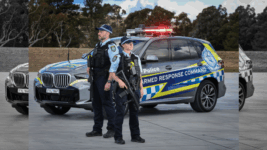
The Minns government announced the roll out of the New South Wales Police Armed Response Command (ARC) on Thursday, 8 October 2026. This is the specialist unit launched in response to the 14 December 2025 Bondi Beach terror attack. And its first 60 officers, who, like all others, will be armed with long arm rifles, will be out on the beat in the Sydney metropolitan area from next month.
The announcement relates to ARC officers, who’ve been training in private, now commencing to do so in public, prior to the next month deployment of its initial officers. This will then grow to a total 250 ARC officers and 28 civilian staff members, who’ll too be equipped with 24 purpose-built vehicles. And this $93 million investment involves Operation Shelter becoming permanent.
Operation Shelter was launched in October 2023, in the immediate aftermath the commencement of the Israeli-perpetrated Gaza genocide. The temporary operation was established to counter rising antisemitic and Islamophobic incidents spurred by the mass murder in Palestine. But in the wake of the Bondi shooting, it was determined that a 24/7 permanent specialist force was necessitated.
“ARC will be a high-visibility, intelligence-led unit capable of rapidly responding to emerging threats, patrolling high-risk areas and providing an increased police presence at places of worship, major events and other locations where it is needed,” the NSW government press release explains, and it adds that the purpose-built vehicles will be made up of BMW X5s and Toyota Land Cruisers.
Whilst the Armed Response Command does not mark the first time that NSW police have been equipped with long-arms, the new unit does mark an escalation in the manner in which constituents in Greater Sydney have been policed in the past, and NSW Greens MLC Sue Higginson warns that some of the noise around the ARC conflates protest with extremism that warrants such policing.
Armed and visible
“ARC will not only provide a policing rapid response, but it will also be a deterrent for those who wish to commit harm, incite hatred or cause fear,” NSW police commissioner Mal Lanyon set out in the NSW press release. “No matter where you are located across Sydney, we want all communities to feel reassured that police can be anywhere, at any time, to keep people safe.”
“The environment in NSW has changed, so the way we police the community has changed and what the community expect from us, has changed,” the top cop added.
In respect of the deterrence and the high visibility, the idea appears to be that officers equipped with long arms will become a common sight in NSW. And the shift towards this type of counterterror policing has been informed by both British and German law enforcement, following a senior NSW Police Force delegation travelling to Europe to discuss best practice in January.
NSW police has determined to use the Australian Combat Assault Rifle (ACAR), which is manufactured by Lithgow Small Arms in NSW.
But this is not the first time that NSW police officers have been provided with long arms, as it was announced in late 2017, that 47 officers from the NSW Police Public Order and Riot Squad were then being issued with Colt M4 Carbines. That number was upped to a total of 300 riot squad long arms, while in 2019, questions in parliament found 1,500 long arms right across the NSW Police Force.
Back in 2017, when the initial roll out of semiautomatic long arms to riot police was announced, then NSW police commissioner Mick Fuller suggested that constituents ought to get used to seeing elite officers equipped with rifles. But this has not been the case, and in February, when ARC was first announced, the public was once again being primed for their first sight of serious weapons in public.
“The new Armed Response Command is based on global best practice,” NSW police minister Yasmin Catley added on Thursday. “Police travelled to Europe to study how other major police forces respond to threats. They’ve taken that on board and will soon be ready to launch an Australian-first rapid response unit.”
A standoff with the constiuency
The NSW government is moving to beef up state law enforcement with the addition of the ARC and its long arms, in a similar way to what it did with the riot squad going back a decade ago. But right now, a tension exists between the public and the state, following the NSW police having bashed and brutalised a section of the NSW constituency at a protest in February.
Around 3,000 NSW police officers set upon a group of 20,000 pro-Palestine protesters opposing the official visit of Israeli president Isaac Herzog on 9 February 2026, following a direction being issued for the crowd to disperse, and it having refused to do so, in contravention of a law that prohibited street marches on Gadigal land in the Sydney CBD, which was later struck down as unconstitutional.
The scale of this excessive force incident against the public was unprecedented. The violence has been captured in numerous social media clips and mainstream media reporting. Yet, there has been no official condemnation of what occurred. In fact, as it stands, the official position is that police officers were acting on the orders of the state and top brass when tossing protocols to the wind.
As it stands, the NSW premier Chris Minns, police minister Catley and commissioner Lanyon have all refused to apologise for the clear misconduct and illegal actions of the NSW police on the night and have instead confirmed that they were just following orders, and therefore, the policing transgressions have not only been justified but could be ordered once more.
An intimidation racket
NSW Greens MLC Sue Higginson pointed to Lanyon’s characterisation of the ARC as having a purpose beyond responding to incidents, which comprises of acting as “a deterrent for those who wish to commit harm, incite hatred or cause fear.” And she went on to characterise this as being “by definition an intimidation unit”, and further, that it marks “an escalation in state violence”.
“After everything we know about the impossibility of defining and judging the inciting of hate and community division, I’m shocked that the commissioner of police would blatantly state that this unit is about intimidation,” the Greens justice spokesperson insisted.
The addition of the ARC on Sydney streets comes after a three-year campaign that the NSW premier has waged against the local Palestine solidarity movement that sprung up in October 2023, following the outbreak of the Gaza genocide. This culminated in Minns suggesting that the Palestine protest organisers had unleashed forces that they couldn’t control which helped spur the Bondi massacre.
The ARC also comes on the back of a raft of antiprotest and hate speech lawmaking, under questionable circumstances that occurred in early 2025. This included the enactment of a controversial incitement to race hatred offence. And its followed two distinct antiprotest laws being progressed by Minns, only to then be struck down as unconstitutional by the NSW Supreme Court.
“It’s political failure of the Minns Labor government that they will now have weapons of death around our streets and put the fear of police violence into our communities,” Higginson continued on Thursday. “To believe you can intimidate your way to community cohesion is authoritarian and draconian.”
The Greens MLC added that it is a step too far for commissioner Lanyon to suggest that the threat of being shot by a long arm might deter constituents from “causing fear”. She further insisted that the public is well aware that NSW police officers might be brandishing such weapons at peaceful protests. And such an idea sends a shiver in the wake of the anti-Herzog police violence.
“The Supreme Court has been clear that deterring political speech which may be offensive or confronting is not a legitimate public policy purpose under our Constitution,” Higginson said in ending.
“If you can’t deter it with antiprotest laws, you most certainly should not try and deter it with guns.”
IMAGE: NSW police official press photo announcing the establishment of the Armed Response Command

Paul Gregoire

Receive all of our articles weekly
Related Articles
 The Perceived Link Between Islam and Terrorism: Misinformation and Media-Fuelled Hysteria
 Should Wrongly Convicted People be Compensated?
 Police Accused of Excessive Force as Arrest Video Goes Viral
 Indigenous Inmate Dies at the Hands of Prison Staff
 Defamation Laws Restrict Public Accusations of Sexual Misconduct
 Sydney Criminal Lawyers® Weekly Rundown – Articles from 26 December 2022 to 1 January 2023