Victoria Cuts Down Yet Another Sacred Djab Wurrung Tree: Interview with Yaraan Couzens Bundle
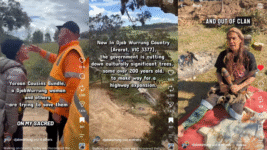
VicRoads workers cut down another of the sacred Djab Wurrung trees on 19 October 2026. The tree was felled after Victoria police dispersed a group of Djab Wurrung people and their allies, who were onsite to stop the destruction. And after the protest camp of around 20 dispersed from the site, following a VicPol promise not to harm the tree, it was then chopped down.
“Today, VicRoads brutally murdered a sacred tree, on Djab Wurrung Country, who had been standing long before the colonial state of ‘Australia’ ever existed,” said AMAN (Antimilitarism Action Network) in a social media post later that same day.
“To get to the tree, Vic Roads and VicPol sent a swarm of riot police to break up the Djab Wurrung Camp holding ground and conducting sacred ceremony at the tree’s base. They arrested eight people, including two brave friends in tree sits,” the network added.
The sacred tree was on an area known as Naram Naram Tyar. Major Road Projects Victoria and VicRoads have plans to construct a 12.5 kilometre stretch of the Western Highway duplication project between the towns of Ararat and Buangor in this area, which is right next to the old stretch. And authorities want to destroy the trees to improve road safety and increase transport times.
The Djab Wurrung protest camp was out on Country last week, as the Eastern Maar Aboriginal Corporation, which represents Djab Wurrung people and other family groups, signed off on the Cultural Heritage Management Plan progressed by the Victorian Infrastructure Delivery Authority in March 2026, and now works are set to progress, even though Djab Wurrung women reject the plan.
The Djab Wurrung Heritage Protection Embassy first established itself in June 2018, in an attempt to protect the scared land and trees from the highway duplication project. The camp drew much attention to the dispute over the following years, until things came to a head in October 2020, when a 350-year-old directions tree was chopped down and 50 protesters were arrested.
Climate activist Brad Homewood was on Djab Wurrung Country last week and he spoke to Djab Wurrung, Gunditjmara, Yuin, and Bidjera woman Yaraan Couzens Bundle on behalf of Sydney Criminal Lawyers about the defence of Djab Wurrung Country, what occurred in respect of the felling of the sacred tree, and the alternative to the project that Djab Wurrung women are advocating for.
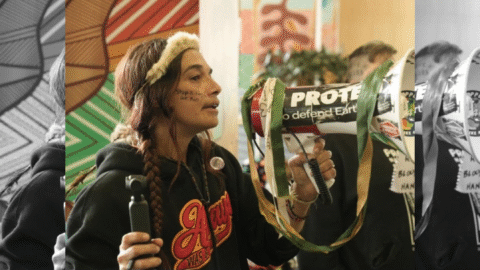
Brad Homewood: Okay, so I am here on Tuesday morning, 27 October, with Yaraan. So, Yaraan, would you tell us why we are out here on Djab Wurrung Country and what happened here last week?
Yaraan Couzens Bundle: We are here to defend the sacred Naram Naram. This covers an area within and beyond the highway expansion, so we are really here to protect Country, and in particular, the old growth trees and special cultural heritage sites.
But also, we, as cultural guardians and custodians of Country, advocate for the safest route for the highway, which is what we consider to be the existing road and that they should slow the speed limit down on that section.
This has been very triggering for a lot of people. This has set off a chain reaction across the state and the nation about the destruction that is continuing.
In resistance, I have been supported by a group of people, or comrades, who witnessed my ceremony, which was deliberately interrupted by VicPol.
What about the tree sitters?
There were two people arrested. There were about 10 to 12 allies trying to stop the trespass, with two tree sitters. And once the tree sitters were removed, they moved in as quickly as possible with the heavy machinery.
It was quite traumatic for us. But we managed to stand ground. The authorities actually broke the conditions of the Cultural Heritage Management Plan that they signed off on.
The legal plan has a condition that Djab Wurrung women can conduct ceremonies before any work is started. So, that is why I was there holding ground. It was for other matriarchs that didn’t have the chance to visit these sites again for a long time, or the opportunity to conduct ceremonies.
That was taken away from us.
I know they took a number of trees last week. But that main sacred tree that they destroyed, what was the significance of that?
That tree was estimated to be in between 400 and 500 years old, officially by arborists.
So, she was precolonial and she bore the marks of a very significant cultural scar that looked to have been put there when she was about 200 to 300 years old.
So, it was quite significant, and it was right in the middle of our sacred Naram Naram, which translates as Djab Wurrung women’s birthing country.
So, can you tell us a little about yourself?
I am a proud mother-of-four. I belong to the Djab Wurrung, Gunditjmara, Yuin, and Bidjera family groups. I am here defending my mother’s and grandmother’s matrilineal Country.
I am here with my family – my two daughters. I am trying to bring all my children up in their cultural lore and cultural birthrights and culture.
We are not separate from this landscape, but we belong here.
Do you want to further tell us about how you were the firekeeper at Camp Sovereignty for a year, and you were there when the neo-Nazis attacked in August 2025, and these were the same Nazis who were harassing you on Country?
Unfortunately, me and my children were harassed on Djab Wurrung Country at our place of residence. We were living on a bush block where our family created a ceremonial ground with our flag.
They came onto our land and into our ceremonial ground and cut our flag down, as well as doing more things of a harassing nature, which went into a police report. But nothing was done about this.
Then I experienced the Camp Sovereignty attack by the neo-Nazis, who I believe were some of the same people who harassed me on Djab Wurrung Country.
I received some anonymous intelligence about a Nazi camp on our sacred mountain, which is called Beeripmo. That is also known as Mount Cole.
So, this story is much larger, as is the story of the highway, and why they are insisting on this particular route, when it should be about safety.
We have concerns about the next parts of the highway that are going to damage much more of our sacred Country, our women’s Country. But we are also really concerned about the damage this will do to the water, and that this is being done during a climate emergency.
We feel like there is a much bigger story to tell about what they are going to be shipping from South Australia across Victoria on this highway, which is rare earth minerals and uranium that is being mined, whilst the world is at war.
At this point, it is ever more important to create sanctuary for our people, because they are continuing at a fast rate a multileveled cultural genocide and ecocide.
This is at the cost of everybody who calls Australia home.
What about the legal proceedings that you have engaged a lawyer in, and they are putting together a legal team to possibly obtain an injunction?
The word is out about us setting up a legal defence on behalf of Country. So, the works are now being rushed.
They have rushed in with heavy machinery, and they are trying to get as much of the route of their highway mapped out while the court proceedings are still taking place.
As far as I am aware, there was an emergency declaration put in earlier, so that we are awaiting advice about what that means in terms of the trees being cut down.
But we plan to disrupt this corrupt process and the highly significant damage and destruction that has been happening to our landscape. We have a lot of support across the nation and the international community to challenge this cultural genocide.
And lastly, Yaraan, Eastern Maar Aboriginal Corporation has signed off on the Cultural Heritage Management Plan for section 2B of the Western Highway duplication project between Buangor and Ararat in March 2026. But the Djab Wurrung Women’s Working Group has not signed off on this.
So, how is this all working?
We advocated for the Djab Wurrung Women’s Working Group specifically through the Eastern Maar Aboriginal Corporation of which our family groups belong to.
So, we are working with our family groups and trying to advocate for women’s Country and to stop men from making the decisions about sacred women’s sites. So, it is really important that we have a women’s voice for that women’s Country.
The working group was created to advocate for protection.
Also, we are Djab Wurrung citizens, so we are part of the Beeripmo, or the women who look after the Naram Naram.
So, we have every right to challenge on behalf of our future generations and the legacy of our culture, as citizens, as well as to try and advocate through what jurisdiction was given in the courts a couple of years ago and was with the Native Title process and the Eastern Maar Aboriginal Corporation.
So, we have been advocating with both our family groups.
And it is important for us to have a voice within our community and what we believe to be a deliberately destructive and very corrupt Native Title process that we were forced into one part of.
But then as Djab Wurrung citizens we have every right to assert our cultural inheritance birth rights, and that is particularly what the government is afraid of.
Main image: Last week’s Djab Wurrung protests supplied by @djabwurrung

Paul Gregoire


Brad Homewood
Receive all of our articles weekly
Related Articles
 Protecting the Sacred: An Interview With the Djab Wurrung Embassy’s Zellanach Djab Mara
 “Stand Up and Take Back Your Homelands”: Gurridyula on His Mission to Stop Adani
 NSW Aboriginal Land Council Lodges Discrimination Complaint Against Minns Government
 Court Ruling Proves Land Grants Covering Wiradjuri Are Illegal: Interview With Uncle Paul Towney
 The Ihumātao Occupation: In Protection of Māori Land
 We’re Taking Back Our Land and Future, Says Black Peoples Union’s Kieran Stewart-Assheton