Racist Border Force Raids on Sex Worker Workplaces Are Increasing: Interview Scarlet Alliance
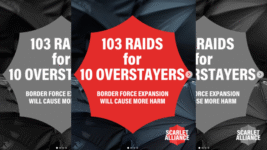
In a recent social media post, Scarlet Alliance highlighted that there were 103 raids on sex worker workplaces conducted by the Australian Border Force over the 12 months to June 2026. The national peak body representing sex workers explained that this resulted in just 10 alleged visa overstayers being located. And the Scarlet Alliance further underscores that “the harms don’t add up”.
These raids are nothing new. These raids specifically target Asian migrant sex workers, and the raids began in late 2022,under the ABF’s Operation Inglenook, which had a stated focus on exploitation of the temporary visa system and sex trafficking. But according to its sex industry critics, this has meant traumatising all sex workers at raid sites for a primary focus on visa overstayers.
Sex workers critical of the ABF randomly descending on sex worker workplaces late night underscore that this is a racist endeavour that involves the targeting of Asian women from overseas, which often sees Australian Border Force agents profiling individuals at the border and at their workplaces, or to put it another way, officers are homing in on women based on looks.
Over the 21 months to August 2024, the ABF turned back 154 Asian women from overseas expecting to enter the country. This included 89 Japanese women, 18 Chinese women, 16 women from Taiwan, 12 women from Thailand, 7 Indonesian women and 6 women from South Korea.
An offshoot of Scarlet Alliance, the Asian Migrant Sex Worker Advisory Group has been campaigning for an end to the ongoing racist raids on sex worker workplaces and AMSWAG has also been involved in securing the release of several Asian trans women who were profiled at the border and then stuck in Villawood Detention Centre.
Sydney Criminal Lawyers spoke to Scarlet Alliance policy and advocacy manager Dr Elena Jeffreys and the peak body’s migration policy analyst Aysha Zaharin about the uptick in raids on sex worker workplaces taking place even though Operation Inglenook has officially ended, and how federal Labor’s newly announced immigration enforcement package is set to only make matters worse.

The Australian Border Force-led Operation Inglenook took place over November 2022 to December 2024. The ABF said its joint operation with Australian police forces was to crackdown on the exploitation of migrant workers in Australian workplaces.
How this played out was over 200 raids on sex worker workplaces by 2025, as well as the refusal to allow certain Asian women to enter the country on suspicion that they might be here to conduct sex work.
But even though Inglenook has ended, the raids on sex worker workplaces have been continuing across the country.
So, Aysha and Elena, can you talk about what is occurring with these raids at present?
Elena: Under the guise of an operation with a different name, Operation Greentale, it appears that Inglenook never really ended, but it just folded its operations into a larger and better-funded program of harassment and targeting.
These operations are based on the assumption of intelligence officers, who consider the raids are in sex workers’ best interests, as they’re supposed to be about resolving a supposed sex slavery problem in Australia and that the border profiling is somehow preventing what again is being framed as a sex slavery problem.
Out of more than 100 raids over the last financial year, there were less than 10 people who were allegedly found to be working in contradiction of their visa requirements, or were overstaying in Australia for longer than their visa allowed them to.
This means thousands of sex workers have been through the trauma, violence and the insult of uniformed and armed Australian Border Force officers entering into their workplaces for the sake of a tiny number of people who were allegedly found to be overstaying or breaching their visa in Australia.
Of that, less than five, which can mean perhaps none, were referred to the Support for Trafficked People Program.
Aysha: The 10 people out of 103 raids does not show an effective regulatory model. But for the authorities, they consider it a success.
One thing now is the concern around home affairs minister Tony Burke having said that they are going to increase the numbers in detention centres and increase staff numbers working at them.
But the raids are not about protecting sex workers. One of the sex workers who gave evidence said that for the authorities the shaking of the whole apple tree is worth it to get just one or two, when it actually affects all of the people involved. A lot of other sex workers who do get affected by these raids lose their jobs or lose clients.
When they raid a sex worker workplace, it is not the same as when they raid other workplaces, like a farm, for example. It is different because often the workplace has to shut down sometimes for weeks, while the workers don’t go out and seek any help afterwards.
If anything, this is contrary to the attempts to stop modern slavery because the sex workers that are supposed to be assisted don’t want to speak to the authorities.
The Scarlet Alliance post earlier this month highlights that the recently announced Albanese government’s migration policy will “directly undermine state-level health and safety protections for Asian migrant sex workers”. This policy aims to slash net overseas migration via restrictions on visas and a focus on visa overstayers.
Can you outline how this is going to impact Asian migrant sex workers?
Aysha: From a legal studies perspective, we do have the principle of procedural fairness. This aspect has been challenged in the courts previously when it comes to different issues regarding refugees and asylum seekers.
But procedural fairness can also be challenged when it comes to situations involving Asian migrant sex workers because the Migration Act 1958 (Cth), which is used to justify the raids, is a legacy of the White Australia policy, and it does not reflect the recent human rights obligations that Australia has since that time become a signatory to.
The Migration Act impacts local health inspector protections, while the government increases the threat of visa cancellations and deportation. And this absolutely causes a climate of fear amongst sex workers.
These migrant workers who experience assault or even workplace abuse become terrified to contact state police or the workplace regulator, because by doing so, they may risk ABF intervention, detention, removal or visa cancellation.
So, by conflating this kind of visa compliance with criminal enforcement, especially when the parliament has never declared that Asian migrant sex workers should be treated as criminals, the ABF is treating these people as criminals for visa noncompliance, which is unproductive.
This situation is also dismantling state level protections for workers and the commitments for Australia to eliminate gendered violence.
Elena: As Aysha outlined, these policies curtail and infringe upon the human rights of Asian migrant sex workers in Australia. These are human rights that Australia, as a nation state, is obliged to protect for everybody in the country, including Asian migrant sex workers.
So, that would be from a legal perspective, our first and foremost concern. Secondly, the health promotion that is so successful in Australia is being undermined. So successful is this locally because sex worker communities run our own organisations to deliver health promotion, workplace support, PPE sales, promotion of condom use and promotion of STI testing of sex workers.
So, sex workers in Australia enjoy some of the lowest HIV rates in the world. We are the envy of other countries, due to the excellent health and safety that is implemented at sex worker workplaces throughout Australia.
Research has shown that decriminalised jurisdictions, like NSW, when compared with other jurisdictions where the industry is criminalised, or in the past were licensed, decriminalisation of sex work, or the removal of police from our workplaces, is associated with the increased take up of health promotion messaging by sex workers in workplaces.
The presence of uniformed and armed Australian Border Force officers one hundred times in just one year, bashing down doors of lawful workplaces that have had no complaints against them, and aren’t breaking any workplace rules or laws, is undermining what decriminalisation has delivered.
These workplaces are allowed to be there, just like the nail salon or the fish and chip place next door, so this is undermining what decriminalisation has been delivering in this country for decades, and they are taking away those benefits and those health and safety protections from Asian migrant sex workers, of whom they are unfairly targeting.
So, you’re saying there’s a sense that the impact of decriminalisation, which opened up the industry, so that people are able to access health programs in the workplace or make a complaint to police about harms against them, is being ruined by these raids and that the ABF is rather, once again, taking away the hard-won beneficial outcomes that came with decrim.
Elena: Absolutely. Inglenook, now Greentale, is a federally funded and uniformed campaign by armed public servants, who directly serve to undermine the national HIV strategy, the national STI strategy, the national hepatitis strategy and the state and territory STI strategies.
All these states that have decriminalisation recognise that the removal of police from sex worker workplaces and the normalisation of sex worker workplaces has led to key health and safety strategies operating in these workplaces, and this is a key health pillar in Australia.
This is not an imaginary pillar, but it is a practical, researched, proven and international best standard pillar for the prevention of STIs and HIV.
Aysha: When they changed the name to Operation Greentale, they said the operation is to stop human trafficking and modern slavery. But from the statistics none of the workplace raids have yielded human trafficking victims. There are no statistics on this.
If anything, these raids on sex worker workplaces have created circumstances that allow people to exploit Asian migrant sex workers even further.
Scarlet Alliance has stated in the description accompanying its End Racist Immigration Raid petition, which is addressed to immigration minister Tony Burke, that the “militarised raids do not protect workers”, but rather “they terrorise them”.
Scarlet Alliance has also listed ways in which the harassment involved in these raids goes beyond the actual raids themselves, as there appears to be a level of intimidation by the authorities towards sex workers. Can you talk about this?
It includes sex workers who don’t have English as their first language being giving documents, and when they try to use their phone to scan these documents to translate them, then having officers taking the phone away, whilst asking the sex workers to sign the documents, even though the document is only in English, and they have not been allowed to translate it.
This has involved people being held onsite for a period of time, even if the actual shift that they were intending to stay for has ended, and their family, children and loved ones are expecting them home, as the ABF is not allowing them to leave the site.
Aysha: In locations, where sex work is still criminalised, such as Adelaide, there are cases where the state police would come, and because sex work is still criminalised, they would confiscate the women’s phones and their cash, whist also slapping them with fines.
On occasions, they are being provided with translators, but these interpreters weren’t independent people. They forced the workers to sign the documents without even properly explaining them.
The violence just doesn’t stop at sex worker workplaces.
Scarlet Alliance is also part of a detention centre working group, which comprises of human rights organisations, including Amnesty International and the Australian Human Rights Commission, and we know that Australian onshore detention centres are run by a private contractor that is linked to the United States Management and Training Corporation, or MTC. The detention centres are no longer run by Serco.
What happened was there were widespread allegations of negligence and abuse about Serco. We don’t have any clearer details, because Serco didn’t let any organisation come in and review them. And because these places are run by private contractors, we cannot get access to consider how Asian migrant sex workers are being treated in detention.
Along with the raids, Operation Inglenook involved Asian women being turned back at the border on the assumption that they could be entering the country to perform sex work. And this profiling continues at the border.
Scarlet Alliance has further been highlighting that all of these operations rely on racist ideas and mechanisms. Can you talk about how this regime being run by the authorities is actually a racist endeavour?
Elena: We are currently putting a submission together to the Australian Human Rights Commission, which involves us making the argument that these operations are racist.
Aysha: When I started at this job, I realised that Australian Border Force kept stating that they had these powers under the Migration Act. But when I looked into the details of the Migration Act, I realised that it is a direct legacy of the White Australia policy, and nobody actually acknowledges that.
The Migration Act grants the state vast unaccountable powers. And due to the fact that we don’t have a federal Human Rights Act, it permits them excessive powers to surveil, detain and deport noncitizens.
As examples, there is section 116 of the Migration Act, or even, section 189 and section 167 that work together with section 250 of the Migration Act. These mechanisms in the Migration Act have been condemned by the United Nations Human Rights Council and the UN Committee Against Torture and the Australian Human Rights Commission for violating fundamental human rights.
This is not just a recent issue. This has been going on for decades. And as we know, Australia is a signatory to a lot of major human rights conventions, including the International Covenant on Civil and Political Rights and the International Covenant on Economic, Social and Cultural Rights.
But the current enforcement vision obviously violates the CCPR and the CESCR by using this discriminatory profiling at the border and at workplaces. This is the basic point we are trying to make in producing a submission for the AHRC.
And lastly, Aysha and Elena, since Operation Inglenook has ended but the raids are continuing apace, does this mean that raiding sex worker workplaces, in both jurisdictions where sex work is decriminalised and also where it remains illegal, is just part of regular policing now? And how does the Scarlet Alliance plan to bring this all to an end?
Elena: It is about law reform. To stop these operations from happening we are going to have to campaign for amendments to the federal Migration Act, and that is what this AHRC submission will call for.
It will detail the federal reforms that need to happen to end these racist powers that public servants, the ABF officers, are employing.
All of our advocacy, including when we are meeting with various government departments, appears to find that there is no consideration for these operations to be slowed down, even though they involve the racist targeting of Asian migrant sex workers in workplaces and at the border.
It actually appears that the opposite is true, as the latest announcement by Tony Burke means that these operations will be increasing, not decreasing.
Aysha: If anything, that statement by Tony Burke appears to be against the National Plan to End Violence against Women and Children, because it ignores Asian migrant sex workers in this commitment.
I don’t think you can combat violence against women, while the authorities are complicit in the systematic subjection of Asian migrant sex workers to immigration raids and detention.
As Elena said, we want to have comprehensive reform of the Migration Act, that is in line with the United Nations and the Australian Human Rights Commission’s recommendations to protect migrant workers’ rights.
This is not just for Asian migrant sex workers, but this is for all of the intersectional struggles.
Currently, we are also demanding that they include the voice of Asian migrant sex workers in all of their antiviolence strategies and to ensure that state and territory level protections are maintained and protected from the impact of ABF enforcement.
Elena: Another point that is coming through loud and clear from the sex worker community is that it is unacceptable to create visa conditions, where a person is allowed to stay in Australia but is not allowed to work. Such provisions destine people to live in extreme poverty.
Just for people’s own survival, of course, they are going to work. We don’t agree with the immigration targeting of individuals for breaching their visa status over working. The visa status that outlaws their ability to work is unfair and inhumane.
Aysha: This restriction on working is creating more circumstances for the bad actors to progress exploitation.
Please sign the Scarlet Alliance petition calling for an End to Racist Immigration Raids on sex worker workplaces
Main image: Scarlet Alliance social media post supplied

Paul Gregoire

Receive all of our articles weekly
Related Articles
 Misgendered Incarceration: An Interview With Scarlet Alliance CEO Jules Kim
 Sex Workers Unite to Condemn Racist Raids Against Asian Migrant Workers in Brothels
 Sex Workers Mobilise to Ensure the Murder of Yuko Isn’t Downplayed and Dismissed
 Release Asian Trans Woman Detained in Villawood: Interview AMSWAG’s Damien Nguyen
 Sex Work as Work Is a Feminist Issue, Says Rights Activist Julie Bates AO
 Empowering Sex Workers: An Interview with Urban Realist’s Julie Bates