Labor MP Stephen Lawrence Demands That Police Brutality Hearings Be Open to the Public
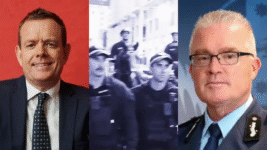
The Law Enforcement Conduct Commission’s investigation into the New South Wales police use of excessive force upon protesters at the 9 February 2026 demonstration against the official visit of Israeli president Isaac Herzog was again raised in NSW parliament this week, as NSW Labor MLC Stephen Lawrence questioned why only some of the disputed hearings will still be heard in public.
Controversy sprung up around the long slated LECC investigation’s public hearings into the inquiry known as Operation Makalu, when it was announced in mid-September 2026 that the hearings supposed to begin on 21 September were to be delayed. And these doubts about the public hearings were then cleared up in early October, when it was announced they’d be progressing in part.
In his 8 November 2026 published reasons, LECC chief commissioner Peter Johnson SC set out that 12 days prior to the hearings, lawyers for NSW police commissioner Mal Lanyon raised questions about senior police being interviewed in public, despite having known about the hearings since March. And this contention was only raised, after a brief of the evidence was shared with police.
Commissioner Johnson determined that Lanyon’s argument that the Law Enforcement Conduct Commission Act 2016 (NSW) doesn’t allow for public hearings was wrong. And he added that he’d determined to hold hearings involving senior police in public, and further, the hearings involving witnesses and low-ranking police officers would now be held in private due to their sensitive nature.
However, in speaking in parliament on 10 November 2026, Lawrence insisted that despite questions raised about top cops being quizzed in public, non-senior police and civilians are to be questioned in private, when Lanyon had no real issue with these hearings being held publicly. And the barrister noted that if “social discord” is the concern, then “sunlight is said to be the best disinfectant”.
Public hearings promote social cohesion
Lawrence explained on Wednesday, that there had been “a fundamental change” to the Operation Makalu hearings, as low-ranking police and civilians will now be testifying in private. He added that the LECC commissioner’s reasoning involved the public airing of witness statements possibly sparking “community discord in a way that impacts negatively on social cohesion”.
“Social cohesion is obviously an incredibly important thing. It is the glue that holds our society together,” Lawrence told the chamber. “There is a danger, though, when such vague concepts are deployed in a way that might begin to infringe on protests… but also might infringe on the way that transparency and accountability bodies operate.”
The outspoken Labor upper house member then listed his reasons for holding all inquiry hearings in public. These included that much of the community considers that social cohesion would be “enhanced by the public operation of accountability agencies”, that a lot of people were hurt or adversely affected by the police behaviour at Herzog and that there’s intense interest in the inquiry.
The 9 February 2026 NSW police operation at the anti-Herzog rally involved 20,000 pro-Palestinian protesters being set upon with unbridled force by 500 NSW police officers in a coordinated manner, after the crowd refused to disperse and insisted it march on NSW parliament in opposition to the official Israeli visit and in violation of a since-struck-down antiprotest law outlawing the procession.
“With the greatest respect to commissioner Johnson, who I have appeared before as an eminent Supreme Court judge, I am not denigrating him,” the Labor MLC underscored. “I do not accept for a moment that keeping these things secret is an aid to true social cohesion, even if that term is deployed, like it often is, in a positive way.”
Watching the police officers
LECC inquiry Operation Makalu was first raised in the NSW upper house on 10 November, as NSW Greens MLC Sue Higginson questioned NSW treasurer Daniel Mookhey in regard to the LECC having requested an additional $1.9 million in funding over 2026-27, in order to properly carry out the Operation Makalu investigation. However, only $1.034 million was provided to the watchdog.
“If the LECC makes another request for the funding it needs to investigate police violence against peaceful members of our community, will the treasurer agree to that request?” Higginson then asked Mookhey, to which he replied, that he couldn’t answer that question without an actual LECC request having been made, but if one was forthcoming, it would then be considered on its merits.
“Unless the government has a policy that it will not fund the independent police oversight body to investigate cases of egregious state violence perpetrated on members of the community, I would strongly suggest to the treasurer that he fully fund the requests the LECC has made,” the NSW Greens member then insisted.
Higginson further put to Mookhey that he has “approved every request for funding from the LECC, except for the one request that is needed to undertake Operation Makalu”, and she then wondered aloud as to whether he hadn’t simply approved this request because the NSW premier had said that “there should be no independent investigation into the egregious police violence that took place”.
The treasurer then claimed that premier Chris Minns hadn’t made this statement but rather had said that such inquiries are up to agencies like the LECC. He then explained that whilst Higginson said his department hadn’t funded the request, it actually had. And Mookhey added that all such agencies have the ability to request extra funding “whatever its particular circumstances”.
New tricks in the toolbox
The anti-Herzog rally took place on Gadigal land before Sydney Town Hall. The NSW Police Force was not refusing the pro-Palestinian crowd, that opposed the Israeli official’s presence during the Gaza genocide, from marching because the crowd was being problematic, rather the since-struck-down “PARD law” was preventing protesters from marching in the CBD post the Bondi Beach mass murder.
All the crowd did was refuse to disperse, and at the point when the police in charge understood they weren’t leaving, law enforcement then unleashed hundreds of officers on the crowd to use excessive force to push them on. Officers kettled people in at different areas, horses and officers then charged these civilians, beat upon them, wrestled people down, punched civilians and pepper sprayed them.
Despite the huge amount of footage circulating on social media capturing police brutality and misconduct, along with the documented injuring of protesters, including the elderly and people with disabilities, the premier, police minister Yasmin Catley and commissioner Lanyon have all refused multiple chances to apologise, and instead, have justified the behaviour as officers following orders.
The circumstances of the mass police brutalisation incident are further muddied, as the group of protesters were pro-Palestinians rallying against Herzog’s visit, as they had been railing against the Gaza genocide in general for more than two years. And over that same time, premier Minns had been demonising these constituents and suggesting there was an issue with their peaceful protests.
So, as it stands, a large group within the constituency, who support the Palestinians and have long been opposed by the state government, gathered and demanded to march through the Sydney CBD, and when they refused to disperse, a large group of law enforcement officers then allegedly broke the law and used unbridled force upon the public, injuring many and traumatising manner more.
Further, this use of excessive force has been justified as having been ordered by the NSW state, and now it appears somewhat beyond reproach. So, without any official critique, like the LECC inquiry, the manner in which this operation was conducted continues to remain a tried-and-true policing technique that officers might deploy upon the constituency again when necessitated.
Image: NSW police by Paul Gregoire. Official NSW police photo of Mal Lanyon. Photo of Stephen Lawrence supplied
Paul Gregoire

Receive all of our articles weekly
Related Articles
 Is the AFP Partly Responsible For the Deaths of Chan and Sukamaran?
 Police Protect Paedophile Within their Ranks
 Winner of 2019 Sydney Criminal Lawyers Criminal Law Scholarship Announced
 The Morrison Government Is Not Fit for Purpose
 Sydney Man Charged with Murder Over Boarding House Fire
 The NSW Offence of Intentionally Recording an Intimate Image Without Consent