Benny Wenda Demands End to Indonesia’s Genocidal Attacks in West Papuan Highlands
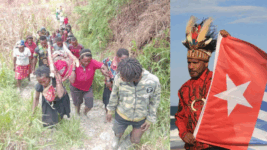
West Papuan provisional government president Benny Wenda has called on Pacific leaders to condemn the ongoing occupation of his peoples’ country by Indonesia, as Jakarta, the so-called administrator of the region, has again been carrying out aerial and land raids upon villages in the West Papuan highlands, specifically in Puncak Regency, commencing on 31 January 2026.
Wenda called for fellow leaders in the region to put pressure on the Prabowo government on 10 February, following the Indonesian military having dropped bombs upon a makeshift refugee camp in Puncak’s Kembru District, causing West Papuans, who were already displaced and left defenceless, due to the ongoing assaults upon people living in the highlands by earlier military operations.
Currently, there are around 105,000 internally displaced villagers in the highlands. The numbers of displaced West Papuans have been increasing along with Jakarta’s aerial attacks upon rainforest villages since an initial escalation in Nduga Regency in December 2018, which was sparked following an incident involving the killing of construction workers building the Trans-Papua Highway.
Wenda further questions how, as Indonesia has been engaged in military attacks upon villages in the West Papuan highlands for coming on close to eight years now, Indonesia’s permanent representative to the United Nations, Sidharto Reza Suryodipuro, had the ability to be appointed to the position of president of the UN Human Rights Council last month.
The attacks in the highlands began under the former Jokowi government, but they’ve since been intensified by October 2024-installed Indonesian president Prabowo Subianto, who, as a Suharto-era army general, earned an reputation as a war criminal whilst stationed in East Timor and West Papua, and hence, Wenda is calling on neighbouring nations to condemn these atrocities in his homeland.
Freedom fighters and occupiers
After the attack on the internally displaced villagers in Kembru District, Jakarta cut off the internet in the region, preventing the sharing of information about the attacks or details about those who’d fled the area as a result. Internet blackouts are a regular occurrence in West Papua, a region that Indonesia has restricted journalists from entering since taking control in 1963.
In the days following the drone attacks in Kembru, West Papua National Liberation Army (TPNPB) fighters fired upon an Indonesian plane as it landed at Korowai airport in Boven Digoel Regency, killing the pilot, copilot and a passenger. Yet Wenda called out reporting of the incident because it suggests the flight was a commercial one, while he maintains it was part of military operations.
“Indonesia is again disguising their military activity as civil activity. They are also wilfully breaching the no-fly zones established by the TPNPB,” explained Wenda on 19 February. “This is the same pattern Indonesia used in 1977, when Indonesia used a disguised civilian plane to bomb villages across the highlands and massacre thousands, including many members of my own family.”
TPNPB freedom fighters attacked and killed 19 workers and an Indonesian army soldier, who were engaged in construction of the notorious Trans-Papua Highway, on 2 December 2018. This led to reprisals in Nduga Regency. The highway project is opposed, as it is destroying the ecosystem and tightening Jakarta’s grip on the Melanesian region with the third largest rainforest on the planet.
“We must always remember that the Indonesian military uses any armed action by West Papuans for their own gain, as a pretext for more militarisation, more displacement and more deforestation and ecocide,” Wenda underscored.
“Their aim is always to escalate the situation as a way of ethnically cleansing Papuans, forcing them to become refugees in their own land and strengthening their colonial hold over West Papua.”
Forging liberation from deceit
The 1962 New York Agreement was a deal struck as the Netherland colonisers of West Papua were about to pull out of the Melanesian region, just like they’d relinquished colonial control over Indonesia in late 1949. This agreement saw the United Nations taking over administration of West Papua briefly, prior to handing that over to Jakarta on 1 May 1963.
This was done on the proviso that Indonesia allow West Papuans to hold a referendum on remaining with Jakarta’s rule or taking independence. The UN-brokered Act of Free Choice vote was held in 1969. The locals refer to it as the Act of No Choice, as the Indonesian military rounded up just 1,026 West Papuan men and had them vote in favour of continuing with Indonesia at gunpoint.
Since the dodgy referendum, Jakarta has continued an oppressive rule over the Melanesian region and kept out prying eyes as it does so. Jakarta has killed more than 500,000 West Papuans during its occupation. A transmigration program established in the 1970s has left West Papuans making up less than 50 percent of the people in the region. This program has been revamped under Prabowo.
Compiled in 2017, the West Papuan People’s Petition, which calls for a new and legitimate vote on self-determination, was signed by 1.8 million West Papuans, or 70 percent of the Indigenous population. This had to be carried out clandestinely in occupied West Papua. Wenda presented the petition to then UN High Commissioner for Human Rights Michelle Bachelet in 2019.
The United Liberation Movement for West Papua has also succeeded in establishing a West Papuan provisional government both on the ground and in exile. This includes 12 government departments. The West Papuan Legislative Council met for the first time in Jayapura in July 2025: an occasion it was said that marked the “rebirth of the West Papuan state”.
“It is an international disgrace that Indonesia has been chosen to lead the UN Human Rights Council,” Wenda said earlier this month. “How can Indonesia lead on human rights when they are dropping bombs on refugees?”
Time to depart Indonesia
“Their presence on Donald Trump’s Board of Peace is yet another hypocritical joke,” Wenda added, in reference to Indonesian president Prabowo now holding a seat on the neocolonial board that directly undermines the United Nations. “Indonesia asks for justice for displaced Palestinians, while displacing hundreds of thousands of Indigenous West Papuans.”
And as the head of the ULMWP, Wenda is further demanding that Indonesia permit the UN High Commissioner for Human Rights to conduct a fact-finding mission, in line with the demand of 110 UN states, as well as that Indonesia lift its media and aid blackout in West Papua, and that his fellow Melanesian and Pacific leaders heed his plea and put pressure on Jakarta to facilitate UN access.

Paul Gregoire

Receive all of our articles weekly
Related Articles
 Time to Support West Papua: An Interview with Independence Leader Benny Wenda
 Wenda Confirms West Papua is Readying to Gain Independence from an Indonesia in Chaos
 Violent Crackdown in West Papua: An Interview With Independence Leader Benny Wenda
 Indonesian Government Enters a New Phase in the Occupation of West Papua
 Albanese Cuts Secretive Military Deal with Indonesian President-Elect Prabowo
 West Papua’s “Mandela” Filep Karma Dies Under Mysterious Circumstances