“Just Too Absurd”: Socialist Alliance’s Alex Bainbridge on His Arrest for Using a Political Slogan
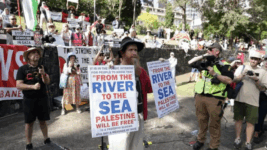
Twenty protesters were arrested by Queensland police at the Not Our Law rally in Magan-djin-Brisbane on 18 April 2026, for the crime of either displaying or speaking the currently illegal phrase “From the River to the Sea”. The outcome was not so unexpected because the point of the action was to highlight the absurdity of this criminal offence recently enacted by the Crisafulli government.
Those arrested are now facing the March enacted offence of recital, distribution, publication or display of prohibited expressions, contrary to section 52DA of the Criminal Code Act 1899 (Qld). To prove this crime, which carries up to 2 years prison and/or a fine of $25,035, it has to be shown a reasonable person might feel “menaced, harassed or offended” by the act of uttering the slogan.
The prohibited expressions are “from the river to the sea” and “globalise the intifada”. The first is a popular chant that the local Palestine solidarity movement has been using over the last two or so years that Israel has been perpetrating a genocide in Gaza. The second phrase, well, a lot of locals in Queensland are dumbfounded as to why it has been singled out because no one uses it in that state.
The Justice for Palestine Magan-djin organised rally was not the first time police got heavy over some words arranged in a certain order. The Crisafulli government and the QPS made a point of arresting people protesting the law just a few hours after it first took effect. But many consider as the law does allow for the use of the phrases “in the public interest”, those charged will likely be found not guilty.
Unconstitutional laws are the new black
Green Left Weekly journalist Alex Bainbridge was one those arrested at the rally where people actively broke the laws. The “high-stakes offender” is now facing time in gaol for making a speech explaining to those gathered why the laws ought not to have been enacted and carrying a sign stating that it is in the public’s interest to know that the phrase “is a freedom slogan not a message of hate”.
Justice for Palestine Magan-djin is launching a High Court challenge to the law, claiming that it’s unconstitutional. NSW premier Chris Minns was the first politician to suggest he would pass such laws, but he’s now stating he might wait to see how the challenge to the Queensland law goes, given his own track record of passing unconstitutional laws.
Sydney Criminal Lawyers spoke to Socialist Alliance member Alex Bainbridge about what happened over the weekend of protests in Magan-djin-Brisbane a few weeks back, and the member of Justice for Palestine Magan-djin provides some sound reasons as for why these laws are an absurdity, especially in the face of other mass atrocities occurring elsewhere on the planet.
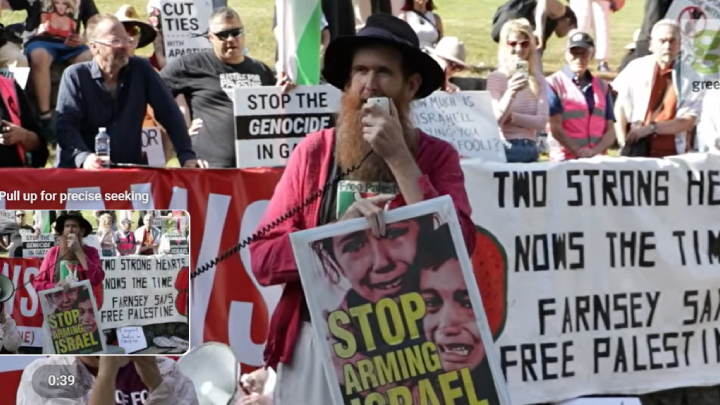
Alex, Justice for Palestine Magan-djin organised a rally to oppose the Crisafulli government’s laws that specifically ban a couple of political slogans. It was held on Turrbal and Jagera land in Brisbane’s Emma Miller Place on 18 April 2026.
These slogans are “From the River to the Sea” and “Globalise the Intifada”. Twenty people were arrested by Queensland police during the event. Can you fill us in on what happened?
This was part of a whole weekend of actions. With actions on the Friday night, the Saturday afternoon and the Sunday afternoon. There were 22 people arrested over the course of the weekend.
It was three different events. The Friday night action was the John Farnham inspired flashmob. So, people were singing the song Two Strong Hearts, which has the line “like a river to the sea”, which is similar to the banned expression “from the river to the sea”.
That was a fun and light-hearted action that was definitely poking fun at the laws, and it was also testing out how police would react, because in the week leading up to that weekend, Queensland police had been indicating that they would arrest people for saying expressions that were similar to the actual proscribed expression.
There was an important legal point there. When the law was first drafted, a provision of the law was going to be that the legislation proscribed expressions, and the attorney general was then going to insert the specific expressions into the regulation.
This would have proscribed the expression and it also was going to ban similar words or expressions that could be confused for it.
But the government changed their minds at the last minute. They took out the provision for the attorney general and instead, the actual slogans would to be stated in the legislation itself, and when that changed, they took out the provision around similar expressions.
So, the current law only proscribes the explicit expression of those phrases that were going to be ruled out.
A few weeks prior to the weekend of actions, one person had a sign that said, “From the Sea to the River”, which obviously was not the exact wording of the proscribed expression. But police were threatening that person. They threatened him with arrest, and the person actually did take the sign down in the end, so there was no arrest.
When the John Farnham flashmob was organised, there was no clarity that the police weren’t going to be arresting people for singing a John Farnham song.
As it turned out, only a few police turned up at the John Farhnam flashmob on the Friday night. That was an extraordinary lowkey presence.
I have never been to an action for as long as I can remember that has had such a lowkey police turnout. And the officers said they were only monitoring community safety and not the expression of the words.
I filed the notice of intention for the Saturday action. Compared to the Friday night fun flashmob that was skating close to the line but not crossing the line, the Saturday action was an opportunity for people to explicitly say the proscribed expression.
In the police liaison that I did at the beginning of that action, the police came up and said they’d had legal advice and were only going to enforce the exact expressions found in the legislation. The advice must have made them realise that what they were threatening around arresting those over different forms of the expression was not legal.
That was a change from police: a welcome change.
Twenty arrests took place. There were people who said the phrase or carried a sign or a banner or wore a t-shirt with the phrase on it. They were the arrests that happened on the Saturday.
Then, on the Sunday, there was a rally that was a political protest. There was no intention to challenge the law. And it was also in solidarity with those who were arrested the day before.
As it turned out, a couple of people were arrested at the Sunday rally for saying the proscribed expression. Although I had a bail condition that said I could not attend that rally.
Some of these conversations that you were having with the police around the fact that they would be arresting people over saying “from the river to the sea” but if people twisted the phrase, they would not be arresting them, must have seemed somewhat absurd?
It absolutely felt absurd. I can’t believe that these laws are going to stay on the books. They are just too absurd. There is a High Court challenge coming. So, one way or another, my expectation is that these laws will not remain.
So, you were one of the people arrested on the day?
I was arrested on the Saturday. I face two charges. One for saying the expression, “From the river to the sea, Palestine will be free”. The other was for holding a sign displaying the same expression.
So, one for holding a sign and saying the expression under the same offence?
Same offence, two different charges.
Why did you go out and break the law in this way? Your actions were a blatantly against the law. So, why do that?
There are many reasons. The law is a draconian overreach in terms of free speech. I don’t think the government should be arresting people over a simple phrase.
The most polite way you can say it, is that these phrases have contested meaning. I would personally go more strongly to say that the government is projecting false meaning onto these phrases.
The government is saying that the phrases are messages of genocidal intent against Jewish people and therefore, they are antisemitic. But as I said, the most generous response is to say that the meanings are contested.
There are two banned phrases. With “Globalise the Intifada”, I have never heard that said at a rally in my life. I have seen memes on social media using the phrase, but I have never heard it chanted or recited.
But “from the river the sea, Palestine will be free” that is a slogan that is regularly chanted at rallies, and I have chanted it multiple times over the last couple of years. And when we chant that slogan, it is not a message of hate. It is a message of freedom.
It is a message of freedom and equal rights for the people of Palestine and for all people, living between the Jordan River and the Mediterranean Sea.
In the current circumstances, there is a genocide that is being perpetrated by Israel. That is my opinion, but it is also a finding that has been made by the United Nations Commission of Inquiry.
It is a finding that has been made by many international human rights organisations, like Amnesty International.
There has been a finding of this made by the International Association of Genocide Scholars. I believe that resolution involved 85 percent of scholars.
Chris Sidoti points out that the UN Commission of Inquiry is the most authoritative legal finding to this point. The International Court of Justice is the ultimate arbiter, and its formal ruling will not be made for years yet.
But even if we just look at the current finding that the ICJ has made. Firstly, it made a public finding that genocide is plausible. Secondly, on 26 January 2024, so more than two years ago, not only did it find that genocide is plausible, but it also ordered provisional measures that Israel must undertake.
The court ordered Israel to do X, Y and Z provisional measures to ensure that genocide isn’t being committed.
The whole point of the Genocide Convention is to try and prevent genocide, and the court said that these are the measures that must be taken by Israel and other countries to ensure that genocide isn’t being committed.
Now, only a month later, the court came back and made another finding that Israel had not implemented those provisional measures. Then they issued additional provisional measures, and the same thing happened again.
So, while the ICJ hasn’t made its final decision about genocide, I consider that when you look at those facts, it’s fair enough to say that the ICJ has definitely made a formal finding about plausible genocide, but when they have instructed Israel to do those things to prevent genocide, Israel has not done those things, and the court has made a formal finding that Israel has not done those things, that’s a strong indication of genocidal practices showing intent.
I say Israel is committing genocide. That is not a word to throw around lightly. It is not an epithet. It is not hyperbole.
I acknowledge that people have the right to contest that finding if they want. But if anybody does want to contest that finding, they need to have a really strong case. It is not enough to say Israel is not committing genocide in Gaza. That is not adequate.
If you want to contest that finding from multiple, authoritative legal and scholarly bodies then, you need to have a very convincing argument, and Israel does not.
In the context of an actual genocide being perpetrated, and in which the Australian government and the Queensland government is complicit, when we chant those slogans, those slogans are part of building an actual movement against an actual genocide, and that warrants their use, in my opinion.
Those slogans help build an actual movement against genocide. They help to put pressure on the government to stop genocide, to stop complicity in genocide.
So, for all these reasons we are not going to stop our campaign. There are extra reasons. Obviously, free speech is important. But we are trying to stop a genocide, and we are not going to stop our campaign just because the government has passed a dubious law.
You said you’d never heard Globalise the Intifada being chanted. And of course, NSW premier Chris Minns was the first politician to come out and suggest banning both the slogans now illegal in Queensland.
When Minns raised these slogans, many people down here, including myself, thought the same thing about globalise the intifada, as we’d never heard anyone chanting that phrase at any of the Palestine solidarity movement protests over the last 31 months.
However, this was around the time of the Bondi Beach massacre, and the New York Times ran a headline stating, Globalize the Intifada Means Blood on Bondi Beach. So, I gathered that headline had spurred Minns to suggest he would ban it.
Well, I would suggest it goes back even further than that. At least a month or two before the Bondi massacre, there was a lobbying conference by the Zionist movement. It was on the Gold Coast.
That Zionist lobbying movement called for prohibition on that phrase, as I understand.
The point is, the Zionist movement has called for the prohibition of both those slogans before the Bondi massacre, so it is not a response to Bondi, but they have just used that atrocity.
It was an atrocity at Bondi, but it does seem that the Zionist movement used that atrocity to push their talking points, push their campaign and pushback against the movement for Palestine.
Your premier David Crisafulli seemed to jump at the chance to ban these political slogans after our premier first suggested the idea, but hasn’t done so himself as yet.
A lot of people are likening the current political climate in Queensland to the time of premier Joh Bjelke-Petersen, which was way back in the 1980s.
The Crisafulli government has passed a swag of draconian laws in your state since it took office in late 2024, including harsh youth justice laws targeting First Nations kids.
Can you talk about what is going on in Queensland in regard to premier Crisafulli and his Liberal Nationals government? How is its governance impacting?
The youth justice laws were one of his signature policies: harsh laws targeting kids as young as 10. “Adult crime, adult time” was the slogan. Since first legislating the laws, they’ve gone on to make them worse. Those laws are a human rights abuse in their own right.
This is indicative of the kind of direction that Crisafulli wants to take Queensland in. They have also brought in attacks on safety standards for workers. There have also been attacks on trans young people.
There are a lot of things that the government has done. But at the same time, for most of the last 30 years we’ve had Labor governments, with the brief exception of Liberal premier Campbell Newman, who got in with a large majority of seats but only lasted one term.
My impression is that, while the Crisafulli government is bringing in these draconian measures, they’re also a bit conscious of not going too far too fast so as to avoid Newman’s fate. That is my read on it.
The laws against locking up young children, there is a case that it is against First Nations youth in particular, and these laws are a draconian human rights abuse.
The legislative attack on the Palestine freedom movement is also an abuse, even the NSW government hasn’t moved to ban those slogans yet. So, Crisafulli is the only premier in the country to have done this.
And lastly, Alex, Justice for Palestine has announced it will be launching a court challenge to these laws, while the pushback against them is huge. However, the Crisafulli government, as we have just discussed, keeps spruiking laws that seem unfathomable but then actually get across the line.
So, where do you see all this going? What does the legal challenge involve? And will the bans on political slogans remain?
Justice for Palestine’s Remah Naji is the best person to talk to about the details of the High Court challenge.
But what I can say is that there will be a challenge and the details will be out in the coming weeks. There are a number of lawyers working on it.
And while these things are never certain, there’s a good chance, or at the very least, it is plausible that these laws will be struck down by the High Court.
In terms of the cases against those who were arrested, the first thing is I said the words. I am not denying I said the words. But the second thing regarding the case is that the law involves whether the act was harassing or menacing or likely to cause offence.
Any assertions that my actions could be harassing or were menacing are completely false. That was the same for anyone arrested over that Saturday action.
So, if I and other people have been charged simply on the basis that somebody might be offended, that is an extremely low bar, and it is an extremely worrying bar to set: arresting people over something just because somebody might be offended.
People get offended over all sorts of things, and that should not be criminal to do something that offends, because that could be somebody not liking your haircut or you say a word that somebody might be offended by.
It would be embarrassing for a police officer to turn up in court and be asked whether I was harassing somebody and they respond no, and then the officer be asked if I was being menacing and again that would also be denied, but then when asked whether I caused offence, the officer says, “Well, you know, there is a slight abstract possibility that somebody might be offended by what he said.”
If that is the kind of evidence I am going to be facing in court, that would be embarrassing even for a police officer, I would have thought.
Another point, is the law allows for excuses for people to say or use these phrases, and the legal advice that we have gotten is that nobody at that action on the Saturday was saying the phrase that was not without a legal excuse and that is that it was “in the public interest”.
My sign clearly said, “It is in the public interest for people to know” and the comments in my speech were also clearly directed towards it being in the public interest. Other people did this in their own way, and I’m not speaking on behalf of them.
Exactly how the courts will interpret this law is an unknown. There is a good chance that the law will be defeated in the High Court, and even if it isn’t, there’s a good chance that the police won’t be able to prove their case, as there was a lawful excuse to use the phrase.
So, more likely than, one way or another, these laws will not stand.
Paul Gregoire
Receive all of our articles weekly
Related Articles
 Banning Political Slogans: The Absurd New Way to Stamp Out Pro-Palestinian Support
 NSW Government’s Proposal to Criminalise the Public Display of Political Slogans Is Concerning
 Proposed Federal Anti-Hate Speech Laws: Silencing Outrage Over Gaza
 The Israeli Soccer Fan BS Highlights the Dangers of Proposed Misinformation Laws
 The Federal Government’s Crackdown on Free Speech Affects All Australians
 The New Federal Hate Group Laws: Further Empowering the Government to Silence Dissent