March for Australia Is Mobilising Again, and This Month It’s to Protect Free Speech
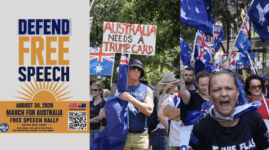
March for Australia are rallying nationwide on 30 August 2026. This is occurring 12 months after its first continentwide demonstrations announced a new white nationalist movement had descended upon the nation. Yet, while the group’s initial monthly protests, that continued on until January 2026, had focused on ‘ending mass migration’, this time round, the group is seeking to ‘defend free speech’.
Organisers of the rallies, which are occurring in the capital cities of all mainland states, claim that the major parties have recently passed laws restricting freedom of speech and political communication. And they’re warning that if nothing is done, the majors will lead Australia to a similar situation as the United Kingdom, where an estimated 12,000 people are arrested annually over social media posts.
March for Australia events have been organised by the remnants of the COVID freedom fighter movement and this country’s neo-Nazis. These forces were initially provoked into action by the gigantic pro-Palestine demonstration that crossed the Sydney Harbour Bridge on 3 August 2025, and the far-right movement is strongly linked to the Unite the Kingdom white nationalist rallies in the UK.
Indeed, March for Australia is further intimately connected with the rise in support for far-right political party Pauline Hanson’s One Nation, which, as of January 2026, started to outstrip support for the traditional Liberal opposition, and by midyear, the far-right minor party had overtaken the Labor government’s top position in the polls.
These white nationalist movements in the UK and Australia are further affiliated with the MAGA White House.
Due to the broad rise in the support for One Nation, the Australian public sphere that March for Australia is to again descend upon, is now one much more receptive to the concerns of these far-right actors, as, over the last year in this country, long condemned and reactionary white nationalist sentiment has become mainstream.
Defending Australian identity
“Free speech is under direct attack in this country,” says far-right influencer Andre Mamet in an 11 August 2026 post on the March for Australia Facebook page. “The uniparty have already passed some of the most restrictive hate speech laws in the western world. The new prohibitive hate speech law is so broad that constitutional experts say it can be used to ban One Nation.”
“Pauline Hanson has already been found guilty under existing hate speech laws. Without free speech, we cannot fight mass migration, cannot defend Australian identity and cannot hold the government to account,” he continued in his rallying cry for 30 August 2026 protests. “Eighty seven percent of Australians say that free speech is an important value, and it is time we acted like it.”
Mamet, who goes by @Ausmaxx online, has been the subject of media scrutiny over the last week, as the Herald reports that he has just joined One Nation as a rank-and-file member, after having interviewed Hanson on the sidelines of a CPAC conference in London last month. The article goes on to question Hanson’s involvement with Mamet, as he’s said to have associated with neo-Nazis.
Another far-right influencer, Mitch Hobbs, appears in a 12 August Facebook post to explain that Australia has never had any free speech protections, and rather, it only has an implied right to communicate. And therefore, the ability to freely interact had relied upon “a certain level of trust and social cohesion,” which, he claims, has been eroded by “the state’s policy of multiculturalism.”
“The Albanese Labor government is taking advantage of the inevitable conflict that arises within a multicultural society to strip away our freedom of speech that was built on this principle of trust,” Hobbs further suggested, prior to going on advance that these are the reasons that March for Australia are again mobilising at the end of this month.
Rising hate speech laws
The Herald noted that while Mamet has been interviewing Hanson and joining One Nation, he has also been seen out mixing with former members of the now outlawed neo-Nazi group, the National Socialist Network. And the January-passed hate group laws that saw the NSN disband are just one of the recently passed hate laws that March for Australia is opposing.
These laws were in response to the 14 December 2025 Bondi Beach attack. The same bill further amended the Migration Act 1958 (Cth), so that any involvement with a hate group or having been involved in behaviour that constitutes a hate crime, and regardless of any conviction in that respect, are now both grounds for deportation, visa cancellation or visa denial.
The NSW Minns government also passed a series of hate crime laws in February 2025, in the wake of the so-called antisemitic crimewave over the summer of 2024/25. And these included the controversial incitement of hate offence, as well as laws that serve to restrict protests that are staged near places of worship and another set that prohibit far-right symbols and prejudicial graffiti.
Incidentally, it has been leftwing activists in NSW, who have twice taken the Minns government to the NSW Supreme Court over the last 12 months to challenge some of its recent antiprotest provisions, and they’ve succeeded in having two of these laws struck down as unconstitutional, specifically because they did impinge upon the implied freedom of political communication.
The violence of the far-right
But whilst March for Australia is posturing as the ‘bastion of free speech’, the reality of the far-right is a lot more grim. The initial March for Australia rallies on Gadigal land in Sydney and in Naarm-Melbourne were aggressive, racism-filled demonstrations that involved physical confrontations and strong neo-Nazi participation.
Whilst those taking part on 31 August 2025 were said to be opposing migrants, the neo-Nazis in Naarm further took their demonstration to the First Nations sacred site, Camp Sovereignty, in the Kings Domain and the white men then attacked the Aboriginal people present, which revealed it was white supremacy underpinning the demonstration, rather than just antiimmigration sentiment.
The nationalist movement went on to again rally on 13 September last year, and whilst the violence of the first rallies was no longer on display, these demonstrations did coincide with similar Unite the Kingdom rallies in the UK, which saw trillionaire tech bro Elon Musk making a televised appearance to suggest that white Brits revolt to topple their own government to end mass migration.
However, at present, it would seem that Australia’s white nationalists won’t have to stage a coup, as the plan down under is for a One Nation Coalition government to take out the next federal election, and for its leader Pauline Hanson to take this vassal nation down the same divisive path that the US Trump administration is taking the people of the United States.
Main image: Protest poster taken from the March for Australia Facebook page. Images of March for Australia protesters taken by Paul Gregoire

Paul Gregoire

Receive all of our articles weekly
Related Articles
 March for Australia Demonstrators Appeared to Harbour Racist Sentiment, Despite Denials
 NSW Government Continues Its Rights-Eroding Bonanza
 The NSW Government’s Relentless Assault on Civil Liberties
 NSW Government’s Attack on Civil Liberties
 NSW Greens and Civil Liberties Groups Are Aiming to Protect Citizens Rights in Law
 NSW Police to Be Given Power to Wand Individuals Without Reasonable Suspicion