Poland: Muslims, “Do not Come to the Polish Border or You Will Be Dead. Shot Dead”.
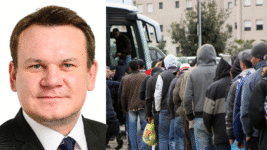
Polish member of the European parliament Dominik Tarczyński unleashed an antimigration diatribe on 8 July 2026, as he warned Muslims, “Do not come to the Polish border or you will be dead. Shot dead . Do not come to the Polish border”. And the overtly racist nature of his outcry, revealed the growing anti-Muslim prejudice in this debate, which is often concealed behind terms like “migrants”.
This was not the first time that Tarczyński had railed against rising immigration. In September 2023, the Polish MEP made controversial claims about his nation not having experienced terrorism incidents, because it resisted “illegal immigration”. While last month, the Law and Justice party (PiS) member claimed other European countries are awash with migrants committing rapes and murders.
Tarczyński’s “be like Poland” rants are in line with his nation’s resistance to waves of Middle Eastern and African migration that commenced in Europe in 2015. The nation’s antiimmigration stance has been heightened since thousands of migrants gathered at the Belarusian border in August 2021, which the European Union (EU) has condemned as form of hybrid warfare on that nation’s part.
Anti-Muslim sentiment in Poland is often cast as “Islamophobia without Muslims”, as its domestic Islamic population is less than 0.1 percent of the overall populace. But Tarczyński’s claim that keeping Muslims out of the country has kept Poland free of terrorism recently fell down, when far-right actor Michał Oksiński shot dead six people in Krakow’s Main Market Square on 7 November 2026.
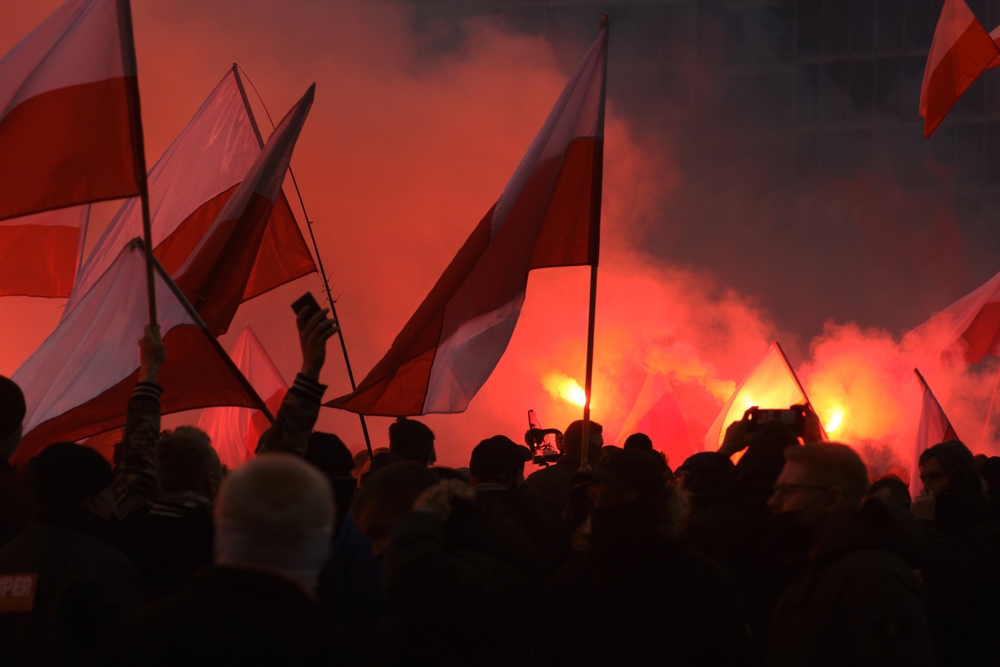
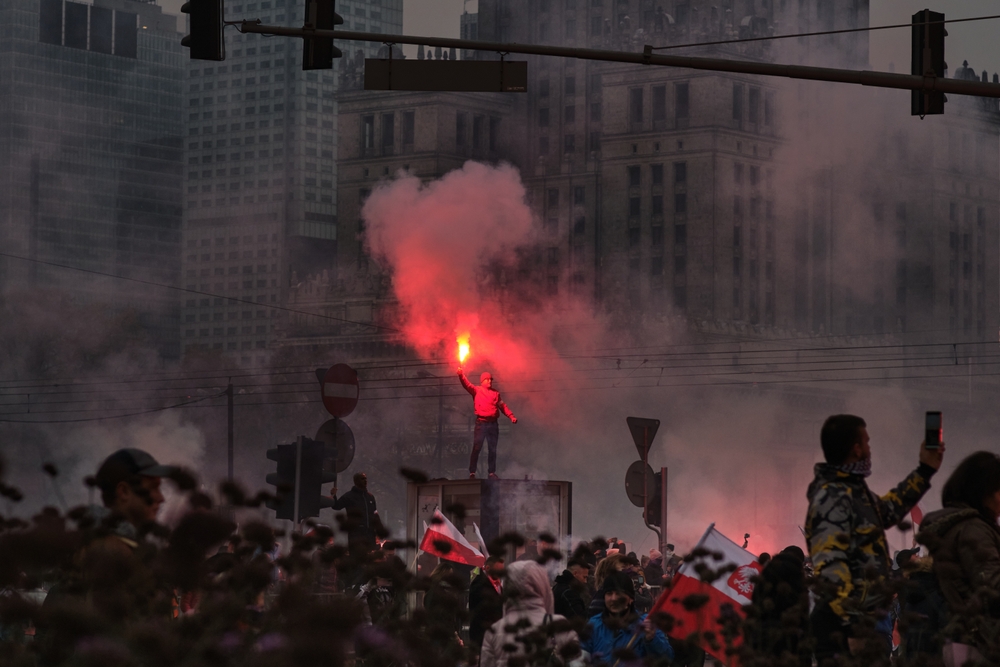
That neo-Nazi sympathiser Oksiński broke Poland’s “terrorism-free record” seems at odds with the nation’s modern history, as it was brutally occupied by Nazi Germany for more than five years during World War II. However, the 11 November Independence Day march in Warsaw, just three days later, saw rightwing nationalists taking to the streets and openly spouting antimigration rhetoric.
Make Poland great again
“When our soldier was killed with a spear, we changed the law and our soldiers can use live bullets now,” said Tarczyński in July, in the true sensationalist style that he’s become notorious for spouting in European parliament since 2020. “So, I have a message for all jihadists. Do not come to the Polish border. Do not try to harm any of our soldiers, because you will be dead – shot dead.”
Tarczyński’s statements have since been relayed across social media platforms to suggest that the Polish government recently changed the law so that Polish soldiers can simply shoot down any migrants attempting to enter Poland from Belarus. The overwhelming majority of these migrants at the Belarusian border have been arriving from the Middle East and Africa.
The law change actually occurred in July 2024. It allows Polish soldiers, border guards and police to use firearms to shoot at asylum seekers attempting to cross the border, if they’re threatening Polish lives. Officials who do shoot are then provided criminal immunity. And this was progressed following a border guard dying, after he was stabbed by a migrant attempting to cross in May that same year.
Tarczyński appeared on Piers Morgan Uncensored last month to discuss having stated on the MAGA-inspired Ruben Report the month prior that migrants should “not come to the Polish border or you will be dead – shot dead. Do not come to the Polish border”. And the politician qualified that any migrants regardless of nationality would be shot at the border, if they try to harm a soldier.
In response to his host, the Polish MEP further explained that he considers the last eight weeks of student protests and riots in France to be the result of second and third generation migration in that country. Tarczyński posited that demonstrators are illiterate in the French language, and rather than students, these actors are “violet and vicious people who should be arrested and gaoled”.
Far-right terror in Poland
The 7 November 2026 far-right terror attack in Krakow involved Oksiński firing upon the public in Krakow’s market square from his car. Six people were killed and more than a dozen were injured. Despite social media claims that he was a leftwing pro-immigration actor, the Polish justice minister Waldemar Żurek confirmed that the evidence shows that Oksiński had far-right leanings.
Oksiński died from injuries sustained during a shootout with police two days after the incident. However, Oksiński shot his parents and sister dead prior to moving on to perpetrate his terror attack, so questions are further being asked about whether the attack was the result of a mental condition he may have been suffering.
Polish intelligence agents took three teenage boys into custody on Monday, 16 November 2026, as they’re suspected of having been plotting a terror attack. The teens have links to the international neo-Nazi movement and had been exchanging messages regarding homemade bombs and makeshift firearms. And the authorities note that this has come in quick succession after Oksiński attack.
“The teenagers not only promoted Nazi and fascist ideology but had also already taken steps toward committing terrorist offences,” said Poland’s security services minister Tomasz Siemoniak on Monday. And the National Prosecutors Office has confirmed the teens held antiimmigration and antisemitic views, along with harbouring prejudices against Black people and the LGBTIQA+ community.
A migration outlier
The 2015 EU refugee crisis involved over a million primarily Syrian, Afghan and Iraqi asylum seekers pouring into Europe, as they fled war. It commenced in mid-2015. The European Union developed quota systems for each EU member state to take in a select number of refugees to ease the strain on the frontline EU countries, like Italy and Greece, that were experiencing most of the refugee influx.
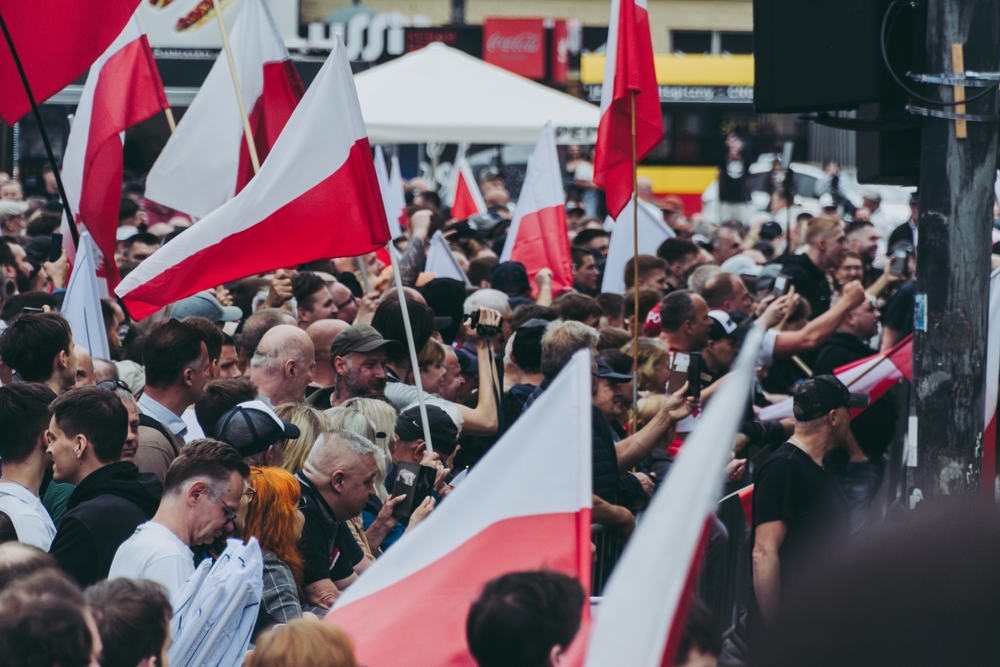
But the debate over accepting asylum seekers was fraught in Poland in the lead up to the October 2015 national election. Tarczyński’s Law and Justice party took out the vote to hold the majority in a coalition government that rejected the request to take in 7,000 migrants in late 2015. This growing Polish nationalist antimigration sentiment is representative of a broader far-right shift in Europe.
The Polish stance stood in stark contrast to then German Chancellor Angela Merkel’s “We can do it” policy, which saw 1.2 million asylum seekers enter Germany by 2016. Tarczyński refers to Merkel’s policy as a moment of “madness”. And because of that policy, and similar open door migration policies of France and Sweden, the MEP today refers to those nation’s politicians as “communists”.
The liberal approaches to the mid-2010s European refugee crisis soon fell into disrepute. This backlash led to the 2024 establishment and June 2026 enactment of the EU Pact on Migration and Asylum, which marked a shift away from the 1999 Common European Asylum System, which sought to harmonise laws across nations and established processing in nations where refugees arrived.
The new Pact on Migration and Asylum marks a shift towards fortifying EU borders against migration. It fast tracks refugee processing, doubles down on deporting rejected asylum seekers and requires all nations to take in their fair share of refugees. Critics of the new system consider that the focus on strengthening borders will see a decline in numbers accepted and a rise in human rights violations.
There is opposition to the Pact on Migration and Asylum in Poland, as critics outline that it does not deal with the fact that Belarus and Russia are weaponising migration flows into Poland and other border nations to destabilise Europe. Indeed, Poland was granted a 12-month exemption from the quota system of the new policy, due to its uptake of Ukrainian refugees and the Belarus situation.
In response to a question from Morgan about whether Polish soldiers may react to refugees who aren’t threatening physical violence at the Belarusian border, Tarczyński said his nation might instead apply water cannons to the asylum seekers amassing at the border.
“If they try to come… illegally, then they’re arrested and the same day, we are sending them back,” Tarczyński told Morgan last month. “That’s why, as you know, Poland is the safest country in the European Union and one of the safest countries in the world…. Investors are coming because they are not afraid that their shops will be robbed and burned.”
“The funny thing is I would like to ask you how many mosques were destroyed during these riots in Paris? Do you know? None. And how many churches? Many,” the far-right Polish politician continued. “The second and third generation of people, who hate Christian values, Christian culture, Roman Law and Greek Philosophy, want to destroy Europe.”
Image: European Union image of MEP Dominik Tarczyński allows for reuse. Refugees entering Italy from Shutterstock
Paul Gregoire

Ugur Nedim
Receive all of our articles weekly
Related Articles
 Neo-Nazis Are Now Demonstrating on the Streets, More Emboldened Than Ever
 Christchurch: True Blue Aussie Terrorism
 Escalating Neo-Nazis Demonstrations Rear Their Heads Again on 26 January 2025
 The Rise of Australian Neo-Nazis: An Interview with Online Activist Slackbastard
 Federal Government Fails to Condemn Antisemitic Nazi Rally in Naarm-Melbourne
 Neo-Nazis Mobilisations Are Becoming Normalised on Australian Streets