Resisting Rising Militarism: WA Anti-War Collective Organisers on Protesting Land Forces 2026

The biannual Land Forces International Land Defence Exposition is about to take place once again. And this year, the nation’s largest weapons festival of its kind, will be taking place on Noongar land at the Perth Convention and Exhibition Centre over 6 to 8 of October 2026, and the WA Anti-War Collective is leading a coalition of antiwar groups set to resist the event.
This is the first time the controversial weapons expo will be held in Boorloo-Perth. The reason Land Forces 2026 has shifted over to the west is that the last event, held in Naarm-Melbourne in 2024, encountered such grassroots opposition that it was considered best to move it on. Indeed, the Victoria police response to that protest comprised of unprecedented use of crowd-control weapons.
The ground force weapons spruiking expo only graced the city of Melbourne for a one-off event, as going back to Land Forces 2022 and prior to that, Land Forces was being staged in Magan-djin-Brisbane. And it was the broad coalition of activist groups that disrupted the final weapons expo held in the northern state that led organisers to shift down to Naarm on the following occasion.
So, whilst organisers have landed upon Boorloo in an attempt to try and outrun the staunch opposition to a global weapons festival, Land Forces, now being staged in Perth, further highlights that some of the most significant AUKUS developments are occurring in its local vicinity, as Submarine Rotational Force – West, a joint US-UK presence in the region, will commence next year.
The Western Australian government is gearing up for a huge response to the Land Forces Exposition. It passed the Land Forces (Special Powers) Act 2026 (WA) on the 16 September. This legislation provides for exclusion zones, special search and seizure powers and heightened authority to require civilians to identify themselves, and these powers will operate from the 1 to the 10 of October 2026.
Sydney Criminal Lawyers spoke to Stop AUKUS WA founding member Sam Wainwright and Friends of Palestine WA member Danica Scott about what the WA Anti-War Collective has install for Land Forces 2026, along with the draconian manner in which the Cook government is legislatively stifling the protest and the accelerating rise of militarism in this country.

Sam Wainwright:
Firstly, Land Forces 2026, the nation’s largest weapons expo, is set to take place on Noongar land at the Perth Convention and Exhibition Centre over 6 to 8 October.
So, Sam, what is Land Forces? Who does it bring together? And what do the WA Anti-War Collective and other groups organising the demonstration have against the event being held in their city?
Sam: Land Forces describes itself as the region’s “premier event for the land defence sector”. This is a conference that happens every two years and it is essentially the biggest weapons fair in the country.
There will be over 100 exhibitors. They include both small Australian companies that are part of the weapon production trade, through to large multinational weapons producers, such as BAE Systems and Babcock.
I should also point out that the event includes Israeli weapons companies, such as Raytheon and Elbit, the very companies that produce parts for the drones that killed Zomi Frankcom, six other aid workers and many thousands of Palestinians.
So, the conference itself is a private event. Exhibitors are not just weapons manufacturers, but also, government departments, universities and a whole range of other institutions, who are all attempting to connect with the boom in the so-called defence industry that’s happening in Australia.
The reason the WA Anti-War Collective is initiating a protest against it is for the obvious reasons that we think events like this shouldn’t have social licence.
The fact that it is going to be an event that both profiles weapons produced by Israeli companies, as well as producers who sell to both Israel, and other countries, like the UAE and Saudi Arabia, which are countries that are committing war crimes, genocide and terrible human rights abuses, is outrageous.
This is unacceptable. We can’t possibly create a better world if we allow these things to flourish.
A coalition of antiwar groups are opposing the event. This includes WA Anti-War Collective, Stop AUKUS WA, IPAN (Independent and Peaceful Australia Network) and Friends of Palestine WA.
What has this coalition organised in terms of civil society resistance to the event? And why would you say locals should get out and join you in opposing this weapons spruiking event coming to your city?
Sam: What we have planned is a big public protest on Tuesday, 6 October 2026. We will be gathering at 5 pm at a place called Yagan Square in Perth City. Then we are marching down William Street to The Esplanade, which is adjacent to the Perth Convention Centre.
We want to have the biggest display of rejection of the conference that we possibly can. This is rejection of the idea that there can be social licence involved in this kind of project, as well as the normalisation of this type of project.
Land Forces is coming at a critical time, and this is more reason for wanting to get people to get down there. It comes at a time when two phenomena are happening and are interrelated and mutually reinforcing.
The first is there has been a long-term plan by the Australian government to make Australia a major weapons exporter. There is a bipartisan plan to put Australia in the top ten of weapons exporting countries in the world. And in fact, the WA government wants to make weapons the second biggest industry in this state.
This also comes at a time when through AUKUS and prior to AUKUS with the force posture agreement, we are seeing a much tighter alignment of Australia with the US military strategy in the region, and more generally.
This is even as Donald Trump has made it absolutely and abundantly clear that he has no intention of respecting international law, or multilateral institutions.
In fact, this process has been turbocharged by the decision of the Trump regime to increase ÙS military spending by 50 percent on 2025 levels by 2027.
This is an absolutely mindboggling amount of money. The United States is already responsible for 40 percent of global military expenditure, and this increase that Trump is proposing would lift the expenditure from $901 billion per annum to $1.5 trillion.
So, in that context, we are seeing from both the Australian federal and state governments, a strategic orientation towards weapons production. They want to pivot the Australian economy to that. And this is all being turbocharged by this decision by Donald Trump.
That is why we are seeing every state government and universities falling over themselves in trying to get some of the crumbs of this massive military uptick that the United States is proposing.
But while these local institutions see dollar signs, for the rest of us, this is frankly terrifying. This is for two reasons. The first is that to pour those kinds of resources into a new cold war, threatens a hot war, which would be devastation on a scale we can barely comprehend.
You don’t spend that sort of money on weapons without the possibility that you will use them.
The second issue is the cost. We do face a desperate threat for human survival in terms of runaway global heating, and you can’t possibly gear up and mobilise the human and material resources we need to confront runaway global warming, as well as gear up for a new war. This is a choice.
The frightening thing that this illustrates is that our leaders do in fact have a plan for climate change: it is repression at home and war overseas.
So, we are at something of a decisive turning point, and we see this, the demonstration on 6 October and all the other antiwar work that we are doing, as beginning the process of building a new cycle of the antiwar movement to steer Australia down a different path.
This is frankly because society and life on Earth depends on a different path. The stakes are quite high. It is very important that we begin the process with the Australian people about why this can and must not be allowed to continue.
So, in terms of climate change, our government’s response is to do nothing besides repress here and fight war overseas?
Sam: Well, that is effectively their real-world climate plan, and not just by default, because there are senior advisors in Defence that understand the climate crisis perfectly well, and they’re anticipating the possibility of a war for resources, a shortage of arable land and drinking water.
We have to accept that repression and war is their real-world climate plan. It just is. And that is not without even considering the horrendous possibility of conventional, let alone nuclear, war with China. That seems to be the path they are pushing us down with this.
The AUKUS plan both brings nuclear powered vessels, and almost certainly, nuclear equipped vessels to Australian shores and that both brings nuclear risk into our heartland, but also, makes us a potential target in a nuclear conflagration.
We actually need to take the war threat and the nuclear threat posed by AUKUS very seriously. And when I say AUKUS, it is important not to understand AUKUS as just Pillar 1, which is the part with the submarines. It is also important to understand everything else that goes around the AUKUS package.
AUKUS was predated by the 2014 Force Posture Agreement. That gives the United States much greater access to Australian bases and other military facilities. In fact, there was a recent article in the Guardian with an infographic showing how many of the military facilities on Australian shores are either directly controlled by the United States, or to which the US has access.
So, you have the Force Posture Agreement, AUKUS Pillar 1, which is the submarines, and AUKUS Pillar 2. The second pillar covers things like missiles, drone warfare and cyberwarfare. And now people are talking about AUKUS Pillar 3, which involves critical mineral deals and AI.
An example of a critical mineral deal is there is a campaign beginning in Western Australia for forest mining for gallium, which is an identified critical mineral by the US military, and Australia is now locking itself into deals for the supply of critical minerals, like gallium and lithium, with the promise that those materials will, therefore, not be supplied to China.
So, it really is becoming an all-of-economy phenomenon, and it is also why we are seeing this push to make Australia defence-ready, so to speak, filtering down from state government departments and into universities, and even into our schools.
The WA government projects that 500 school students will visit the Land Forces expo while it is on.
So, going back to 2022 and prior to that, the Land Forces expo used to meet in Magan-djin-Brisbane.
After the 2022 event was met with such strong opposition from antiwar activists, it was determined that the 2024 weapons festival would take place in Naarm-Melbourne, seemingly because that city was better equipped to deal with demonstrators.
But after the sizable opposition to that event, it has now again been shifted to Boorloo-Perth.
Do you consider your town will be the easier host for the warmongers that are on their way?
Sam: In the short-term, it will be. There are two reasons for that. One is that the activist’s community is not as big in Perth as it is in Melbourne. But secondly, and most importantly, is the fact that the state has passed The Land Forces (Special Powers) Bill.
So, our state government only a week and a half ago, passed special legislation to define both the Perth Convention and Exhibition Centre and a zone around it, as being what is known in the legislation as “the event area”.
In the event area, police have enhanced powers. So, they can move people on without having to provide justification, and they have much stiffer penalties relating to these special powers.
This legislation also establishes a long list of prohibited items in the event area. This list includes obvious things like weapons or lock-on equipment. But it also includes everything from jam jars to tin cans to sunglasses.
Now, I don’t necessarily consider that they will seek to move on people or arrest every single person with one of those items on them, as the area is still open to the public, and there is a major railway station and bus port in the area, so there are still going to be tens of thousands of workers coming and going from those stations.
What that means is that if you are protesting, handing out flyers or anything else within the zone, then they have the power to move you on and arrest you if you don’t comply, or to simply arrest you on the spot.
So, it really gives the police absolute discretion to move people on or arrest them if they don’t like the look of them, regardless of what they are doing.
The second thing they have done is to have allowed the police to draw up a list of people who are prohibited from entering what is known as the event area, during the conference and over the days preceding and after it.
They won’t make the list of names public, but they will be contacting everyone on the list, to advise them that if they set foot in the declared zone, then they will face arrest, with very serious fines and prison sentences accompanying this power.
So, what we are seeing is this worrying precedent of passing special legislation for a particular event.
The police already have powers to deal with things, such as obstruction or property damage. So, to then give them special powers for a sensitive political event is highly problematic, to say the least.
Previous attempts at this kind of measure have been done administratively by the police and have been turned over in the courts in other states, like NSW.
There still remains a question about whether the legislation is constitutional. So, we are facing some serious challenges in that sense.
But our protest isn’t going to be within the declared zone itself. An interesting aspect to this is that the state government and the WA police had identified an area where we would be allowed to protest.
So, there was like a carpark in a fairly obscure location that was going to be fenced off for us to protest in, but it was also in an area where we wouldn’t be allowed to have these proscribed items. So, we wouldn’t be allowed to have a stage or sound equipment. It would all be up their discretion.
We could arrange for our protest to end in the declared zone. But we wouldn’t get very much exposure to the public if we did that. We also don’t like the idea of essentially being their props.
They have passed this legislation that has stripped away people’s civil liberties and their right to protest, but at the same time, they are saying we are going to allow you to protest within the event area.
So, whilst it is true that they didn’t ban protest, it is also true that we would be kettled into this defined area, with fences all around us, while people’s rights have been stripped away.
What do we gain by doing that and playing their game?
That is why we have chosen an alternative rallying point, which is just as close to the conference centre but not within the defined area.
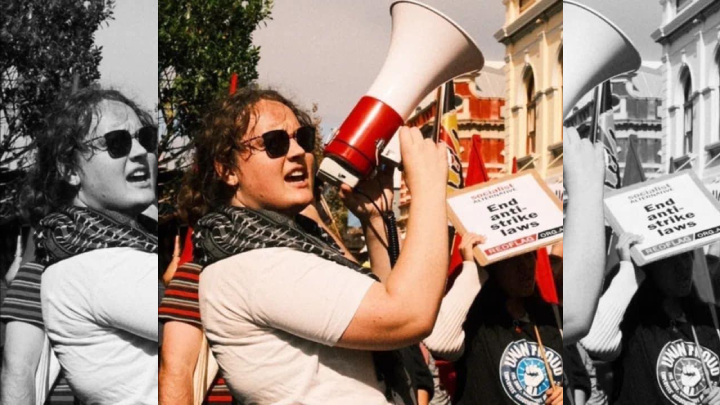
Danica Scott:
Danica, a coalition of civil society groups are opposing the staging of the Land Forces weapons expo in Boorloo-Perth in a fortnight from now.
Two years ago, when the last event was staged in Naarm-Melbourne, it was greeted by significant resistance, which was then met with the unbridled force of Victoria police.
So, would you say that Land Forces is going to get off easy in shifting its operations to your city? And are you expecting WA police to have a robust deployment to counter your efforts?
Danica: It remains to be seen what the deployment will be. But there has been a lot that they have been doing in terms of preparing for the expo and also, exclusively for protests outside of it, which was framed around the Melbourne protest of 2 years ago.
They are spending $10.5 million on security. They have passed special laws to essentially establish a buffer zone around the conference, so as to stop those against it from getting anywhere near it.
The police will be able to stop and search anyone for any reason. They will be able to exclude anyone from the area, without any reason, suspicion or cause.
They are hoping to defuse the opposition and keep it as far away from the conference itself. But that means, the main thing that will stop them from getting off easy with Land Forces is if we can turn it into a controversial event.
That means maximising our side and the size and visibility of the protest. That will be the thing that stops them getting off easily.
So, are you expecting other activists to come from interstate to take part in the protest?
Danica: I have heard people are coming from interstate. It is going to be a big event.
Certainly, we have been doing a lot of work to get the word out, because there is not a big spotlight on the event. So, we have to do that with the conference and the protest against it.
Land Forces is being held in Boorloo-Perth at a time when it appears that the AUKUS pact is perhaps making its most materially tangible impact upon your particular region of the continent.
Can you talk about what is happening with AUKUS developments in your region, and how these developments are impacting locally?
The most significant thing that is happening very soon is that the first US submarine is going to be arriving next year at HMAS Stirling, which is near Rockingham in Perth South.
When that happens, there will start to be American military personnel established permanently in this city. There is public housing being built by the federal government to house these personnel.
This also means there is going to be a need to handle nuclear waste. There is a Republican representative in US Congress, who said, just the other day, that the submarines are going to be capable of carrying nuclear weapons.
So, this is opening up the possibility of nuclear weapons being present in Perth, and we are about to start a nuclear industry in WA.
Aside from the submarines, earlier this year, plans were floated by the state government, around what the minister described at the time, would be a Silicon Valley for Defence. This would start on missile production at the town of Collie, 200 kilometres south of Perth.
There is all this general military buildup, and they are trying to push the weapons industry to be the second most important industry in WA behind mining.
Then, of course, we have just had Richard Marles in Washington speaking with US secretary of war Pete Hegseth and hardening up the alliance.
So, there is a creeping militarism in WA. It is kind of everywhere. You see adverts all the time about the Australian Defence Force and its recruitment drive.
The Fremantle Dockers had an agreement signed in April 2026, with Defence West to help with military and recruitment.
And more tangibly, there is money being spent on this that doesn’t get spent elsewhere.
The $10.5 million being spent on security for Land Forces could have been used for good within the community, rather than making weapons company executives and military personnel feel comfortable at the expo.
So, it sounds like you are already aware of the shift towards militarisation on the ground.
Definitely, it is just creeping in one step at a time. But Land Forces signals a big step forward in terms of militarisation.
And lastly, Danica, since Land Forces was last held in Magan-djin-Brisbane in 2022, global affairs have dramatically shifted, western nations are now prioritising more of their annual spends on defence, the Gaza genocide commenced and continues, and war is spreading across the planet, while the powers that be are insisting that this is the only way.
The example about to be set by the WA Anti-War Collective represents a small instance of a potential much bigger battle against the war machine that would be fought by regular grassroots people.
So, do you consider that the people still have the power to continue to resist this rising militarism that’s spreading across the world? And could grassroots movements impact the strength of these forces which appear to only be escalating in the present?
Absolutely, we do have the power to resist. The main thing within our reach now is to turn things like Land Forces, the AUKUS agreement and all these things related to war, into a controversy. There needs to be a serious loud rejection of it.
The Palestine solidarity movement is a really good case study for how this could be achieved.
Australia has one of the most consistent and sustained movements for Palestine in the world. It ranks high in terms of the number of protests that have been staged over the last three years.
This is also reflected in the general attitude. There was a poll recently from the Pew Research Centre that found the Australian population has a 79 percent rate of holding unfavourable views of Israel.
These two things are connected, the visible street movement that doesn’t give an inch and rejects the Gaza genocide, and this has been the main thing pushing sentiment in a positive direction, and then you have got the big protests like the Sydney Harbour Bridge march and the Global Day of Action in August last year.
These are things to look at in terms of what we should be trying to do on pushing back against this rising militarism. That is in the immediate sense and in terms of what we are planning for Land Forces.
But even beyond that, on a broader scale, it is absolutely possible to resist the general drive towards militarism and not just specific events. And one of the key things within that is that it’s possible to stop wars and militarism because essentially nothing moves without workers.
If workers, as a class, reject militarism and refuse to do the work related to it, then there wouldn’t be any bombs or guns or drones made to conduct war with.
So, what you need beyond the street movement is for the labour movement to become part of this as well and the rebuilding of antiwar, militant unionism.
Ultimately, the power does rest with us, and militarism can definitely be resisted, and this will come via grassroots resistance at every small step along the way.
The Protest Land Force 2026 rally is meeting on Noongar at Yagan Square in Perth at 5pm on Tuesday 6 October 2026
Main image supplied

Paul Gregoire

Receive all of our articles weekly
Related Articles
 Combating Radicalisation in Schools
 The CNS Prevents Indigenous Deaths in Custody: An Interview with Gerry Georgatos
 Morrison’s Jerusalem Moment: The Damage Done
 Police Allegedly Shot Dead an Unarmed Teen
 Not Guilty Verdict for NSW Police Officer Highlights Bias in Criminal Justice System
 Thailand’s Cannabis Industry Is Taking Off Under a Hazy Legal Grey Area