Stop Cooking the River: SCRAP’s Paddy Gibson on Preventing the Cook River Datacentre

Goolay’yari, or the Cooks River, has weaved its way across Gadigal, Wangal, Bidjigal and Gamegal land for centuries, and today, it’s nestled between Sydney’s inner west suburbs. Indeed, developers Stockland and John Boyd Properties consider the site so ideal, that they’re planning to build an AI datacentre on its banks, and newly formed local community group SCRAP aren’t going to have it.
The 25,400 square metre AI datacentre is part of a proposed $2.9 billion logistics centre to be located on the site of the old Kogarah Golf Club, which is on the banks of a section of the river in the suburb of Arncliffe. But the imposition of a polluting datacentre on the side of the waterway is about as environmentally sound as when they built factories beside rivers during the Industrial Revolution.
Stop the Cooks River AI Project, or SCRAP, held its first rally and community meeting to oppose the datacentre on Friday, 9 October 2026. And around 250 people turned up on Bidjigal land at Wolli Creek’s Cahill Park to discuss tactics on how to put a stop to the datacentre, which doesn’t hold any benefits for the local community, as it will rather be assisting US AI companies in their endeavours.
SCRAP member Padraic “Paddy” Gibson explains that the datacentre project in Arncliffe is just “the tip of the iceberg”, as there’s about to be an explosion of AI (artificial intelligence) generating datacentres being built right across the continent. And these facilities are exceptional consumers of electricity and water to the detriment of local communities and the heating planet.
But all is not lost, as the Lane Cove community has been mobilising against a datacentre proposal and so successful was it that the Project Mars AI datacentre slated to be built on Cammeraygal land close by residents’ homes has just been dropped. Yet, while this has meant the northern suburb has been spared its second datacentre, this is only momentarily so, as other proposals are in the works.
Sydney Criminal Lawyers spoke to UTS Jumbunna Institute Associate Professor Padraic Gibson about the devastating affect that AI datacentres have on the environment, the fact that dozens of projects are planned for urban and regional centres right across the continent, and how SCRAP is looking to join forces with other groups to form a broad cross-community resistance to the datacentre boom.
The Cooks Cove redevelopment involves a $2.9 billion overhaul of the Kogarah Golf Course site, which is situated directly along the banks of Goolay’yari-Cooks River. The Stop the Cooks River AI Project, or SCRAP, is opposing the massive 25,400 square metre artificial intelligence data centre that is part of this redevelopment.
So, Paddy, why is SCRAP opposing the construction and establishment of this datacentre along the Cooks River? And what sort of impact will it have if it goes ahead?
There are two issues really. One is the issue of the site itself that is being targeted, as this is quite a fragile and unique ecosystem on the Cooks River.
For many years, this land has been a green space. It has been a golf course, so there has been quite a significant development of native vegetation on the site.
The site has a long history. At one time, it was a sewage farm. But for many years, it has been a golf course, so there has been a lot of development in native vegetation. There are a number of endangered species that rely on the golf course, and there is a wetland there.
It’s obviously a riverfront ecosystem. It interacts with the river. There are water birds there.
So, it is a beautiful little green space on a much-loved local river that has been smashed over the years by industrialisation. The current position of the river is a result of the rediversion of it, when they built the Sydney Airport runway. So, they filled in the original mouth of the river and rediverted it to the south.
There was an enormous amount of industrial pollution just dumped into the river by factories throughout the 20th century, which has only stopped over the last 40 years, and remediation has been ongoing.
So, a lot of work has been done by a lot of people to try and rehabilitate the ecosystems around the river and protect the health of the river itself.
There is a lot of community concern that this development will undo a lot of that good work. It will destroy a lot of the native vegetation and the habit that currently exists on the golf course if they go ahead with the development. This is not just the datacentre, but it’s the broader development that it is part of.
The datacentre is part of a major redevelopment that will include a logistics hub for the airport, and potentially a hotel and other things.
There is also strong involvement from local Aboriginal people in the campaign. These people have a particular connection to the river. There is a young man Jordan Ryan Hennessey, whose family line included people who camped on that river, and that’s in the colonial records from the early colony. It tells of his early relatives camping on the river.
So, the site has a lot of importance and meaning for local people, who go to the river as a refuge from the busy city life, and use the river to connect to the natural environment.
That is one aspect of it, and we are very concerned that the development as a whole will lead to a degradation of the natural values of the ecosystem.
Then we are concerned that the datacentre itself will have a massive impact. For example, one of the main concerns is these datacentres require there to be diesel generators on site to back up the datacentre, in case the main power goes down and they can’t access to the grid.
There was a Lane Cove proposal for a datacentre that was recently scraped that was about the same size as the proposal for the Cooks River datacentre. And that would have had 1 million litres of fuel stored onsite to run 40 backup diesel generators.
So, you can imagine the catastrophic impact of some kind of leak to 1 million litres of fuel stored right on banks of the Cooks River. That gives you an idea of some of the threats that this poses to the local ecosystem. But then there are the broader ecological issues that are posed by these datacentres as they use an enormous amount of water.
Sydney Water predicts that by 2035, 20 percent of Sydney’s drinking water will be used by datacentres, and this is on the driest continent on the planet, as we are heading into a climate crisis.
This is a terrible waste of water. But the major issue is the power usage. Datacentres are major users of electricity.
Even the Cooks River proposal, which is fairly modest compared to a lot of the mega datacentres being built across Sydney, would use more than twice the amount of electricity of all of the households combined in the Bayside LGA, which is the local council area. That is just for one facility.
We just can’t afford this in the context of the climate crisis and the attempt to transition away from fossil fuels. This will put an enormous amount of pressure on the electricity system.
Then there are a whole range of issues around AI. People are very concerned about the impact of AI. I’m an academic at the University of Technology. AI is a major industrial issue, in terms of the disrupting impact of AI on higher education. Bosses everywhere are trying to sack workers to replace them with AI.
So, there are a whole range of issues around AI that people feel strongly about too. As you can see, there is a smorgasbord of reasons why people are opposed to this.
These reasons involve both a commitment to the place involved and the local ecosystem, and they involve political opposition to datacentres.
SCRAP held an initial protest gathering on Bidjigal land at Cahill Park in Wolli Creek, in Sydney’s south. Bayside Council tried to stop the meet on the grounds that it was not a protest but a community event. However, the council does oppose the datacentre just like the group.
But the 9 October 2026 SCRAP meeting did go ahead in Cahill Park and I saw photos of it on social media afterwards, and the comments relating to the event involved surprise about how many people turned up on a Friday night to this location to speak out about the datacentre.
So, judging from that event and the exchanges that SCRAP has been having with the community, how much opposition is there to the Cooks River datacentre proposal and how much opposition is there to datacentres more generally?
This is an emerging issue that is being taken up by campaigners because it is posing itself sharply. There are a huge number of datacentre proposals on the table and datacentres are being constructed right across Sydney and right across Australia.
Communities are starting to grapple with this development and respond to it. So, this is early days for datacentre opposition really, and there is a long way to go, particularly if you look at what is proposed in terms of AI datacentres and infrastructure.
We are at the tip of the iceberg of what is going to be a very significant movement to challenge this destructive program of infrastructure development that is being supported by the state and federal governments. This is largely being driven by these American AI firms that are trying to set up shop in Australia.
So, locally, there is an enormous amount of opposition. There was a very short window when people could make submissions about the Cooks River development application. My understanding is that 600 submissions opposing the proposal came in within a week.
Bayside Council is opposed to the development too.
On the issue of how much opposition there is to AI datacentres in general, this is a sleeping giant. There is huge sentiment out there against this, and as I mentioned, this is only getting started.
There have been a few places, like Lane Cove, where the community has been dealing with datacentres for a long time. They have been quite well organised over the last 18 months. They have just had a win to stop another datacentre proposed for Lane Cove.
In Moss Vale, there have been big community meetings against a datacentre complex. They are particularly concerned about the use of gas-fired power stations to power the datacentres. That really shows you in a nutshell what is wrong with these datacentres, and how they are going to contribute to climate catastrophes, via increased fossil fuel use, when we needed less of it.
So, this is going to continue to grow and snowball. And we have found locally that there is a massive amount of support when we get out to hold stores and interact with the local community.
Currently, in NSW, there are close to 50 datacentres operating and another 50 in the works. The pace of datacentre construction appears to be picking up exponentially. And while a lot of the public are aware of these strange buildings, many aren’t so clear on why more and more of them are needed.
So, what do datacentres do? And why are so many being rolled out at the moment?
You mention that there’s about 50 already. But the thing is that the previous generation of datacentres were nowhere near as much of a threat and were nowhere near as much of a drain on society’s resources.
Those were datacentres were just the basement of a building with servers that held files for people to access, or there are datacentres that have cloud storage facilities, so they’re essentially hard drives and servers conglomerated.
But what we are seeing with AI is a fundamentally different datacentre. We are seeing a datacentre that has got an incredible processing power built into it.
They all have these state-of-the-art chips and AI accelerators from NVIDIA. So, these are NVIDIA GPUs. And there is actually export restrictions on these things, so they can’t go to China, because so much of it is being driven by this imperial competition between the US and China for global supremacy in terms of AI both for the economy and the military.
This has really driven this massive accelerated development in the power of the GPUs, or graphic processing units, that are required to power the AI systems.
The datacentres that are being built now are very different from the datacentres that were being built in the 2010s. These are even different from the datacentres that they were building in the early 2020s. They’re now using hundreds of megawatts of power, and that wasn’t the case a few years ago.
Some of them that are proposed are more than a gigawatt of power. If you are building a datacentre that uses a gigawatt of power, then you are talking about a serious chunk of the electricity that is used in NSW.
My understanding is about 14 to 20 gigawatts is the amount of power in NSW that is produced and used day-to-day.
If you are building a gigawatt datacentre that is an enormous commitment of resources and electricity.
What they do is, they are powering huge areas that are full of NVIDIA GPUs that are doing inference, or training, of the American AI models.
What the Australian government wants to get into is AI training. So, training of the AI models for the likes of OpenAI and Anthropic. This is an incredibly energy intensive process, as they are doing trillions and trillions of calculations running through these processes. These models are basically digesting the entire content of the internet.
This is a very different landscape that we have now, compared to even a couple of years ago. So, what is planned is for Australia is for it to be the second home of many of the US AI firms, and the Australian government is very clear, it wants to build the infrastructure that allows the Americans to train their AI models here in Australia.
We are talking about gigawatts and gigawatts and gigawatts of power to basically crunch 1s and 0s in these GPUs.
So, Australia is being set up to play a major global role in the AI datacentre boom?
Massively. If you read the Australian government’s discussion paper on this, they say explicitly that Australia’s position as a Five Eyes security partner with the United States puts us in the position to be the hub for AI infrastructure in the region. That is the way they are putting it.
As I mentioned before, this is commercial development. It is something that they want to make a lot of money out of for commercial companies. But this is something that the government emphasises also has major security implications because they are trying to build upon systems that are currently running the US military.
A lot of the US military and the Australian military, which is more and more integrated into the US military, utilise AI tools, like those produced by Anthropic, OpenAI, Amazon and Google, and all of the companies involved in AI, and all of them are integrated with the Pentagon.
These AI companies all have contracts with the Pentagon, and they are all developing these cutting-edge systems that will give America and its allies both an edge in economic competition and in the preparation for warfare.
So, the rollout of datacentres in Australia needs to be understood as part of Australia’s position in the US empire and the willingness of our rulers here to embed us and our resources as deeply as possible in the US war machine.
The Americans say very explicitly that they want Australia to be indispensable for these AI companies. They want us to have infrastructure here that the AI companies will come to rely on, as a way of tying Australia more closely to this nexus.
It is inconceivable that there would be this level of investment and interest in Australia if it wasn’t for the security alliance they have got with us, in terms of AUKUS and the Five Eyes partnership.
You mentioned Lane Cove, where three weeks ago, Goodman Group announced that it would not be going ahead with the planned $1.2 billion Project Mars datacentre, which was to be situated just metres away from residential houses. And this appears to have been due to community outcry.
So, what do you understand happened in relation to this datacentre?
I don’t have any more information than what has been in the press. There are people in our group that have reached out to the crew in Lane Cove to build connections and alliances.
We are trying to prepare for demonstrations and mobilisations that would unite all the different groups and people that are campaigning against local datacentres into mobilisations with other organisations to actually demand that they stop building datacentres.
The scramble to build these things is insane. They are so resource intensive. They use up so much energy, so much water, so much capital and so much important labour. The labour force that is building the datacentres should be used for building socially important things like accommodation.
There are so many workers being pulled into this, and in particular, electricians and construction workers. And it is already starting to impinge upon the availability of labour and materials for other industries, particularly, the construction of housing and accommodation.
So, there is this enormous commitment of resources, and it is something that should be opposed. We are very pleased to see the development in Lane Cove, and we have taken inspiration from that. We are hoping to get a win here as well.
These companies are quite vulnerable in terms of forging ahead with these plans, when there is often very little support for them.
People see these centres as impositions that don’t benefit the local community. These are developments that are going to benefit these US AI firms, and people have a lot of hostility towards them.
We are hoping to build upon the win at Lane Cove and to generalise that.
And lastly, Paddy, right now, the Cooks Cove redevelopment is going ahead. The SCRAP campaign is just getting underway. But further, the push to build more datacentres in NSW and the growing opposition to it, both appear to be just getting underway as well.
So, what’s next for the SCRAP campaign?
We have a few different events coming up. Tomorrow night, we are holding an open organising meeting for anyone who wants to get involved in our movement. That is happening at Club Arncliffe. It is a little RSL in Arncliffe on Wollongong Road. People are welcome to join.
We are having a speak out at the Wolli Creek train station on Friday, 23 October, at 6 o’clock, just to get the word out, and also, to assert our right to protest.
One thing that has become clear by organising protest and campaigning activities in areas like Arncliffe and Wolli Creek, is that the local authorities don’t usually see these types of things, and a lot of them think that they can just block protests from happening.
“You are not allowed to protest here. You are not allowed to protest there,” they’ve been saying. Well, we are saying that we are actually allowed to protest there and we will.
So, this Friday, we will be holding the rally and speak out at the train station. And we going to continue to build opposition and more protest events.
There is a plan for a flotilla of kayaks down the river to the site that is threatened. And as I mentioned, we are also interested in teaming up with other groups campaigning against datacentres and other climate groups to organise demonstrations and campaigning against datacentres in general, and to call for a moratorium on the construction and approval of any new datacentres.
The Speak Out Against Datacentres rally is taking place on Bidjigal land at Wolli Creek train station at 6 pm on Friday, 23 October 2026
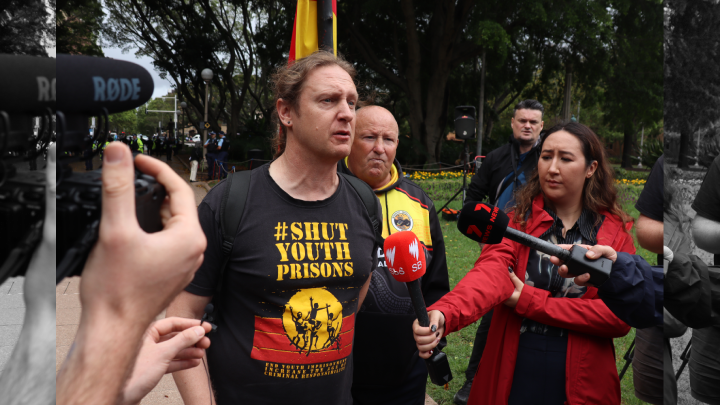
Main image of Padraic Gibson addressing the first SCRAP the Cooks River AI datacentre rally held on Bidjigal land at Wolli Creek’s Cahill Park on 9 October 2026 was supplied

Paul Gregoire

Receive all of our articles weekly
Related Articles
 Alan Jones Loses Nine Year Battle Over Racist Comments
 Indigenous Nations Are Set to Become Economically Independent
 Tinder Rapist Granted Bail
 What is Grievous Bodily Harm in Criminal Law?
 Man Faces Court for Filming Under Cubicle Door
 Criminal Defence Lawyers to Get Better Protections Against Harassment, Intimidation and Reprisals