Terrorism Prosecution of White Australian Over Perth Bomb Attack Sets Important Precedent
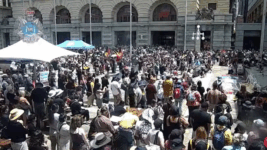
The 31-year-old white Australian man who tossed a homemade bomb that failed to go off into the crowd at the First Nations Invasion Day rally in Boorloo-Perth was charged with engaging in an act of terrorism on 5 February 2026. This is significant, in terms of white settler violence towards First Peoples being recognised as terrorism, as the act mirrors the foundational violence of the nation.
“It is alleged the man acted to advance a national racially motivated ideological cause,” said the AFP press statement. “It is the first time an individual has been charged with the engage in terrorist act offence in Western Australia.” But what the presser does not mention is this is most likely the first time a white settler has been charged with terrorism against Aboriginal people.
The 26 January 2026 incident on Whadjuk land in Forrest Place in the Perth CBD was initially marked by a lack of consideration by Western Australian authorities. The man who made a highly volatile bomb that could have maimed and killed, was initially charged with unlawful act and making explosives, offence that carry maximum penalties of two and three years respectively, whereas engaging in an act of terrorism act carries a maximum penalty of life in prison.
WA police commissioner Col Blanch said the police had come to the decision to investigate the crime as terrorism, following the location of white nationalist materials and understanding the act was a racially motivated assault on First Peoples. While the broad outcry about the original downplaying of the crime is thought to have led to the reconsideration and additional terrorism charge.
The other matter that heightened the outrage against the initial downplaying of the “potential mass casualty event” is that the nation is undergoing a massive legislative and policy overhaul to combat antisemitism. So, while hate crime legislating has become a national pastime, when it came to this violent act against First Peoples that luckily failed, it was first met with a shrug of the shoulders.
But this should no longer be case, as it has now been recognised that violence perpetrated by a white person against First Nations people can amount to terrorism, when it is politically motivated, and therefore, it should be investigated as such.
Foundational violence and acts of terrorism
Declaring acts of violence terrorism-related has been on the uptick in Australia recently, which wasn’t too hard, as they’d been rare. Recent declarations on Gadigal land in Sydney have been made on the same day of the crime. So, the nine day pause prior to charging the 31-year-old with engaging in terrorism is representative of how white violence towards First Peoples is usually dealt with.
But due to the nationwide pushback, WA authorities and the Australia federal police have found that this man, whose violent act mirrored foundational violence, was motivated by white nationalist ideology to carry out his attack on a crowd of First Nations people and their supporters, and a precedent has been set for further such decisions.
Australia is the result of a violent British invasion commencing in the late 1700s, with the founding of this country based upon the usurping and genocide of First Peoples by Europeans. Progressing this aim was a large part of the mandate of the early versions of our modern police. So, at times, the violence perpetrated against First Peoples by white people had been sanctioned.
High levels and particular types of violence continue to playout against First Peoples in the system. Aboriginal deaths in custody and the forced removal of children continue on at starkly disproportionate rates, whilst overincarceration means that 36 percent of adult inmates are First Nations people, yet they make up only about 4 percent of the entire population of the continent.
Senator Lidia Thorpe has described these and other such circumstances as subtle forms of genocide in the present.
A terrorism designation
Section 100.1 of the Criminal Code Act 1995 (Cth) defines a terrorist act as an action or a threat of an action that comprises death, serious harm or endangerment, or serious property damage or serious risk to public health or safety, or a serious interference to critical infrastructure or an electricity network.
This violence must have the intention of intimidating the public or part of it or it must have the aims of coercing, or influencing by intimidation, the Commonwealth, or a state or territory government or that of a foreign country.
The act or threat must further have had the intention of advancing a political, religious or ideological cause. So, in the Boorloo case the police are alleging the man, in tossing the glass container filled with volatile chemicals, ball bearings and nails, has been motivated by white nationalism in doing so.
Engaging in a terrorist act, under section 101.1 of the Criminal Code, carries life imprisonment.
The charging of a white person with a terrorism charge has been quite rare since these laws came into play. The charging of a white person with a terrorism-related charge over an act against Aboriginal people has unlikely ever happened before.
The definition of terrorism and terrorism offences contained in part 5.3 of the Criminal Code were inserted into the Act in 2002. This was following the passing of UN Security Council resolution 1373, which passed on 28 September 2001, as it called on all states to enact terrorism offences into their domestic law and that they carry steep penalties in the wake of the 9/11 New York terror attacks.
A precedent set
The April 2024 Wakeley church stabbing attack on Dharug land in Sydney’s west was designated an act of terrorism on the same night it occurred. And community tensions rose, when, in its wake, a series of raids occurred on the family homes of Muslim teenage boys, who were arrested, some on terrorism charges, over what appeared to amount to having discussed planning something.
In response to the raids, the Australian Muslim Advocacy Network produced a briefing note outlining that internationally terrorism is considered only politically motivated violence, and there is no such thing as religiously motivated terrorism, like in Australia. Yet, in this country, it is religiously motivated terrorism that comprises the majority of charges laid against mostly Muslim people.
AMAN calls for the removal of religiously motivated terrorism as a category under the definition. The network points out that many white people who engage in acts that appear terror-like are often designated as having a mental health issue. So, what further transpires is Muslim Australians facing life sentences on terror charges, while others receive criminal offences with much lighter penalties.
“Throughout Australian prosecution history, only one Australian white male has been prosecuted for terrorism,” reads the 2024 briefing note. That man had been charged with terrorism conspiracy, and he was obviously not convicted.
The WA Joint Counter Terrorism Team is investigating the 26 January Boorloo bomb incident. This is made up of officers from the WA police, the AFP and ASIO.
The charged 31-year-old man has been held on remand. The man will next appear in the Perth Magistrates Court on 17 February.
And as this precedent has been set in terms of considering white nationalist violence targeting First Peoples as potentially terrorist-related and hence, investigated as such, neo-Nazis might now think twice before a repeat attack like last year’s on sacred site Camp Sovereignty in Naarm-Melbourne, as, these days, a life sentence could await them in its wake.

Paul Gregoire

Receive all of our articles weekly
Related Articles
 Extremists Treated Differently Based Upon Religion
 Police Should Target Sovereign Citizens and Other Right-Wing Extremists, Not Muslim Youths
 Right-Wing Extremists: The Real Terrorism Threat
 Failure to Label the Wieambilla Far Right Killings as Terrorism is Unacceptable
 Terrorist Act Against Pro-Palestinian Not Regarded as Terrorism at All
- Sovereign Citizens and Other Far-Right Extremists Pose a Far Greater Threat Than Muslim Teens